Get Full Government Meeting Transcripts, Videos, & Alerts Forever!
Get email alerts on the Land Use topic
No spam. Unsubscribe anytime.
Arapahoe County approves Kiowa Creek composting facility over residents' objections
Summary
After hours of public comment and debate, the Arapahoe County Board of Commissioners conditionally approved a use-by-special-review for the Kiowa Creek Composting Facility (USR25-001). Neighbors warned of odor, dust and traffic; commissioners approved the application 3–2 with conditions and required engineering, stormwater and mitigation plans.
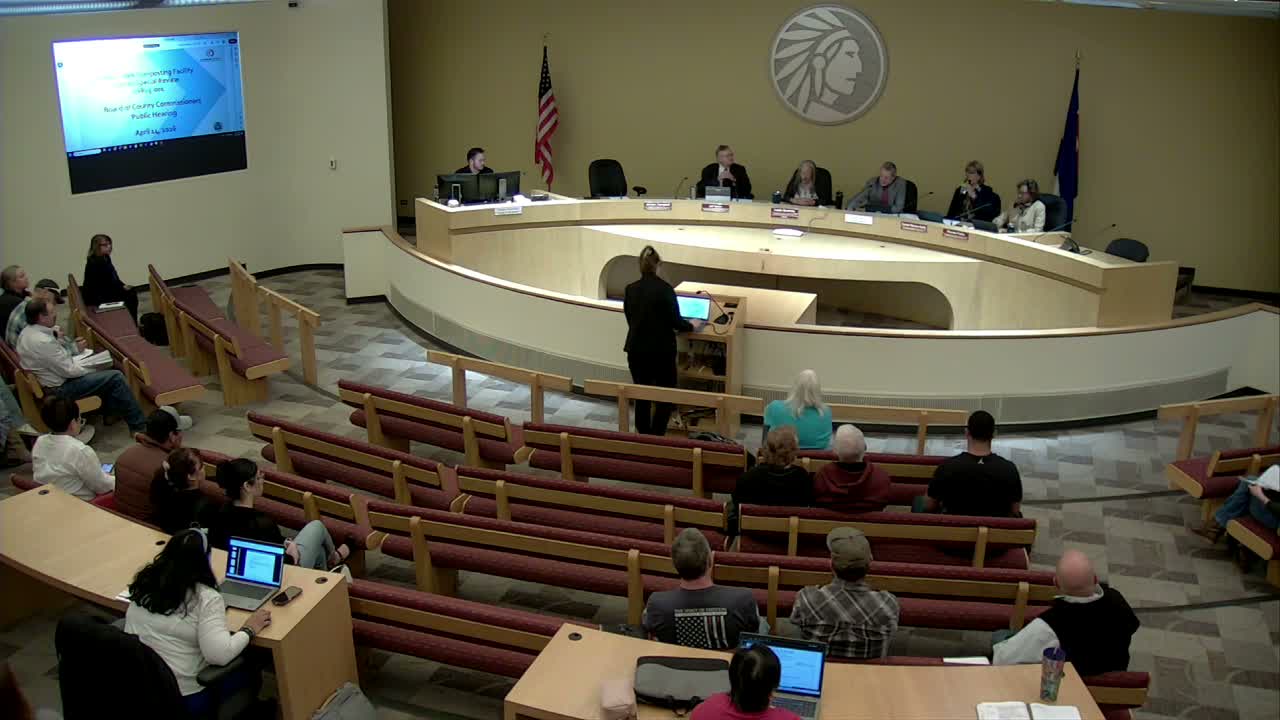
Arapahoe County commissioners voted 3–2 on April 14 to conditionally approve a use-by-special-review for the Kiowa Creek Composting Facility, a proposed green-waste composting site east of Bennett along Quincy Road.
Planning staff told the board the project, proposed by Aesthetic Alternative Recycling, would operate as a Class 1 composting facility limited to vegetative materials — “green waste, wood chips, grass and landscaper-type materials” — and be regulated by the Colorado Department of Public Health and Environment (CDPHE). Ray Fields, the county planner on the case, said staff’s review found the site consistent with zoning and recommended approval with conditions addressing stormwater, traffic and nuisance mitigation.
“The project will create no more than 18 round trips a day, which is nine out and nine back,” Fields said, summarizing the traffic study, and added that the applicant must satisfy county engineering conditions before final approval of construction drawings, drainage reports and maintenance plans.
Applicant representatives described logistics designed to limit community impacts. “This is going to be green waste, wood chips — no food waste, no manure, no biosolids,” engineer Travis Hirtnicki said, adding that feedstocks would be ground at the company’s southeast Denver site and delivered by company trucks. He and owner Kurt told the board the operation would be commercial bulk sales only, not a public drop-off site.
Despite those assurances, dozens of nearby residents urged the board to reject the project. Speakers who live within a half-mile of the site raised concerns about odor, dust, increased truck traffic on poorly maintained gravel roads, impacts on property values and potential vector issues near a proposed detention pond. “It’s undeniable that the compost facility in its nature will introduce dust, odor, increased truck traffic, mechanical noise, added insects and other possible negative impacts,” said Russell Oler, who lives immediately east of the parcel.
Residents also criticized the notification process. “For a project of this scale, relying primarily on a posted hearing notice just weeks in advance is not sufficient to create meaningful community awareness,” Aaron Sen told the board, asking commissioners to ensure agency comments were fully addressed before approval.
Commissioners questioned staff and the applicant about mitigation. Commissioner Baker asked whether the pond would cause mosquito problems; the applicant said the pond is a detention design that will disperse water through a vegetative treatment area and that CDPHE and county stormwater standards apply. Commissioners also discussed a road damage agreement and the county’s ability to require dust control measures on-site.
After discussion, Commissioner Fields moved to approve the application as conditioned by staff; Commissioner Warren Gully seconded. Roll-call vote results were: Fields — yes; Warren Gully — yes; Baker — no; Campbell — no; Sumi — yes. The motion passed and the board adopted the resolution approving USR25-001 with the conditions included in the staff packet.
What the approval includes and what happens next
The board’s decision approves the use-by-special-review with conditions: the applicant must complete county-required engineering plans, an approved drainage report, ownership and maintenance plans, an engineering cost estimate and a GESC report before final acceptance. The project will also be subject to CDPHE permitting for Class 1 composting operations.
Neighbors and commissioners asked staff to monitor and enforce the mitigation measures; several residents and commissioners said they would expect the county and CDPHE to enforce odor, dust and traffic requirements if problems arise.
The board’s action ends the land-use review stage at the county level for this application; CDPHE and other state referrals retain permitting and enforcement authority over specific operational details.
Votes and how commissioners split
The motion to conditionally approve was carried 3–2 on a roll-call vote: Commissioners Fields, Warren Gully and Sumi voted yes; Commissioners Baker and Campbell voted no.
Provenance
This article is based on the county planning presentation, the applicant’s presentation, more than a dozen in-person public comments raising odor, dust and traffic concerns, staff answers about engineering and stormwater requirements, and the final roll-call vote (transcript segments covering the topic from staff presentation through vote).