Get Full Government Meeting Transcripts, Videos, & Alerts Forever!
Get email alerts on the Utilities topic
No spam. Unsubscribe anytime.
After heated public comment, North Port pauses mandatory water hookup and directs staff to draft voluntary code change
Summary
Facing widespread resident opposition, the commission voted 5-0 to pause mandatory city-water connection notices sent to roughly 400-500 properties, to notify affected homeowners the project is paused, to eliminate a $10 administrative fee, and to draft code language making hookups voluntary for existing homes while requiring hookups for new construction.
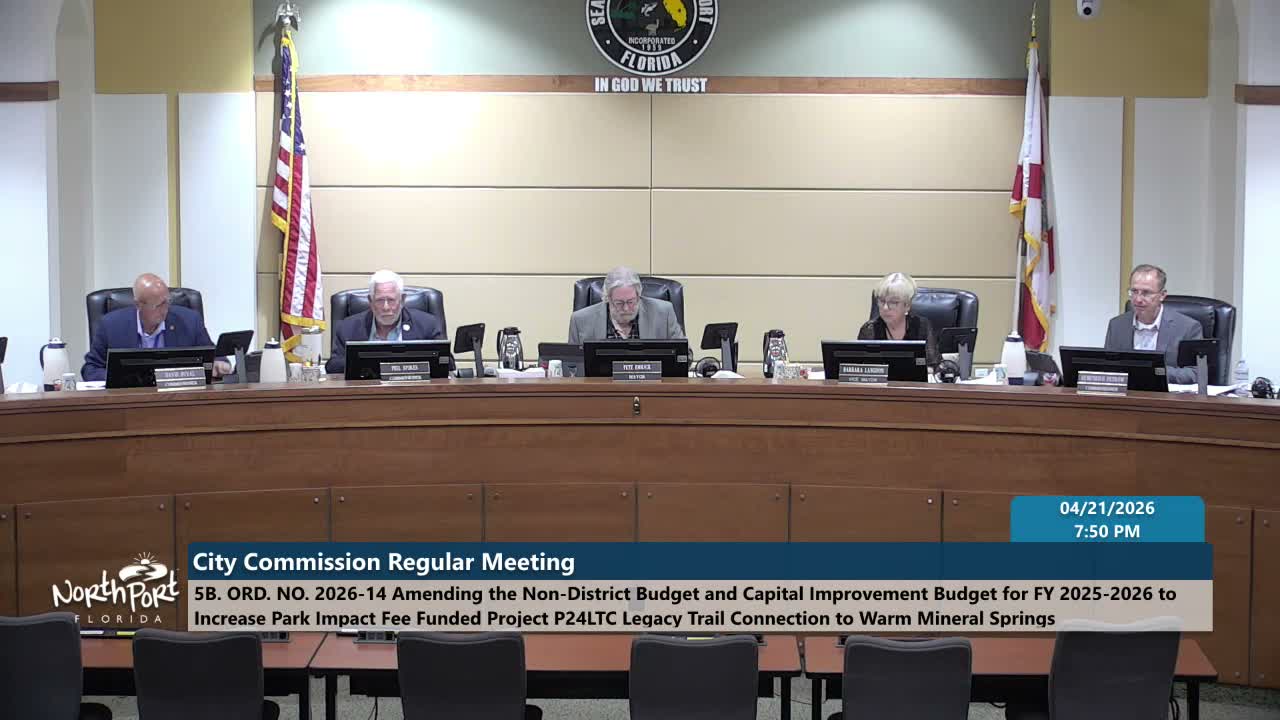
The North Port City Commission voted unanimously April 21 to pause the city's mandatory potable-water connection rollout and instruct staff to prepare code changes that would make hookups optional for existing homes while keeping mandatory connection for new construction where city water is available.
City Manager Fletcher opened the discussion with an apology for a communication breakdown, saying staff'issued mandatory-connection letters before commission briefing and outreach were completed. "I want to apologize to the commission for our memo dated March 26 that did not reach you from my office prior to the community receiving their notifications," he said, acknowledging the timing exacerbated residents' frustrations.
Staff told the commission that the city code has required connection when potable water becomes available since 1992. Fletcher explained current charges tied to a looped distribution project: "That current cost is approximately $12,600, which does include capacity fees, line extension fees, and meter installation," and described financing options including 30-year payment plans and hardship deferrals.
Hundreds of residents submitted written comments and dozens spoke in person. Speakers described working wells and reverse-osmosis systems, cited costs ranging from about $6,000 to $15,000 per residence, and said letters felt abrupt and unaffordable. "We are being told we have no say," one resident said, while another urged a public workshop and grant-seeking to reduce homeowner costs.
Commissioners debated technical, legal and equity considerations for hours. Several members, including Commissioner Stokes and Vice Mayor Langdon, said they support water-looping projects for water-quality reasons but opposed forcing homeowners to pay the full connection cost when infrastructure was installed earlier and homeowners had invested in wells.
Commissioner Stokes moved to direct the city manager to notify affected homeowners that the project is paused; to work on code revisions to make service connection voluntary for already-constructed homes; and to cap costs for homeowners who voluntarily opt in within 365 days. Vice Mayor Langdon proposed two amendments that the commission adopted: eliminating the $10 administrative monthly fee on financed balances and requiring mandatory hookups only for new construction when water is available. The amended motion passed 5-0.
The direction pauses enforcement while staff drafts code language and financial models and conducts community outreach. Staff told commissioners it would still analyze narrower forms of relief, such as targeted fee reductions or extended compliance deadlines, but that broadly waiving capacity fees would require further legal and financial work.
Next steps identified by the commission include a notification to recipients of the letters, public workshops for affected neighborhoods, and staff proposals for specific fee- and financing-parameters for the commission to review.