Get Full Government Meeting Transcripts, Videos, & Alerts Forever!
Get email alerts on the Club Sports Policy topic
No spam. Unsubscribe anytime.
Committee advances club-sports policy to first reading after weeks of debate on safety, insurance and funding
Summary
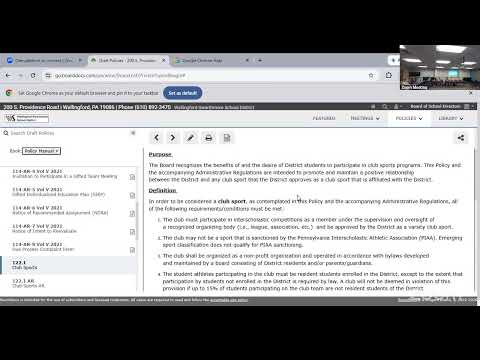
The Wallingford-Swarthmore SD policy committee sent a new club-sports policy to first reading May 5 after extended discussion about AED access, CPR certification timing, insurance coverage and how district funds may be used to support external club teams.
The Wallingford-Swarthmore SD policy committee advanced a proposed club-sports policy (122.1) to first reading on May 5 after members and staff spent more than an hour debating safety requirements, insurance and funding. Administrators said the policy fills a gap by setting clear requirements for how external club teams interact with district facilities and resources.
The policy, introduced by an administrator, would require recognized club teams to provide documentation including proof of insurance, tax forms and point-of-contact information; it also calls for a hold-harmless/indemnification agreement to be developed in the administrative regulation (AR). “If a new group wanted to form, we need a clear process for forming and maintaining one,” an Administrator said during the meeting.
Board members pressed administrators on where AEDs are located and how quickly one could be retrieved during off-site practices. A Committee member said access is “critical” and warned that if an AED is locked in an office and a coach must travel across campus, response time could be too long. Administrators acknowledged AEDs are currently in the office and gymnasium and said the AR will address on-site access and procedures for events held off campus.
Members also questioned whether club participants are covered by the district's student-accident insurance. A Staff member said district student-accident coverage likely does not extend to club sports and that parents and guardians should anticipate arranging their own coverage; clubs will still be required to maintain specified liability insurance under the AR.
Funding sparked sustained debate. The draft policy captures an existing practice in which a single club receives $4,000 and two recognized teams can receive up to $6,000. Some members asked that the policy reflect historical practice and be explicit about how funds may be spent. “As it stands now, volunteers could receive a check and there’s no clarity on expenses versus coach pay,” a Committee member said, urging that the AR require an annual accounting of expenditures. Administrators agreed to include accounting and reporting requirements in the AR.
On coach safety and training, members objected to language that would have given club coaches up to a year to obtain CPR certification. The committee directed staff to require CPR certification within six months of the policy’s effective date, with a current certification on file thereafter. An Administrator said the district will offer training opportunities and that certification periods (typically two years) will be reflected in the AR.
Public commenters representing club teams asked about insurance limits, whether JV or middle-school activities are covered and how registration windows align with seasons; administrators said they will provide additional insurance pricing and the draft indemnification agreement for review before the policy returns for a second reading.
The committee moved the club-sports item along with several others to first reading and asked staff to return revised AR language addressing CPR timing, AED access procedures, insurance documentation and an accounting requirement. The next policy meeting was scheduled for June 2, and first-reading items were set for the May 24 board first read.