Get Full Government Meeting Transcripts, Videos, & Alerts Forever!
Get email alerts on the Out Of School Time Data topic
No spam. Unsubscribe anytime.
Montgomery County council pushes for unified data and signed MOU to map after‑school services
Summary
Council members heard agency presentations on the out‑of‑school time network and pressed for a clear plan to sign a county‑MCPS MOU, adopt shared program metrics, and fund a dedicated data capacity to track who participates in after‑school programs and where gaps remain.
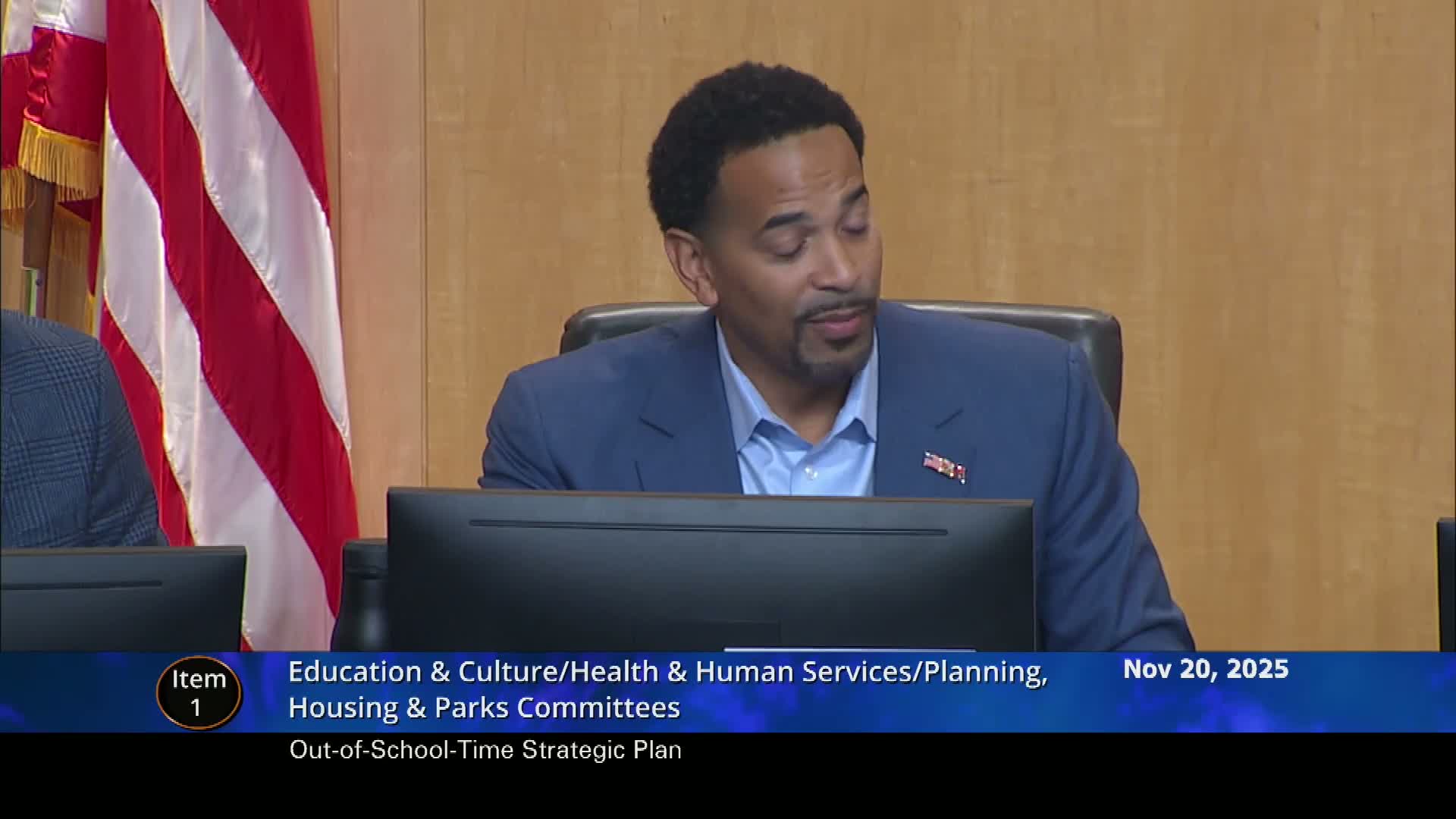
Council Vice President and Chair Jiwanda convened a joint work session of three County Council committees to review progress building a coordinated out‑of‑school time (OST) system and to seek concrete next steps on a pending data‑sharing memorandum of understanding (MOU).
The Council heard presentations from the Montgomery County Collaboration Council, the Maryland Out of School Time Network, Montgomery County Public Schools (MCPS), the Department of Health and Human Services (DHHS), and the Department of Recreation about network growth, program offerings and the county’s new data‑collection pilot. Sydney Wilson Hunter, Director of Programs at the Collaboration Council, told members the advisory group has grown to 17 organizations and the OST provider network to more than 30 partners but “the Collaboration Council holds no authority to mandate participation at any level for this work,” and it lacks centralized capacity to collect and clean countywide OST data.
Why it matters: Council members said they need a single, auditable source of data to answer the basic policy question the Council has repeatedly asked: of the county’s school‑age population, who is being served, where programs operate, and which students are not being reached. Without consistent, unduplicated counts and shared performance measures, members warned it will be difficult to direct scarce funds, demonstrate impact to philanthropy, or prioritize programs that reduce youth violence.
Agencies described the tools and limits. Hunter said a needs‑assessment tool built with 6 Tool Solutions launched Nov. 6 and had nine responses as of Nov. 18, and staff urged more participation so the network can produce a usable countywide picture. Ellie Mitchell, director of the Maryland Out of School Time Network, said Montgomery County is “one of the few counties that are really undertaking the work right now to build a coordinated system,” but cautioned that state and federal funding streams remain uncertain, and that local planning will be needed to sustain services if higher‑level funding shrinks.
MCPS and DHHS gave operational summaries: Dr. Lakeisha Lashley, director of the George B. Thomas Learning Academy and co‑presenter for MCPS, demonstrated an interactive district heat map of OST sites and said MCPS aims to expand 21st Century Learning Centers and align school‑based OST with county efforts. Lori Garabe Aquino, chief of Children, Youth and Family Services at DHHS, said DHHS oversees 27 OST contracts with a combined county‑funded budget of about $13 million and is updating contract language to require stronger outcome and reporting measures.
Recreation leaders noted scale and quality measures. Adrienne Clutter, acting director of Recreation, said county recreation OST programs operate at more than 100 year‑round locations and serve roughly 25,000 young people annually through Excel Beyond the Bell, camps and other programs; she and Recreation’s Manager of Youth Development also highlighted evaluation tools, youth workforce hiring and remaining gaps in middle‑school summer offerings and inclusion supports.
The immediate sticking point: the MOU and background checks. Several presenters said the county‑MCPS MOU is at the signature stage but delayed by a single technical issue: reconciling background‑check language across represented employee groups. A presenter explained officials were close to agreed language and that the MOU, once executed, would enable secure, FERPA‑compliant student‑level matching (using student IDs) so agencies can produce unduplicated participation counts and more sophisticated outcome studies.
Council demands: shared metrics and dedicated capacity. Councilmembers repeatedly asked agencies and the Collaboration Council to return with a scoped plan that identifies (1) who will be the coordinating entity or project lead, (2) what minimum data elements and performance measures will be required in contracts, (3) where the data function will sit and how much staffing it will require (several members suggested a single specialist is a minimum starting point), and (4) how the pilot data tool will be improved and scaled. Members emphasized that signing an MOU is necessary but not sufficient; the Council wants clarity on who will “be on first” to implement data collection, contract language changes and regular reporting.
Next steps and timeline: County staff and the Collaboration Council committed to return with a more detailed plan and shared metrics and to provide an update on the MOU signature status within days. The Council asked agencies to scope staffing and technical needs for a countywide OST data function before the next budget cycle.
The session closed with Council direction for a short, deliverable plan to be returned to the Council: a scoping of data capacity, a proposed set of shared OST metrics, and a timeline for signing the MOU and piloting data‑matching workflows.