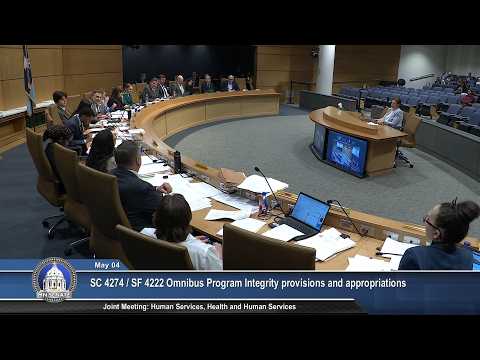
Broad program-integrity amendment advances amid debate over nursing-home cuts and oversight
Summary
A sweeping amendment (A13) consolidating provider-enrollment recodification, sanctions, billing-error definitions and program-integrity tools was debated at length; the committee adopted select lines (including clarifying that billing errors are not automatically fraud) but members sharply contested nursing-home rate and prepayment provisions and a proposed termination-for-fraud amendment failed.
Lawmakers spent much of the joint hearing on a large amendment package (A13) that bundles changes to provider enrollment, sanctions and program-integrity rules. Sponsors said A13 compiles proposals from multiple lawmakers and stakeholders; counsel summarized extensive recodification and new policy elements.
Mister Monahan, counsel, walked members through the amendment's main components, saying the first half recodifies provider enrollment statutes and expands verification, fingerprinting, site-visit and revalidation language. He noted a new enrollment moratorium for designated high-risk provider types and directions to the commissioner to propose additional financial stability and proportional integrity interventions.
Senators debated specific contested items. Senator Abler urged adoption of lines 9.1–10.1 to clarify that billing errors are not necessarily fraud and to reference federal regulations; the committee informally adopted those lines. Other members raised strong objections to parts of the amendment that would affect nursing-home finances and reimbursement design, warning they could prompt facility closures and workforce impacts. Senator Gruenhagen unsuccessfully offered A15, which would have mandated termination of the DHS commissioner if a threshold of fraud were identified; the A15 motion failed in committee.
Operational concerns repeatedly surfaced: DHS reported unprecedented workload in provider enrollment and revalidation and asked for time to analyze new deadlines and surety-bond requirements; members and sponsors discussed the risk that prepayment review language could shift payment timing and have a large state-share fiscal impact (one member cited a figure of about $340 million in state share), which advocates said should be limited to new or high-risk providers rather than applied universally.
Committee chairs and sponsors said adopted amendments and agreed changes would be incorporated into the consolidated "delete-everything" draft and that further work would continue in conference and through technical assistance with DHS and stakeholders before final floor action.
AI generated
The text on this page is AI generated. Summaries, highlights, analysis, and video transcripts are all produced from the original source material.
AI can make mistakes, so if you spot one, and we will fix it for everyone.
Note: the source content is unaltered by us. Any content source we link to, be it a video, an audio recording, or a document, is presented exactly as its publisher released it. That publisher is usually a government body, sometimes an individual official or another organisation.