Get Full Government Meeting Transcripts, Videos, & Alerts Forever!
Get email alerts on the Public Comment Transparency topic
No spam. Unsubscribe anytime.
Community urges data transparency, school partnerships and clarity about MACRO as Oakland commission finalizes plan
Summary
Public commenters at the April 20 Oakland commission meeting pressed for accessible dashboards, stronger school partnerships and clearer oversight and performance metrics for MACRO and violence-prevention programs; the Department of Violence Prevention described existing pilots and an MOU with the county office of education.
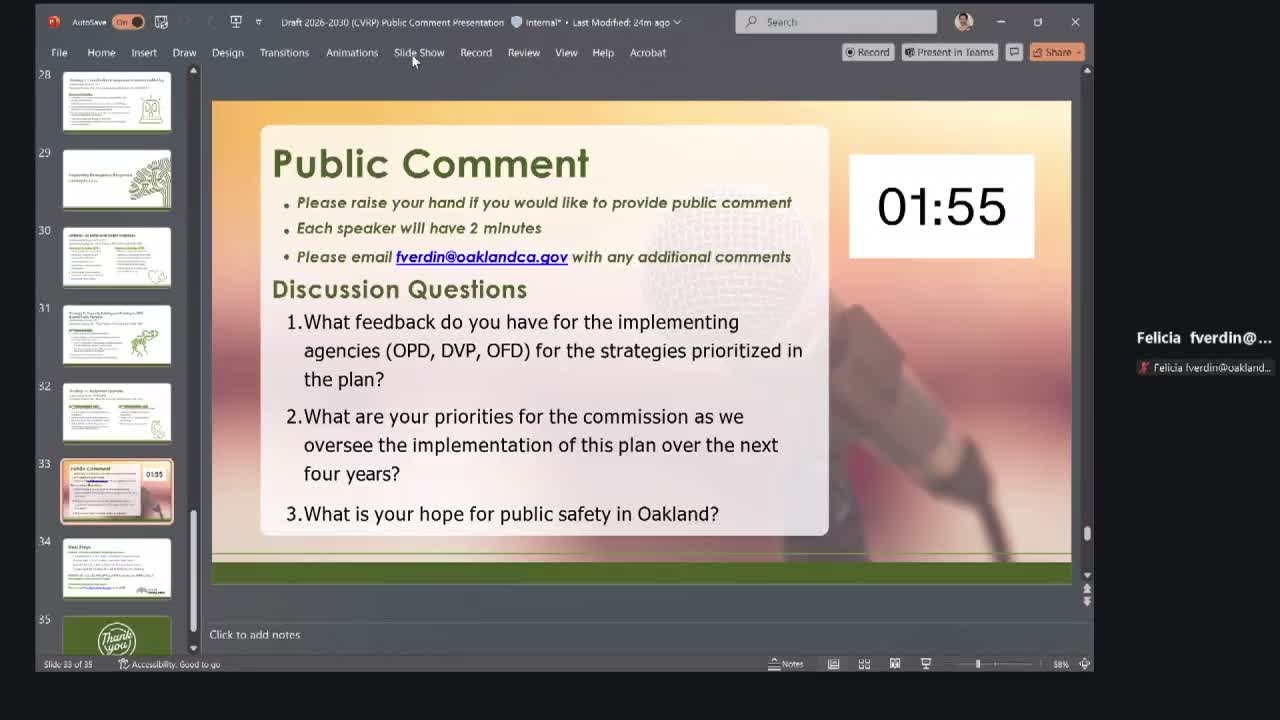
Community members used the April 20 meeting to press the commission and city departments for clearer data, school partnerships and more community-led prevention.
Ryan Hunt (District 4) told the commission that civilian and community-based responses should get more funding and roles and called for consolidated, accessible statistics so residents can evaluate city performance. "We should increase funding and increase roles for civilian and community based responses whenever possible because they are the closest to the pain of the problem," Hunt said, and he urged a public-facing dashboard compiling OPD, OFD and DVP statistics.
Public commenter David Boatwright congratulated the commission on the draft report but urged outcome reporting tied to funding: "The key words 'track progress to demonstrate positive impact' and base strategies on qualitative data," he said, and recommended that Measure NN reporting provide clearer evidence of program outcomes over the measure's life.
Sheila, a parent with a student in special education, asked how the commission and departments are working with the Oakland Unified School District on violence-prevention in schools and whether music and anti-hate-speech efforts could be supported. Chief Joshi of the Department of Violence Prevention said the department had coordinated a four-year pilot "school VIP" program in nine OUSD high schools and that the pilot's extension year was ending; she said DVP is meeting with OUSD and the city administrator to plan next steps and is preparing an MOU that will include the Alameda County Office of Education to improve referral coordination.
Chief Joshi also said DVP funds 21 community-based organizations and coordinates referrals from the school district into city-funded services; she described a "credible messenger" staffing model and emphasized the department's focus on lived experience as part of program design.
Several speakers raised questions about MACRO, a non-law-enforcement mobile-crisis response program. Commenters said MACRO's mandate and data have been unclear to the public. Chief Covington (OFD) said MACRO's role has evolved and the department is asking for city-level clarity, including a proposed MACRO council meeting to better define the program's core functions and metrics.
Commissioners and staff responded that departments maintain their own data, but that the commission's forthcoming CVRP evaluation and accountability plan is expected to include more detailed metrics and reporting; commissioners said they may use a portion of commission administrative funds to produce dashboards or more public-friendly summaries.
Where this stands: the commission is incorporating community feedback as an appendix to the CVRP and will meet with department chiefs to invite written responses; it moved the CVRP forward to the Public Safety Committee with instructions to finalize edits and include the appendix of public comments.