Get Full Government Meeting Transcripts, Videos, & Alerts Forever!
Get email alerts on the Project Freedom topic
No spam. Unsubscribe anytime.
Secretary Rubio outlines "Project Freedom" to escort stranded commercial ships through Strait of Hormuz
Summary
Secretary Rubio announced "Project Freedom," saying U.S. forces will provide a defensive escort to rescue nearly 23,000 civilians from about 87 countries and to restore freedom of navigation in the Strait of Hormuz; he also described stepped-up sanctions and plans to seek a U.N. resolution condemning Iran's actions.
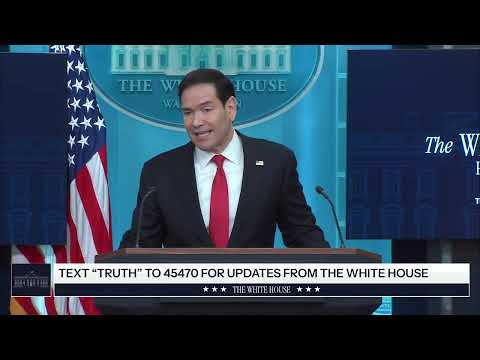
Secretary Rubio told reporters at a White House briefing that the administration has launched "Project Freedom," a U.S.-led effort to guide stranded commercial vessels safely through the Strait of Hormuz and to restore freedom of navigation.
"As you know, over the weekend, the president announced this project, Freedom," the secretary said, describing the mission as intended to "rescue, like, almost 23,000 civilians from 87 different countries" and to provide a "protective bubble" of naval and air assets that would allow ships to move to safety. He repeatedly characterized the operation as defensive: "There's no shooting unless we're shot at first," he said.
The secretary framed the operation as part of a broader campaign combining military protection and economic pressure. He said U.S. forces supporting the effort include guided-missile destroyers, "over a 100 land and sea based aircraft," multi-domain unmanned platforms and "15,000 of the finest military service members on the planet," and asserted that U.S. forces had destroyed seven fast Iranian boats that posed a threat. He also said the blockade has inflicted heavy economic pain on Iran, alleging losses "as much as $500,000,000 a day" in revenue.
Why it matters: The Strait of Hormuz is a key artery for global trade and energy shipments; the secretary said reopening it is critical to preventing broader economic disruption that would ripple to U.S. and global markets. He warned that allowing any country to normalize control of an international shipping lane would set a precedent other states could exploit.
On diplomacy and multilateral pressure, Rubio said the administration is preparing a U.N. resolution that would condemn Iran's use of mines and attacks on commercial vessels and call for the free flow of humanitarian aid. "All we're asking them to do is to condemn it, to call on Iran to stop blowing ships, to remove these mines, and to allow humanitarian relief to come through," he said, acknowledging past vetoes and calling passage "a test for the U.N."
Reporters pressed him on related topics. Asked whether Iran had offered credible, verifiable indications that it would abandon any nuclear weapons ambitions, the secretary said Iran's past behavior—citing clandestine facilities and retained highly enriched uranium "at 60%"—indicated the country had not given up such ambitions and that U.S. negotiators were working to define the topics and concessions necessary for talks to proceed. On the question of whether the blockade amounted to an act of war, he said the U.S. view was that the measure is a defensive counter to Iran's shutting of the straits and planting mines.
The secretary declined to provide operational details on which commercial vessels would be moved for security reasons, saying movements would be announced "after the fact" as confidence in transit grows. He also declined to provide new details about alleged U.S. weapons transfers to Kurdish groups, framing recent presidential comments as an expression of sympathy for the Iranian people and not elaborating on operational specifics.
On other regional issues, Rubio said Lebanon's problem stems from Hezbollah operating inside Lebanese territory and described U.S. aims to help build Lebanese capacity to confront the group. He warned that China and Russia should support the U.N. effort because disruptions to international shipping harm their interests as well. When asked about the War Powers Act, he called the statute unconstitutional while saying the administration complies with notification elements and has briefed Congress multiple times.
The briefing ended after roughly 50 minutes. Rubio said the administration will continue both the protective escort operations and diplomatic efforts, including the U.N. approach, and that additional announcements about safe transits would be released once operational security allows it.