Get Full Government Meeting Transcripts, Videos, & Alerts Forever!
Get email alerts on the Zoning Signs topic
No spam. Unsubscribe anytime.
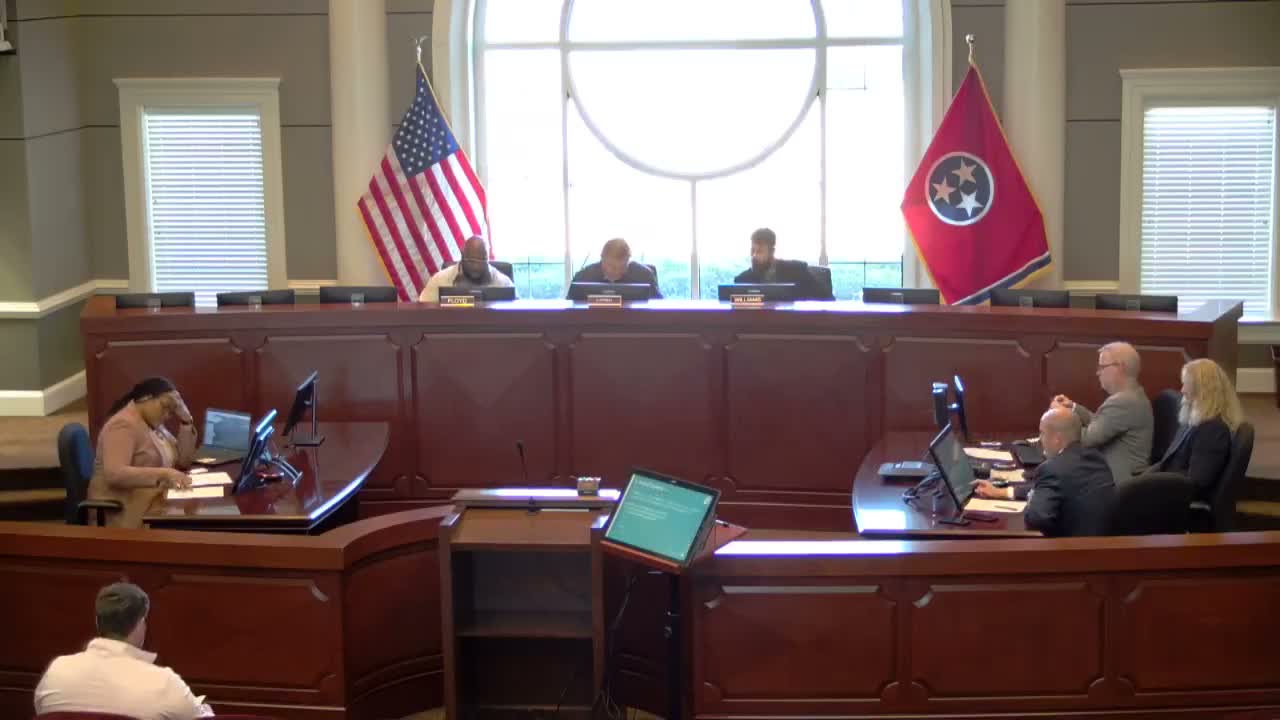
Collierville zoning appeals board upholds staff denial of illuminated wall sign at Roseview shopping center
Summary
The Collierville Board of Zoning Appeals sustained a staff denial of a wall-sign permit for Guff's Wine and Liquor at the Roseview Shopping Center on Highway 72, citing that a tenant change removed the sign's nonconforming protection; the board voted 2–1 and asked staff to work with the owner on compliant options.
The Collierville Board of Zoning Appeals (BZA) voted 2–1 to uphold a staff decision denying a wall-sign permit for a new tenant at the Roseview Shopping Center on Highway 72.
Planning staff told the BZA that when Wilkinson's Liquor was replaced by Guff's Wine and Liquor the existing plastic‑face cabinet sign lost its legal nonconforming protection and therefore the replacement needed to meet current town standards. "If there's a change in tenant in a multi tenant shopping center, the sign would need to comply with current standards," the staff presenter said during the hearing.
Staff provided background on the site — a roughly 6‑acre shopping center built in 1973 and formerly known as Roseview Shopping Center — and explained that the town amended its sign regulations in 2010 to prohibit new plastic‑face cabinet signs and to add a compatibility requirement for older centers. The staff report noted the applicant applied for a wall sign permit after replacing the tenant face and converting the sign lighting to LEDs; staff denied the permit in February, citing lack of compatibility with adjacent businesses and illumination and design concerns.
Applicant Jason Guff, who said he owns and operates Guff's Wine and Liquor at 146 East U.S. Highway 72, told the board the sign is important for his business and safety. "That sign provides a lot of light," Guff said, adding that about three‑quarters of his business occurs after dark and that a new or altered sign is costly. He said he would consider alternatives if given time: "I was told that the all white lettering sign, illuminated, could maybe be a possibility, and I'm not against that at all if that's what the city wants."
Board members framed the legal question as three parts: whether a permit was required, whether the sign lost its nonconforming status when the tenant changed, and whether compatibility with adjacent businesses could be defined for this particular center. Several members said a permit was clearly required and that the nonconforming protection appeared to have been lost. One member summarized the difficulty in applying the compatibility standard here: "I don't think within the particular case, compatibility can be used as a measurement, because there's no compatibility," he said, noting the center's widely varying sign types.
Despite sympathy for the owner's financial concerns and the safety argument, the majority voted to sustain staff's decision. The motion to overturn the staff decision failed; Commissioners Floyd and Williams voted to sustain staff ("no" on the motion to overturn), while Chairman Littrell voted to overturn ("yes" on the motion). The board recorded members' reasoning for the minutes and instructed staff to work with the applicant on compliant, cost‑sensitive options that meet the ordinance's illumination and material standards.
Staff highlighted technical permit criteria the applicant would need to meet if pursuing a conforming sign, including the town's lighting preference: "Our requirements are for 5,000 Kelvin or less," the staff presenter said when explaining acceptable color temperature.
The BZA noted that an adverse decision can still be appealed to court and that, in practice, staff will help the owner identify alternatives such as white‑faced channel letters or other permitted, illuminated options that align with the code.
The meeting concluded with routine announcements about required training hours and upcoming comprehensive‑plan charrettes; the BZA adjourned after scheduling follow‑up between staff and the applicant.