Get Full Government Meeting Transcripts, Videos, & Alerts Forever!
Get email alerts on the Utilities Rates topic
No spam. Unsubscribe anytime.
Colorado Springs Utilities seeks daily gas fee to fund accelerated pipe replacement; council signals preliminary support
Summary
At a public hearing, Colorado Springs Utilities proposed a temporary daily bill rider to fund an accelerated Distribution Integrity Management Program required by federal regulators; council gave preliminary assent and staff will prepare final documents for April work sessions and an April 28 adoption vote to take effect July 1.
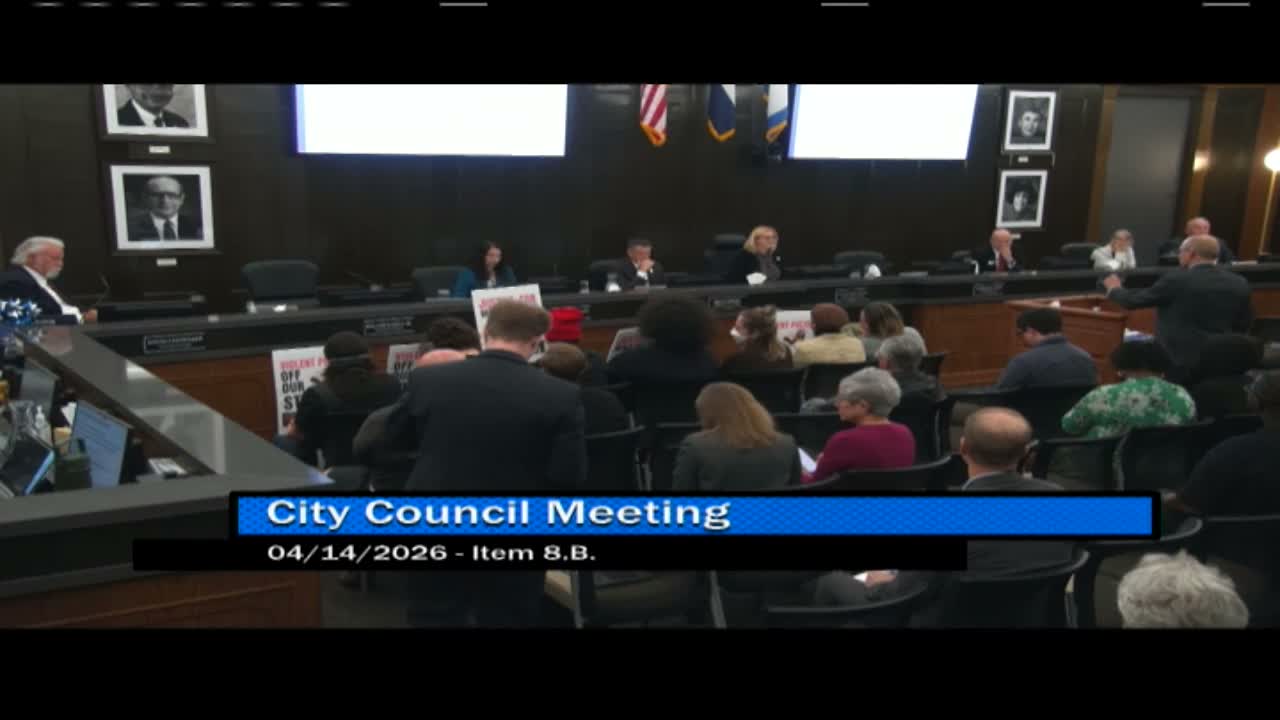
Colorado Springs Utilities told the City Council April 14 that federal regulators require the utility to speed replacement of legacy natural-gas distribution materials, and asked the council to allow a temporary, transparent bill rider to recover the added cost.
Scott Scirola, Manager of Pricing and Rates for Colorado Springs Utilities, said federal requirements following recent inspections require a step increase in replacement work: the utility's baseline had been replacing about 5 miles of distribution main and roughly 550 services per year, but the regulator-driven acceleration would require more than 60 miles of main and over 11,000 service-line replacements within roughly the next nine years. To fund that work, CSU proposed a daily fixed fee (a bill rider) of roughly $0.285 per day for residential and small commercial customers and about $0.60 per day for large commercial and contract-service accounts.
"We're proposing this as a daily fee to transparently recover the costs associated with this work," Scirola said. He presented sample bill impacts showing a typical residential sample customer could see a roughly $8.54 monthly increase attributable to the rider; utilities estimated that change as about a 20% increase to a natural-gas-only bill and about a 3% increase to total utility costs.
Travis Steele, the utilities chief executive (responding to a council request for additional context), said the change is driven by public-safety concerns: "steel in the ground corrodes and over time it can degrade," Steele said, and that failures can create hazardous conditions. He said the utility negotiated a 10-year compliance window with regulators to spread cost and reduce rate pressure compared with a five-year timeline that regulators initially suggested.
The city attorney opened the hearing with a procedural reminder that the council's authority to set local utility rates is grounded in the Colorado Constitution, state statutes, the city charter and city code and that the oral presentations and written materials constitute the record for the rate case. The city auditor's office reported a mathematical accuracy review of the filing and noted methodology changes had been properly disclosed.
There was no formal adoption of a tariff at the April 14 meeting. Instead, council gave a preliminary procedural cue: after presentations and questions, councilmembers signaled assent (a thumbs-up/head-nod) so staff could prepare draft decisions and orders for the April 27 council work session and a final adoption vote at the April 28 regular meeting; utilities requested the rider be effective July 1 if adopted. Utilities stressed customer-outreach plans and directed customers to 211 for assistance and to csu.org for rebates and efficiency options.
Next steps: staff will present draft decisions at the April 27 work session and the council will consider a formal resolution or ordinance adopting the tariff changes at its April 28 meeting. If adopted on that schedule, the new rider would be scheduled to take effect July 1.