Get Full Government Meeting Transcripts, Videos, & Alerts Forever!
Get email alerts on the Airport Fees topic
No spam. Unsubscribe anytime.
Erie advisory board proposes sweeping airport fee changes, seeks council direction
Summary
An Airport Economic Development Advisory Board proposal would raise through‑the‑fence charges, add an $800 per‑plane base fee and increase hangar rents and fuel fees; staff estimate revenues rising from about $141,000 to $385,000 annually but warn legal title and deed questions remain before implementation.
The Town of Erie heard a major proposal Feb. 17 to overhaul fees at Erie Municipal Airport aimed at reducing the town general fund subsidy. The Airport Economic Development Advisory Board recommended shifting residential “through‑the‑fence” (TTF) charges toward parity with commercial tenants, instituting a per‑plane base fee and raising rents and fuel flowage charges.
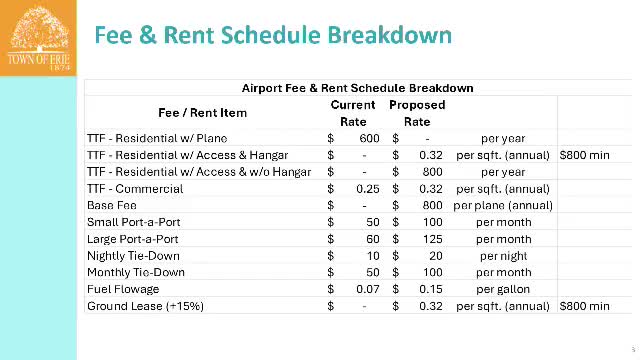
At a council meeting, advisory board members said the proposal would reclassify residences that have legal access to the runway and either charge them a square‑foot rate of $0.32 for hangars or, for properties without hangars, a flat $800 annual TTF fee. The board also proposed a new $800 annual base fee per plane based at the airport, doubled portable‑hangar rents (from $50–$60 per month to $100–$125) and raised nightly/monthly tie‑down and fuel flowage fees. “We tried to get to parity,” the advisory board chair, Paul Heftailing, said during the presentation.
Staff presented revenue modeling showing current airport fee and rent revenues of about $141,000 annually. Under the board’s assumptions, fee and rent revenue could grow to roughly $237,000 and the added base‑fee estimate could generate another $148,000, bringing total fee income to about $385,000. Staff cautioned those figures are estimates and depend on title research, deeded access determinations and additional unit counts.
Council members and residents raised legal and equity concerns. Several airpark residents said they would be charged despite not using airfield facilities. “If you’re not using it and you get charged, that to me is a tax,” said Pat Miller, an airpark resident. Others who live in the airpark but do not keep aircraft said a flat fee would be burdensome.
Councilors pressed staff on how the town would determine which properties have legal access. Staff and board members said deed research, recorded easements and a legal review would be required before drafting an ordinance. “There are questions to be hashed out in the future about who has access and what access they have to the airport,” a staff presenter said.
Board members defended the approach as fairer to businesses already paying on a square‑foot basis and said equitable application would help address racial‑scale burdens on the general fund. One board member noted some commercial tenants have negotiated special rates; the proposal would move toward a uniform per‑square‑foot charge.
Council discussed alternatives that were considered and rejected by the advisory board, including landing or “touch‑and‑go” fees. Board members said landing fees can discourage pilot training and potentially harm safety, and the board took a unanimous position against landing fees.
The board also updated council on hangar development efforts. An RFP posted Jan. 9 closed Feb. 6 and produced four responses from Front Range developers. Staff said the recommended approach is to pursue private development under long‑term ground leases so private partners build and operate hangars and the town receives ground lease revenue. Early market studies indicate one site could hold about 39 hangars and another about 44, though final counts depend on hangar type and site constraints.
Public works staff also reported that a state‑filed unleaded‑fuel transition plan has been accepted, and the town plans to add an unleaded fuel tank in 2027 as part of capital improvements. Staff said they have redlined FBO lease and purchase agreements with Vector Air and will continue negotiations.
Council did not adopt the fee schedule at the meeting. Instead, staff asked for policy direction to continue with title research, legal review and an extended community engagement process before any ordinance is drafted and presented for adoption. Several council members emphasized the need for additional outreach to airpark residents and for careful vetting of deeded access before committing to any change.
If the council provides the requested direction, staff said they will pursue the remaining due diligence and return with an ordinance for formal consideration at a later meeting.