Get Full Government Meeting Transcripts, Videos, & Alerts Forever!
Get email alerts on the Personnel Policy topic
No spam. Unsubscribe anytime.
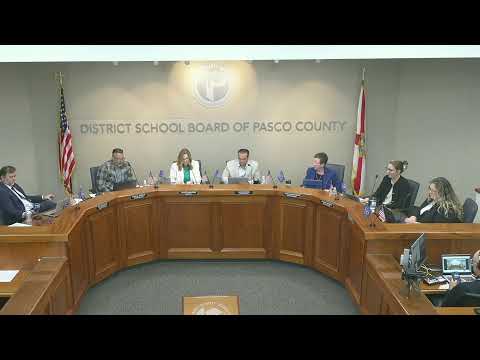
Pasco County School Board approves policy updates on employee suspension after debate over reinstatement authority
Summary
The board voted 4–1 to adopt Neola district policy updates including language on suspensions pending criminal investigations after a lengthy debate about whether reinstatement should require a separate board vote; legal counsel warned that such a requirement could exceed the board's statutory role.
The Pasco County School Board on the referenced meeting approved updates to district policies (Neola policy package, item 16.3) governing employee suspension and reinstatement, following hours of discussion about whether the board should be required to vote to return an employee suspended for an undefined period during a criminal investigation.
The vote passed 4–1, with one board member opposing. The dissent centered on language that, as written in the proposed update, would allow the superintendent and administrative processes to handle reinstatement without a further formal board vote. Mrs. Wright argued for explicit language requiring a board vote to return employees suspended pending criminal investigation, saying the board must "exercise an abundance of caution" when people are allowed back into schools and that reinstatement should be treated like other formal personnel actions requiring board review.
"I do believe that if we have to vote to suspend an employee for an undefined amount of time due to a criminal investigation, then I do believe the school board needs to vote again for that person to return to work," Mrs. Wright said during the discussion.
Board legal counsel, Attorney Meeker, cautioned that school employment law separates duties between the board and the superintendent: the superintendent makes staffing recommendations and the board acts on those recommendations. Meeker warned that requiring a separate reinstatement vote could improperly "encroach" on the superintendent's statutory authority and could create due-process complications for employees. "The superintendent recommends; the board acts," Meeker said, framing the district's checks-and-balances approach.
Other board members said they supported the spirit of stronger protections for students and staff but were concerned about the legal and procedural implications of adding a mandatory reinstatement vote. One board member argued the policy language under consideration needed clearer implementation steps — for example, deadlines and a defined record for how suspensions and potential returns are handled — if the board were to formalize additional oversight.
Following debate, the board voted to adopt the Neola policy updates as presented. The meeting record shows four votes in favor and one opposed (Mrs. Wright). The board did not adopt an additional requirement that would compel a separate board vote to reinstate an employee suspended indefinitely pending a criminal investigation; rather, the adopted language leaves the superintendent responsible for recommendations around suspension and reinstatement, with public notification to the board, consistent with counsel's guidance on statutory roles.
The board discussion also referenced the limits of board authority and the district's obligation to provide due process to employees, including appeal rights and quasi-judicial hearings when termination is recommended. The policy vote does not nullify those appeal rights; it updates procedural language the administration will follow when handling personnel matters involving criminal investigations.
Next steps: The district will publish the updated policy language as approved; board members asked staff and counsel to clarify implementation details and to present any recommended process refinements for later consideration.