Get Full Government Meeting Transcripts, Videos, & Alerts Forever!
Get email alerts on the Accreditation Process topic
No spam. Unsubscribe anytime.
Department draft flips presumption on institutions switching accreditors; panel debates safeguards
Summary
Draft regulations propose treating a request to change accreditors as presumptively allowable unless the secretary finds specific causes to block it. Committee members pressed for clearer timelines, notifications and guardrails to prevent institutions from evading oversight.
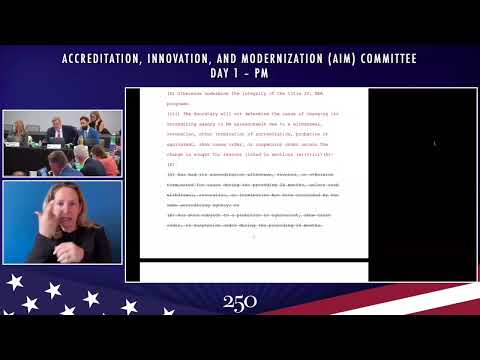
The negotiated-rulemaking session of the accreditor-recognition committee on May 6 reviewed a draft change that would shift the default on when an institution may change accrediting agencies. Jeff (Department staff) told the panel the draft is intended to convert a ‘mother may I’ process into a rebuttable presumption: an institution that notifies the Department of a planned change would generally be permitted to move unless the secretary determines the change was sought to evade enforcement or for other specified reasons.
Committee members raised procedural and substantive concerns. Jennifer Bloom said the current redline still reads like the secretary will have to take action and asked for clearer timing and process language so institutions and other accreditors know when the Department will act. Mark, identifying himself as a college president, asked whether institutions that notify the Department will receive an acknowledgement or only a later notice ordering them to stop; Department staff said a notification requirement could be added and will be considered in drafting.
Several participants urged protections against what they called a potential “race to the bottom.” Michael and others urged language to prevent institutions from switching accreditors solely to delay or avoid enforcement actions; Jake (Department counsel) said the intent is to allow change while preserving the secretary’s ability to step in where there is evidence of circumvention. Raymond recounted a Florida example in which a change-of-accreditor request languished for more than a year before the Department cleared it, arguing that the presumption should be flipped to reduce arbitrary delay.
Department staff told the group they are balancing clarity for institutions with the need to leave operational details—timelines and application formats—to guidance rather than text that would constrain future secretaries. The panel asked the Department to return with drafting options that (1) add an acknowledge/notification step to give institutions certainty about timing, and (2) tighten language that would allow the secretary to block a change when there is clear evidence the move is intended to evade enforcement.
Next steps: staff said they will rework the drafting on the presumption, consider a notification requirement, and return with revised language at a subsequent session.