Get Full Government Meeting Transcripts, Videos, & Alerts Forever!
Get email alerts on the Multiunit Landlord Enforcement topic
No spam. Unsubscribe anytime.
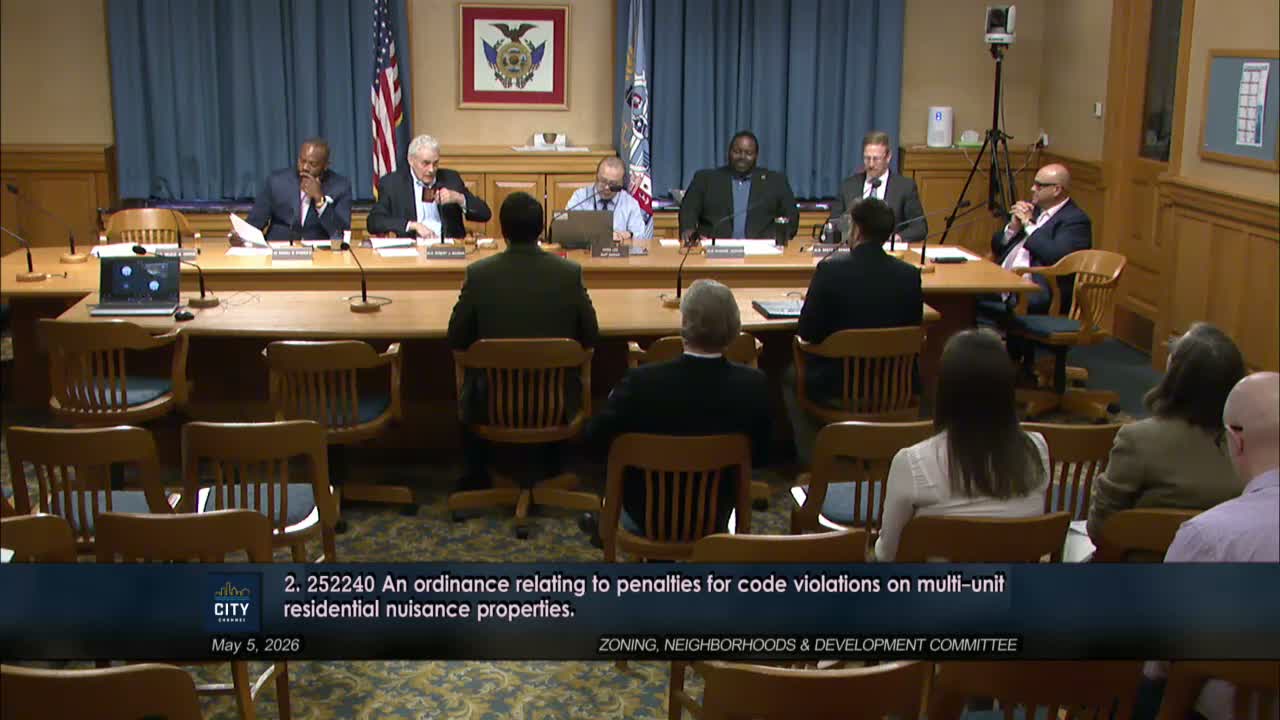
Milwaukee committee advances substitute ordinances to increase penalties and enforcement for chronic multiunit landlords
Summary
A Milwaukee Common Council committee considered two substitute ordinances to let the Department of Neighborhood Services designate multiunit residential nuisance properties and allow municipal judges to apply enhanced penalties; LRB said new penalty ranges could be up to three times current amounts, and DNS warned operational details remain to be worked out.
Alderman Bauman's committee reviewed two substitute files aimed at tightening enforcement for chronic nuisance landlords who manage multiunit residential buildings, and moved the substitutes into the record for further work.
The measures take two approaches: give the Department of Neighborhood Services (DNS) a designation process for multiunit residential nuisances and create a municipal-court mechanism that would allow judges to apply penalty "enhancers" on DNS housing cases. "This ordinance would provide a new special penalty range that is 3 times the, original penalty range provided in section 200-19-1," Gunnar Raasch of the Legislative Reference Bureau told the committee, noting that the exact fines are set later by the municipal court's non-traffic deposit schedule.
The committee heard operational questions from members. DNS Deputy Commissioner Mike Basmian said the department has not finalized how it would operationalize the new designation and appeal process but stressed the goal is to craft a process that is reportable and trackable without overburdening staff: "We haven't really thought about how we would operationalize this quite yet," he said. He described standard practice for an order: inspectors issue orders with timelines, charge reinspection fees if compliance is not achieved, and forward unresolved orders to municipal court, where a summons is issued and, if a defendant does not appear, a default judgment may be entered and fees placed on the tax roll.
Landlord representatives asked for more time and careful drafting. Kirsten Pazewski, attorney for the Rental Property Association of Wisconsin, said many of her members are small, "mom-and-pop" landlords who could be unintentionally swept into heavy penalties under a broad standard and urged narrower exemptions and more workable language: "Mom and pop are not probably the people that you're trying to target here," she told the committee.
Committee members repeatedly pressed DNS and LRB for baseline data (outstanding orders, calls for service, which properties are in court) and said the city attorney has asked for a fuller factual record; Alderman Bauman suggested bringing tenant testimony so the council can document the need for the stronger measures. The chair moved the substitute drafts into the file and recorded no objection; the committee did not adopt final language and left the files pending further work and outreach to stakeholders.
Next steps: DNS agreed to provide data about outstanding orders and court statuses; the city attorney indicated a more detailed record of tenant testimony will be needed before final action. The substitutes are in the committee record for additional review and drafting.