Get Full Government Meeting Transcripts, Videos, & Alerts Forever!
Get email alerts on the Land Use Collinsville topic
No spam. Unsubscribe anytime.
Solano supervisors tell staff to keep negotiating state shipbuilding bill, demand protections for Measure T, environment and taxpayers
Summary
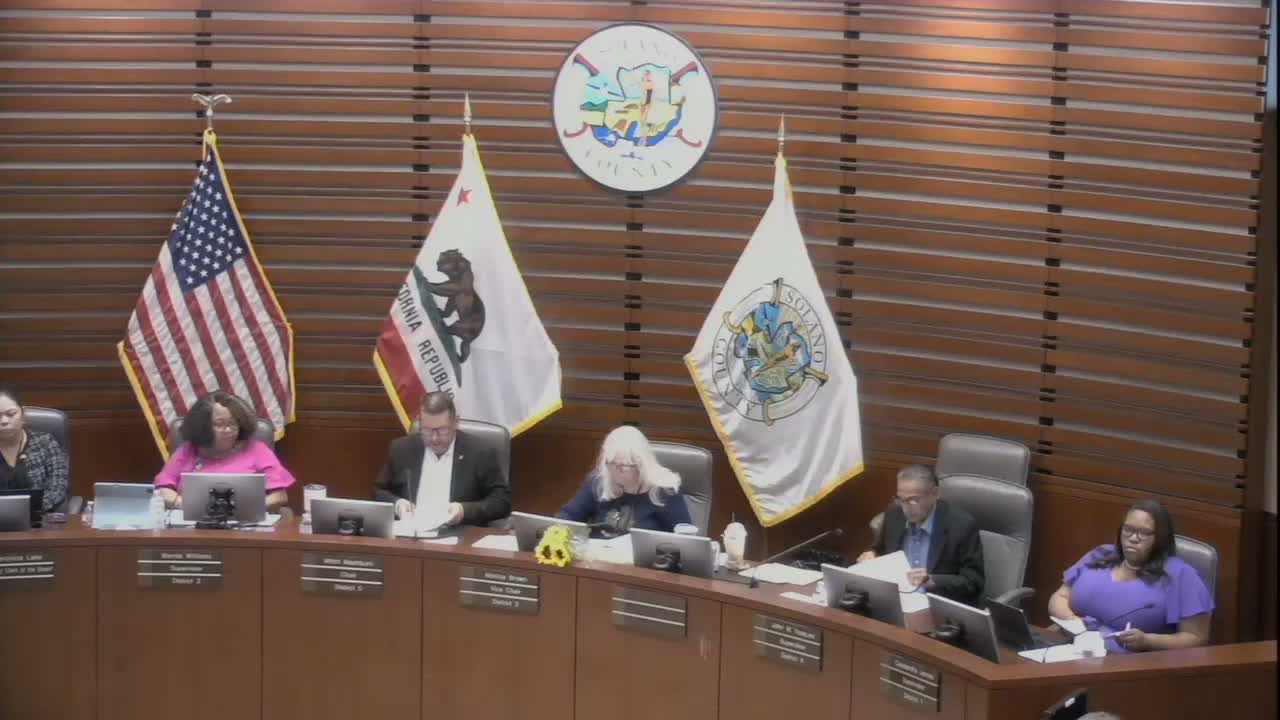
After multi‑hour public testimony for and against a proposed shipbuilding site in Collinsville, Solano County supervisors voted 5–0 to direct staff to continue negotiating with state partners on a draft 'Solano Maritime Act' while insisting on local control, cost neutrality and environmental safeguards.
Solano County’s Board of Supervisors voted unanimously Tuesday to instruct county staff to continue negotiating draft state legislation that would reconfigure a portion of the county’s Collinsville water‑dependent industrial (WDI) boundary to make the site more usable for a proposed shipbuilding project.
The vote follows a full staff briefing and more than three hours of public comment in which labor unions and economic development groups urged the board to keep the county in the running for federal shipbuilding funds, and environmental groups and local residents warned the project could threaten wetlands, groundwater and farmland.
Why it matters: Staff said the draft Solano Maritime Act is intended to allow a focused, time‑limited amendment of the county general plan for about 1,305 acres east of Collinsville while keeping the special study acreage unchanged, and to streamline CEQA review so a project could meet aggressive federal and site‑selection timelines. Board members and speakers repeatedly emphasized stakes for Measure T protections, county finances and the Suisun Marsh.
Staff presentation and proposed bill: James Vieszak, director of Resource Management, told the board the Collinsville special study covers roughly 8,500 acres and that the draft legislation would allow reconfiguration (not net expansion) of the 1,305‑acre WDI footprint and confirm the existing 289 acres zoned WDI west of Collinsville. Staff said the proposal would require the county to adopt an amended general plan and zoning by Dec. 31, 2026, and includes a sunset for the statute in early 2029. Karen Lang, a legislative advisor, explained the urgency: language needed to be put in print within 72 hours for the Legislature to act before the end of its session.
Public arguments split sharply: Supporters — including construction trades leaders and regional economic development officials — framed the site as an opportunity to bring high‑paying, local union jobs and to restore domestic shipbuilding capacity. "Let's bring these jobs home," said Matthew Badu, who identified himself as president of the Travis Unified School District governing board, during public comment in favor. Opponents, including scientists, conservation groups and many nearby landowners, urged the board to block any law that would override local protections or rely on an out‑of‑date environmental review. "Please stop the Montezuma Carbon Hub project," said Steve Federally in a related public‑comment block; other speakers raised similar concerns about pipelines and marsh impacts.
Board concerns and requested changes: Supervisors pressed staff for clearer safeguards. Supervisor Brown said, "I don't like the fact that it has to be done in such a fast motion," criticizing the compressed timeline. Several supervisors asked that the measure explicitly preserve the board’s ability to require project‑level studies, require development agreements that ensure cost neutrality, and strengthen dispute‑resolution language so the county—not only the governor’s office—retains meaningful authority.
Direction and next step: By a 5–0 vote the board directed staff to continue engaging with the governor’s office, GO‑Biz and the project proponents to refine legislation that conforms to county principles (cost neutrality, transparent process, environmental protections and clear limits on any Measure T override). Staff said it will seek to secure specific language changes requested by the board and circulate redlines for review by supervisors and the public. The board did not approve a final position on the bill; members said they wanted stronger written guarantees before supporting legislation in Sacramento.
What's next: Staff will return with revised language and continue consultations with state partners and project proponents. Any formal general‑plan or zoning change, or an applicant’s project proposal, would still require subsequent local approvals and environmental review. The board scheduled follow‑up briefings and asked that proposed statutory dispute‑resolution language be adjusted to preserve local review and mitigation authority.