Get Full Government Meeting Transcripts, Videos, & Alerts Forever!
Get email alerts on the Pavement Damage Weight topic
No spam. Unsubscribe anytime.
Agency of Transportation chief: Trucks cause far more wear than cars, but water and age drive most Vermont road damage
Summary
Jeremy Reed, chief engineer at the Agency of Transportation, told the House Transportation committee that while an 80,000-pound tractor-trailer can cause orders of magnitude more pavement wear than a passenger car, Vermont's primary pavement problems stem from age, poor drainage and freeze-thaw cycles rather than vehicle weight alone.
Jeremy Reed, chief engineer at the Agency of Transportation, told the House Transportation committee on May 5 that heavy trucks impose far greater incremental damage on pavements than passenger cars but that, in Vermont, environmental factors and aging substructure often dominate pavement deterioration.
Reed cited engineering literature compiled by the trucking sector and AASHTO, saying, "for every 80,000-pound tractor-trailer, it puts as much sort of force and and deterioration into the roadway as 6,100 cars." He noted trucking-industry analyses use different methods and sometimes report different equivalencies, but said the engineering takeaway is that loading matters.
Why it matters: the relative damage from heavy vehicles affects enforcement, permitting and design decisions (for example, overweight permits, axle limits and whether to strengthen a subbase). Reed balanced the load emphasis by stressing that many Vermont secondary roads are old, not engineered to modern drainage standards, and therefore fail primarily because of trapped water and poor subbases.
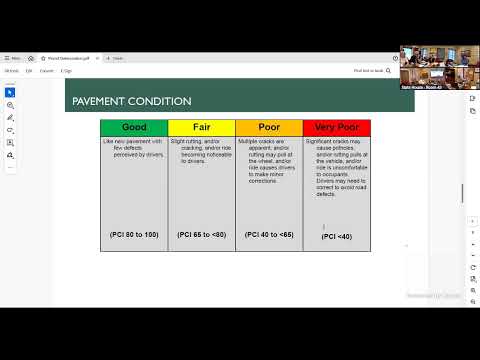
Reed described common failure modes: raveling (aggregate-binder loss), rutting where surface deformation accumulates, and cracking from either repeated loads or freeze-thaw cycles. "Water's the enemy," he said, explaining that cracks fill with fine material, retain moisture, expand when frozen and accelerate structural failure.
Committee members pressed whether heavy electric passenger vehicles are a growing problem. One member asked for "concrete proof" that heavier electric cars are destroying highways; Reed responded that while weight increases wear, he does not think those vehicles are the principal driver of pavement distress in Vermont. He said context matters: steep, slow, stop-and-go truck movements or poor subgrade are often more important locally.
The exchange underscored policy trade-offs officials face: recommending weight limits or special pavements for freight corridors can be expensive, while focusing on drainage, subbase repair and targeted strengthening can produce greater benefit on many secondary roads.
The committee did not take formal votes; members signaled interest in receiving the agency's FAQ and supporting engineering references for future deliberations.