Get Full Government Meeting Transcripts, Videos, & Alerts Forever!
Get email alerts on the Care Court Policy topic
No spam. Unsubscribe anytime.
Researcher says recent California bills widen routes into Care Court and could expand involuntary treatment
Summary
Catherine Wolf, a doctoral candidate and disability advocate, told Oakland's commission that a string of 2023——25 bills has broadened Care Court eligibility and eased evidentiary rules, potentially increasing involuntary holds and treatment; she highlighted local impacts and advocacy responses.
Catherine Wolf, a doctoral candidate at the University of California, Berkeley, told the commission on April 20 that a series of recent state bills has broadened pathways into California's Care Court system and could expand the number of people subject to involuntary holds and court-ordered care.
Wolf, who said she works with All People's Health Collective and collaborates with Disability Rights California, reviewed decades of policy that set the modern rules for involuntary holds and medication hearings, then detailed a wave of legislative changes. "Senate Bill 1338 was the year that the Care Court bill passed," she said, adding later that recent updates "expanded the definition of gravely disabled to include severe substance use disorders" and other criteria that make more people eligible for holds.
Why it matters: Wolf said changes to evidentiary rules and petition procedures make it easier for petitioners and courts to move people into Care Court and related conservatorship pathways. She flagged specific bills discussed in Sacramento this session'including SB883, SB967, SB1016, and the 2025 SB27 package'and said counties have sometimes delayed implementation because the expanded definitions raise the number of eligible people.
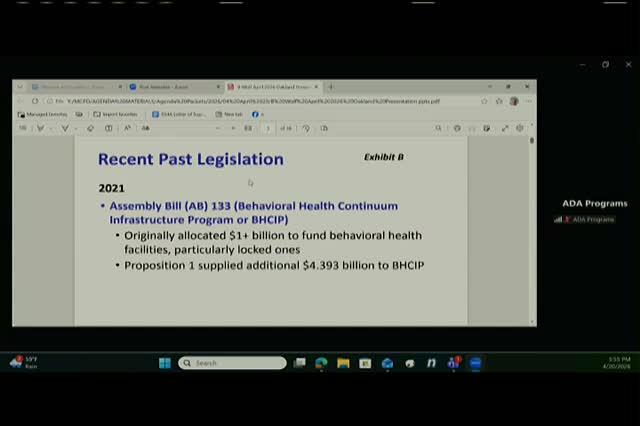
Wolf also raised financial and institutional details that shape outcomes: she said Proposition 1 redirected billions into facility construction and that California obtained an IMD (institution for mental diseases) waiver allowing Medicaid and Medicare funding to support stays in larger psychiatric facilities through 2029. "Proposition 1 amended funding and allowed the money to go to locked facilities," she said.
Commissioners pressed Wolf on alternatives. She described noncarceral outreach and housing-first approaches as preferred substitutes for coercive orders, citing the Trieste model of assertive outreach and peer-led supports. "You don't have to lower the legal status of a person in order to fund assertive outreach," she said, urging investments in community services and universal-basic-income advocacy pursued by some peer groups.
Local impacts and advocacy: Wolf said Alameda County reached a Department of Justice settlement after holding people beyond clinicians' recommendations; she noted Oakland is receiving Proposition 1 funding for a Mark Twain rehabilitation project (about $33 million for preservation and a small unit expansion). She described organizing by Disability Rights California and peer groups opposing bills that would allow forced medication or lower standards for involuntary confinement.
What happens next: Wolf noted several bills were scheduled for committee hearings in late April (several referenced for April 21 and April 28). She encouraged commissioners and the public to follow bill-tracking resources and peer advocacy groups; commissioners asked her to circulate keywords or tracking tools she uses.
The commission's discussion closed with requests for Wolf to return with more precise bill-tracking resources and for continued monitoring of county implementation and funding shifts. No formal action on state legislation was taken at the meeting.