Get Full Government Meeting Transcripts, Videos, & Alerts Forever!
Get email alerts on the Sea Level Rise topic
No spam. Unsubscribe anytime.
County staff recommend exploring HASPA membership to meet sea-level-rise planning requirements
Summary
Planning staff recommended Alameda County explore joining the Hayward Area Shoreline Planning Agency (HASPA) to leverage shared data, grant competitiveness, and technical work to meet SB 272 deadlines for sea-level-rise planning covering about 1.25 square miles of unincorporated shoreline.
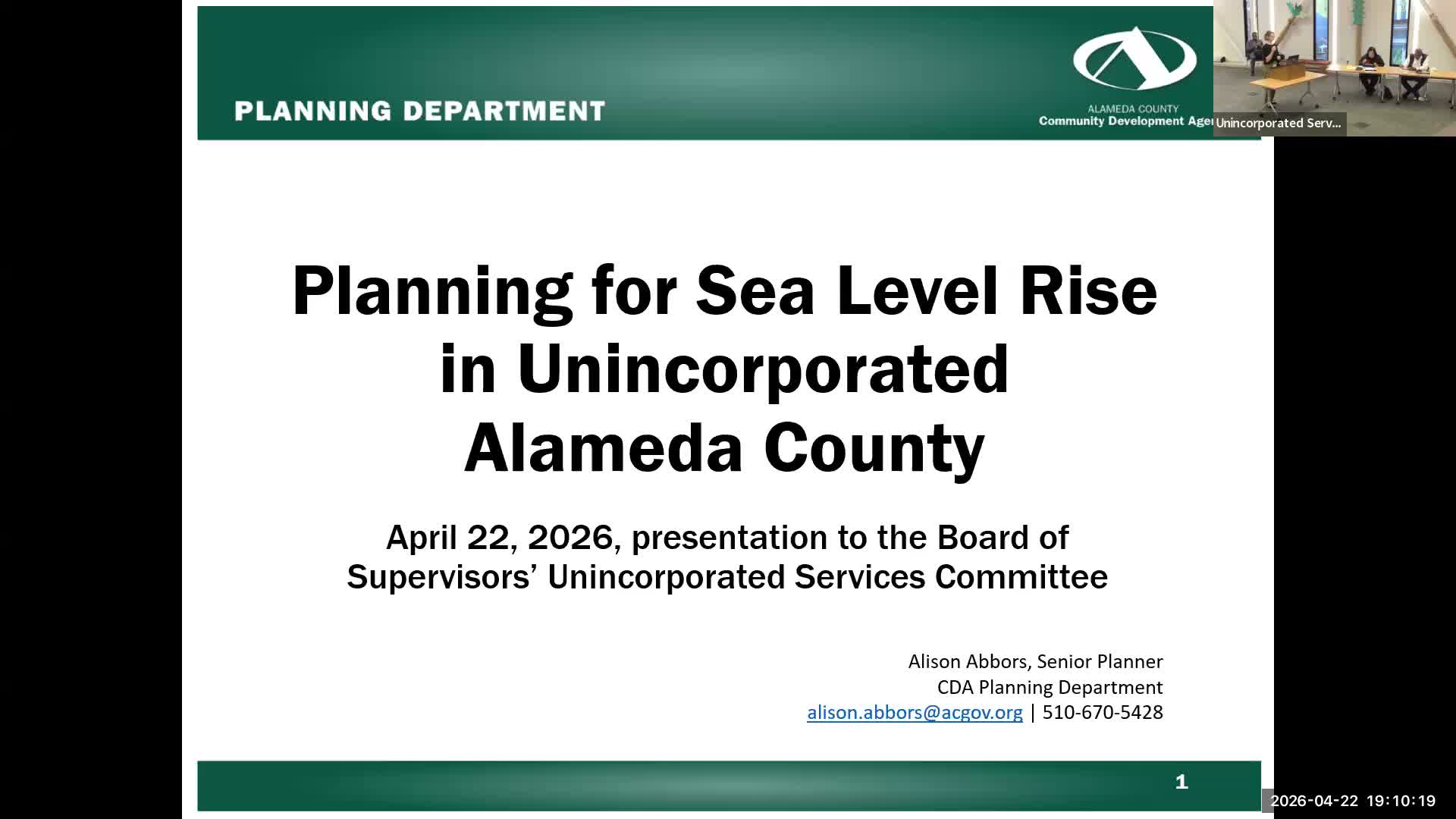
Alameda County planning staff briefed the Unincorporated Services Committee on the county’s obligations under state law to produce a Regional Shoreline Adaptation Plan (RSAP)-compliant sea-level rise plan and recommended exploring membership in the Hayward Area Shoreline Planning Agency (HASPA) as the most cost-effective and collaborative path to compliance.
Ali Abbers of the county planning department summarized SB 272 (2023), which requires Bay Area jurisdictions to adopt RSAP-compliant plans by 2034, and noted the Bay Conservation and Development Commission (BCDC) guidance and a January update that made $21.3 million available in SB 1 funding for planning and early implementation. Abbers said the county’s unincorporated shoreline obligation covers roughly 1.25 square miles—largely in western San Lorenzo—and must account for high sea-level-rise scenarios (up to 6.6 feet by 2100) and emergent groundwater impacts.
Staff recommended regional collaboration through HASPA to share modeling and vulnerability assessments, increase grant competitiveness, and avoid ‘maladaptation’ where one jurisdiction’s protection worsens a neighbor’s flooding. Lou Andrade (HARD) and Adrianne Harris (HASPA manager) described HASPA’s 2021 Shoreline Adaptation Master Plan, existing grant-funded technical work, and an ongoing implementation plan developed with contractor SCAPE. HASPA said its master plan predated BCDC’s RSAP guidance and that HASPA is already aligning its plan with RSAP requirements and discussing any gaps with BCDC.
Supervisors asked technical and governance questions: how membership dues and voting tiers are set, whether the county would join through the Community Development Agency (CDA) or as a county-level member, and whether dependent special districts (e.g., Flood Control) should join separately. HASPA staff described a tiered dues structure (tiers with annual dues ranging roughly from $12,000 to about $31,800) and said membership level and voting weight would be negotiated with any new member. Committee members expressed support for pursuing a membership approach that includes CDA and invites input from Public Works and Flood Control.
Public commenters (Bruce King of Friends of San Lorenzo Creek, Mimi Dean of Oro Loma Sanitary District) urged county participation and noted that flood-control infrastructure and rising tides are an integrated risk; they asked that Flood Control District and Public Works be included in planning coordination.
The committee directed staff to continue discussions with HASPA, coordinate internally with CDA and Public Works, and return with an action item recommending the membership approach (entity of entry, dues tier, and governance terms) to bring to the Board of Supervisors.