Get Full Government Meeting Transcripts, Videos, & Alerts Forever!
Get email alerts on the Residency Domicile topic
No spam. Unsubscribe anytime.
Montana panel splits over residency and domicile definitions after judge enjoins HB 413
Summary
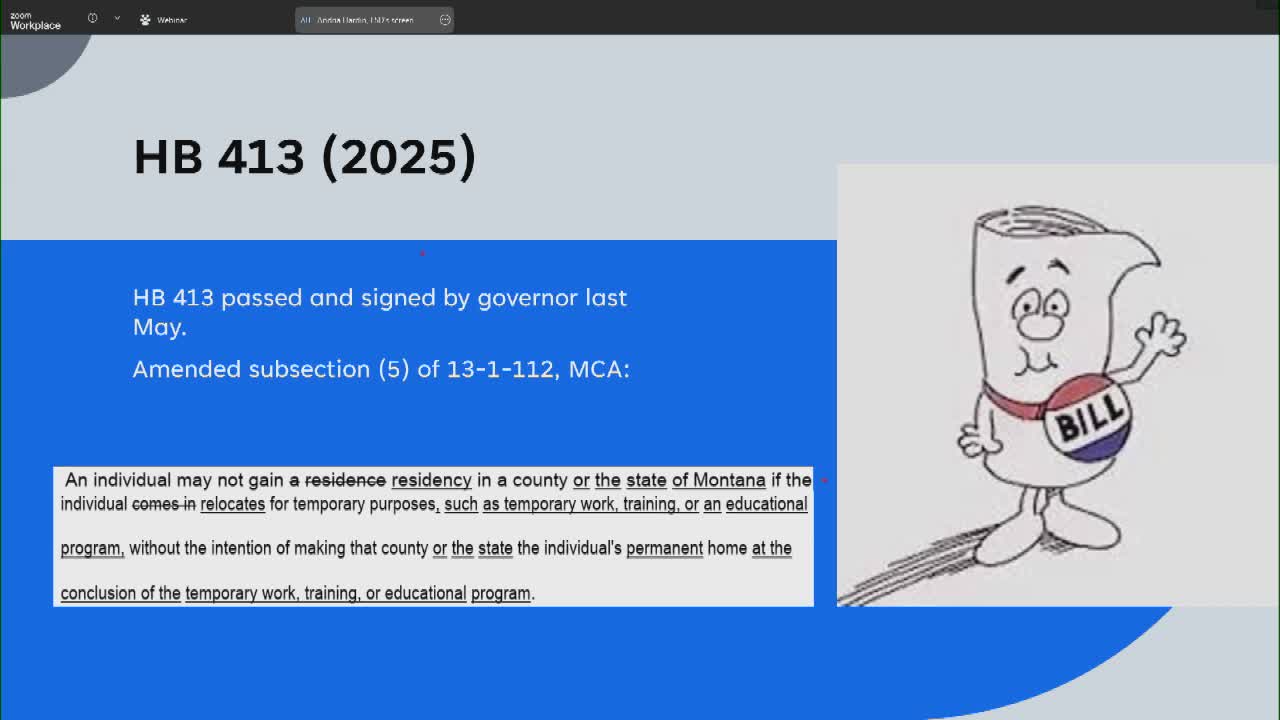
Legal staff told lawmakers a federal court preliminarily enjoined HB 413 after finding it raised vague and heightened residency requirements that could disenfranchise students; committee members discussed options ranging from precise statutory definitions of 'temporary' and 'permanent' residency to a constitutional amendment to change 'resident' to 'domicile.'
Legal counsel to the committee, Miss Harden, briefed members on distinctions between 'residence' and 'domicile' in Montana statutes and the state constitution and explained a recent preliminary injunction against HB 413 by the Fourth Judicial District in Missoula. Harden said the court found HB 413 likely impermissibly raised residency standards—by adding requirements that the student show future intent to remain in Montana beyond graduation and by using undefined terms such as 'permanent home'—and that the bill risked infringing voting rights and equal protection.
Harden reviewed relevant code sections (Title 13 and Title 1) and case law, noting that Montana’s constitution and Title 13 use the term 'residence' for suffrage and that courts apply statutory definitions where available. She advised lawmakers that simply changing the word to 'domicile' in the constitution would not, on its own, avoid litigation: courts use legislative definitions. Instead, Harden recommended drafting precise statutory definitions of 'temporary' and 'permanent' and setting objective indicators (vehicle registration, tax filings, voting registration) rather than leaving intent to subjective determination.
Committee members debated several approaches. Some urged a narrow statutory fix (clear definition and objective tests) to address the court’s concerns; others proposed a constitutional amendment to replace 'resident' with 'domicile'—a longer, costlier process that would require a ballot question to voters. The committee asked staff to research consequences across Montana code and to return with draft language and legal options.