Get Full Government Meeting Transcripts, Videos, & Alerts Forever!
Get email alerts on the 5 Mile Basin topic
No spam. Unsubscribe anytime.
Butte County updates 5‑Mile Basin work; consultant outlines sediment, monitoring and permit hurdles
Summary
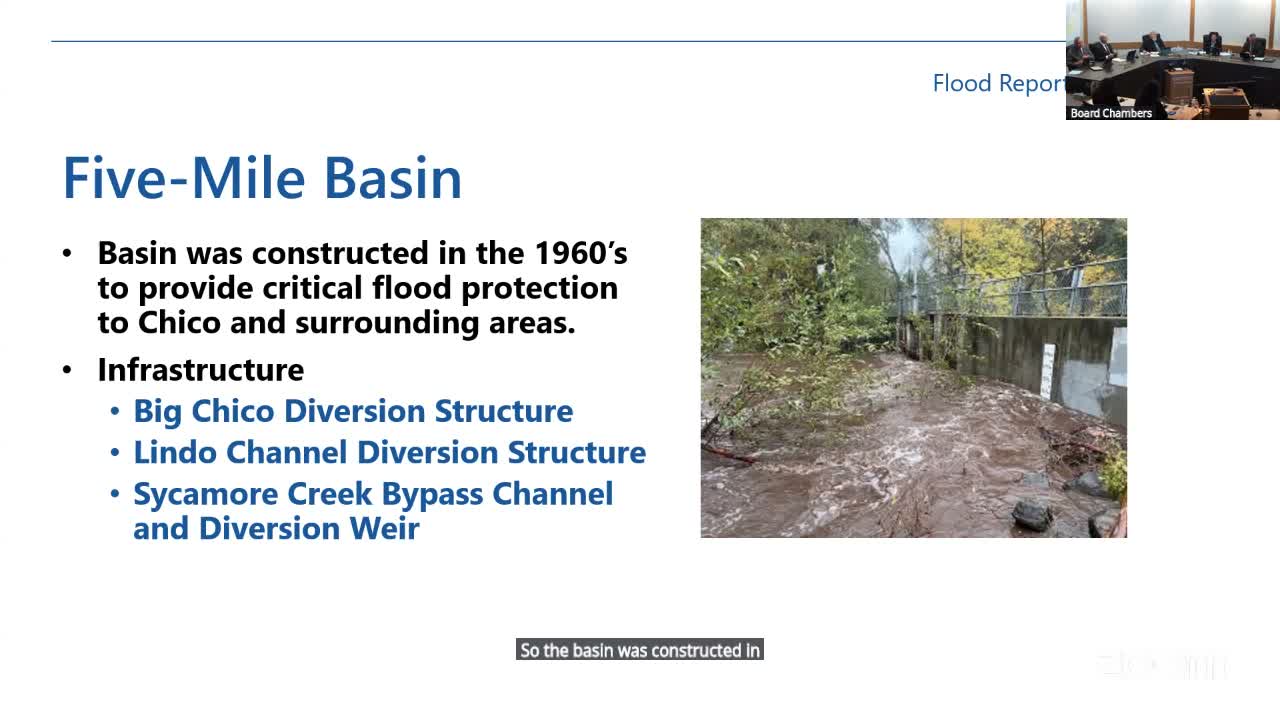
Public Works and consultant NCE updated the Board on 5‑Mile Basin floodwork: the SAFE project completed vegetation and sediment removal in 2025, monitoring continues, estimated sediment volumes remain large (tens of thousands of cubic yards), and staff expects design alternatives to come to the board in 2027.
Public Works and consultant NCE briefed the Board of Supervisors April 28 on the status of the 5‑Mile Basin project, completed short‑term work and planned next steps.
Staff said the SAFE project, authorized in August 2025, delivered vegetation, sediment and gravel removal, channel work and levee repair that increased basin capacity and addressed near‑term risks. The department continues post‑project monitoring and analysis and is coordinating a longer‑term alternatives analysis with NCE, with a goal of presenting design alternatives to the board in 2027.
Scott De Leon of NCE described monitoring activities and regulatory constraints. He said the basin has accumulated substantial sediment — earlier estimates put restoration needs in the tens of thousands of cubic yards — and that any large removal requires multiple permits, biological studies and CEQA review. He described the current monitoring focus on fish‑stranding checks required by Department of Fish and Wildlife permits and staff access to DWR and other gauge data.
Board members asked technical questions about who operates the diversion gates, how flow splits are determined, and what it would take to restore historic conveyance. De Leon and staff said the diversion structure has a finite capacity and that sedimentation and vegetation make it harder for water to enter the basin; they offered preliminary sediment estimates in the 50,000–70,000 cubic‑yard range but said the number is event‑dependent. Staff said permitting work is underway and that additional routine maintenance projects may be pursued under the county's existing maintenance agreements while alternatives are developed.
Staff emphasized balancing flood protection with environmental and recreational objectives to improve the project’s grant eligibility. The board asked staff to continue monitoring, pursue permits for necessary work, and return with clear alternatives and cost estimates for a 2027 decision point.