Get Full Government Meeting Transcripts, Videos, & Alerts Forever!
Get email alerts on the Council Structure topic
No spam. Unsubscribe anytime.
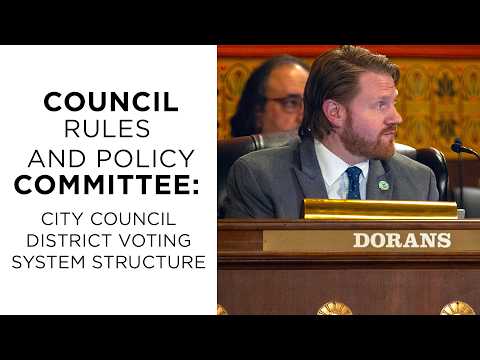
Columbus hearing draws three hours of public testimony on council’s voting structure
Summary
At a public hearing called by the council’s president pro tem, residents, academics and advocates offered sharply divided testimony on whether Columbus should keep its at-large-with-residency system, adopt true by‑district elections or a hybrid; proponents said districts increase accountability, opponents warned of housing and representation tradeoffs.
President Pro Tem (S1) opened a packed public hearing and asked the city’s legislative research director to review how Columbus arrived at its present 9‑member, at‑large-with-residency system before a night of public comment that lasted more than three hours.
Matt Erickson, director of the Legislative Research Office, traced the city’s electoral history from an all at‑large 1914 charter through the 2016 charter change that created the current nine‑member model with district residency requirements and staggered terms. Erickson explained technical map constraints the charter now requires — including a very tight variance rule and contiguity/compactness guidance — and outlined how the districting and charter review commissions operate after each decennial census.
Much of the evening was taken by 36 speakers. Advocates for a citizen‑led amendment called Our City, Our Say urged council to let voters approve “true” districts in which each district elects only its representative. Chris Tabner, a petition committee member, said the change is a simple fix to make representatives accountable to local neighborhoods. “Columbus City Council…should be a beacon of representative democracy,” Tabner said.
Union leaders, neighborhood activists and community organizers framed the debate as one about money and access. Joe Decker of the Columbus Education Association said citywide elections raise the cost of campaigns and let well‑funded interests dominate who can win a council seat. “The current at‑large system means that campaign donations of moneyed interest are more crucial than the support of candidates’ neighbors,” Decker testified.
Speakers for district elections argued the current model dilutes neighborhood voice and insulates incumbents. “Residents of each community in Columbus should feel confident that their representative on Columbus City Council is accountable to only them, not voters on the other side of the city,” said Dan Catello, a volunteer with the petition committee.
At the same time, academic and policy witnesses cautioned about tradeoffs. Vladimir Kogan, a political scientist at The Ohio State University, testified that Columbus’s geography and voting patterns make outcomes less predictable than in other cities, and he cited research connecting district elections with slower housing production in some studies. “Shifting from at‑large to by‑district elections will almost certainly reduce the ability of African American voters to elect candidates of their choice,” Kogan said, noting Columbus’s particular demographic distribution as the basis for his concern.
Several speakers repeatedly raised McCoy Park — a recent council decision to transfer parkland and city funds — as an example of residents’ frustration. Critics said that the park vote showed how a citywide result can override the preferences of the neighborhood most affected, and they cited that episode as fuel for the petition drive.
Other witnesses proposed complementary reforms: stricter campaign finance limits, lower signature thresholds, stronger ballot access, and an independent process to draw fair maps. Some urged a hybrid design (district seats plus a small number of at‑large seats) while others insisted on an all‑district approach with no citywide override.
No formal proposal was before council at the hearing’s close; President Pro Tem (S1) stressed the meeting was primarily level‑setting and said further public engagement would follow if council advances a draft. The hearing adjourned after council members and residents agreed the topic merits additional study and outreach.
A record of the testimony, along with written submissions speakers referenced, will remain available to council as they consider whether to move a council‑sponsored amendment, support a citizen petition or propose alternate reforms.