Get Full Government Meeting Transcripts, Videos, & Alerts Forever!
Get email alerts on the Housing Policy topic
No spam. Unsubscribe anytime.
Poway council hears overview of California's density-bonus law; officials warn it can override local design rules
Summary
City attorney Alan Fenstermacher and development director Julie Trecopio briefed council on state density-bonus law, explaining bonus calculations, waivers and concessions and local examples. Councilmembers and a public commenter warned the law can override elements of the Poway Road specific plan.
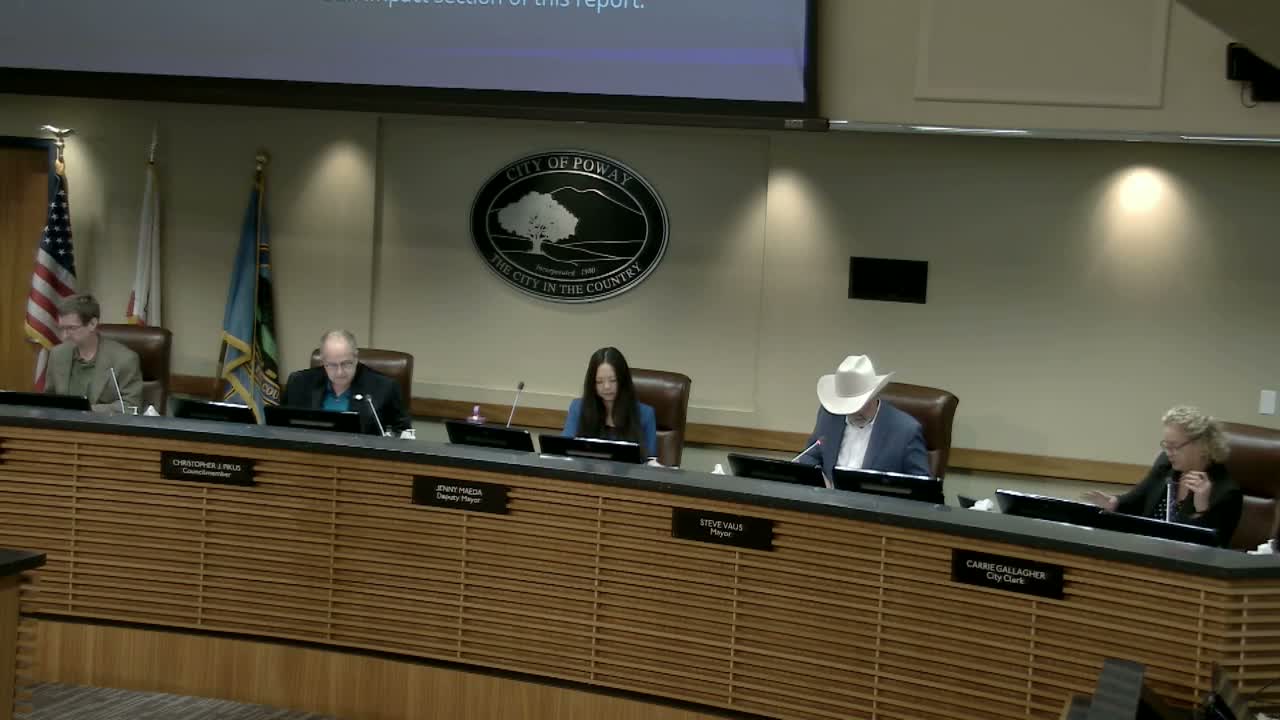
City attorney Alan Fenstermacher and Director of Development Services Julie Trecopio presented an informational overview of California's density-bonus law at the April 21 Poway City Council meeting, outlining how bonus units are calculated, what waivers and concessions developers may request, and how reduced parking and other concessions can change project design.
Fenstermacher summarized the statute's mechanics and recent legal developments, noting developers can request unlimited waivers from physical development standards when they show a standard would physically preclude the project as proposed. "There's no limit on waivers a developer can request as long as they establish that it would be physically impossible to build the project as proposed," he said, explaining case law has tended to favor developers in waiver disputes.
Trecopio gave local examples: the Apollo Senior Housing project (14 very-low and 29 low-income units), the Poway Paseo revisions that increased units by incorporating low-income units, and city-driven projects such as Villa De Vida and Brighton Place that used concessions to reduce parking and setbacks to make projects feasible. She also showed a San Diego example that maximized waivers and concessions, yielding a large increase in units and height and eliminating private open space provisions.
Public commenter Anita Edmonson urged the council to revisit the Poway Road specific plan to preserve local character and to host a public workshop translating plan elements into capital projects such as gateway features, public art and lighting. "This report was equal parts enlightening and frightening," Edmonson said, arguing Sacramento's statute and related court rulings have narrowed local control.
Councilmembers discussed how negotiation with developers and staff engagement can reduce negative impacts in many cases, and cited recent state bills and court decisions referenced in the presentation that have expanded bonuses or placed burdens of proof on cities. Fenstermacher and Trecopio emphasized the presentation was informational; no action was requested or taken on this item.