Get Full Government Meeting Transcripts, Videos, & Alerts Forever!
Get email alerts on the Infrastructure topic
No spam. Unsubscribe anytime.
Ellensburg staff present draft 20-year sewer plan, flagging capacity limits and $125 million price tag
Summary
City staff and consultant presented a 20-year general sewer plan for Ellensburg that prioritizes repairs and new treatment capacity, estimates about $125 million in planning-level costs and says the plan is under final review by the Washington Department of Ecology.
City staff and a consultant team presented the draft Ellensburg general sewer plan at a council study session, outlining a 20-year capital program to address aging treatment and collection infrastructure and looming permit constraints. Derek Mayo, city engineer, opened the session and described the meeting as “a deep dive into the wonderful world of sewer” as the city moves the plan toward final review by Ecology.
Mackenzie Capacis, a consultant with Kennedy Jenks, said the plan uses a data-driven risk assessment, field inspection and hydraulic modeling to prioritize projects and will inform future policy and funding decisions. “The plan is about managing risk and responsibility,” she said, adding that the document is a technical foundation and that adoption does not imply immediate approval of funding.
The presentation identified several near-term projects intended to stabilize operations: rehabilitating a recirculation building (including new pumps and SCADA controls), phased aeration improvements, installation of a new secondary clarifier and a replacement grit classifier. Longer-term work would include additional aeration basins, a new inflow pump station and upgrades to disinfection systems. Consultants recommended an annual repair-and-replacement (R&R) program to reduce infiltration from aging pipe and to direct inspections and lining work.
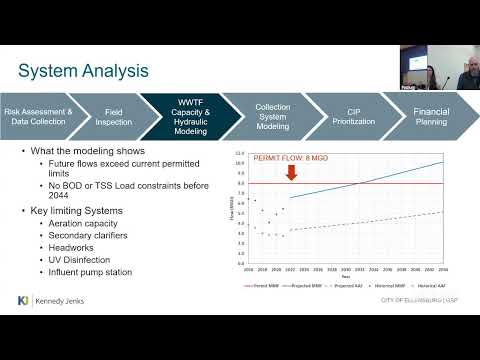
Consultants and staff flagged capacity and permitting as pressing issues. The presenter said the facility’s current permitted flow is 8,000,000 gallons per day and that modeled future flows exceed that limit; she added the plant can handle roughly 10,000,000 gallons per day under modeled conditions but emphasized the need to address regulatory compliance and peak-day exposure. Council members asked whether near-term projects would change the permit; staff said the larger aeration-basin work would be the major capacity driver and that smaller near-term projects mostly replace or improve existing equipment.
Operations staff warned of single points of failure in aging electrical equipment. Mike Alderson, the acting works director, summarized the risk: “If one of those goes out, we’re in trouble,” referring to the electrical MCC units that support treatment operations. Consultants said electrical components and certain large assemblies have extended lead times and that the city is already leaning toward ordering critical items earlier in design to avoid delays.
On the collection system, presenters said excess infiltration from aging pipes is the principal system-wide issue and recommended inspecting and addressing roughly 10,000 linear feet of pipe per year as an order-of-magnitude need over time; staff said current lining work averages roughly 2,000–4,500 feet every two years and that reaching the plan’s targets would be a considerable ramp-up.
At planning level the consultant estimated approximately $125,000,000 in capital improvements across 20 years, with about $118,000,000 concentrated in the next 10 years under current phasing assumptions; Mackenzie Capacis emphasized these are planning-level estimates that will be refined during design and that FCS Group will present a detailed funding and rate analysis at a future meeting. The consultant also said the plan has completed an initial Ecology review and is in final review with the Department of Ecology; Ecology reportedly gave verbal approval pending its final upload and formal signoff.
The session concluded with council questions about when permit renewal work should begin and how Ecology treats systems that reach roughly 80% of permitted capacity; staff said permit timing and design must be coordinated with projects and that the next council meeting will include a deeper dive into finance and rate impacts. The study session adjourned to the regular meeting.