Get Full Government Meeting Transcripts, Videos, & Alerts Forever!
Get email alerts on the Education Financial Literacy topic
No spam. Unsubscribe anytime.
Aliso Viejo approves three-year pilot funding for student-run 'Know Your Dough' financial literacy program
Summary
The council approved a three-year pilot to fund a student-run financial literacy club that pairs Junior Achievement curriculum with a 'High School Heroes' peer-teaching model. The city will make a one-time $3,000 donation to Junior Achievement and an annual $2,500 contribution to the Aliso Niguel High School ASB; the motion passed unanimously after amendment to a three-year term.
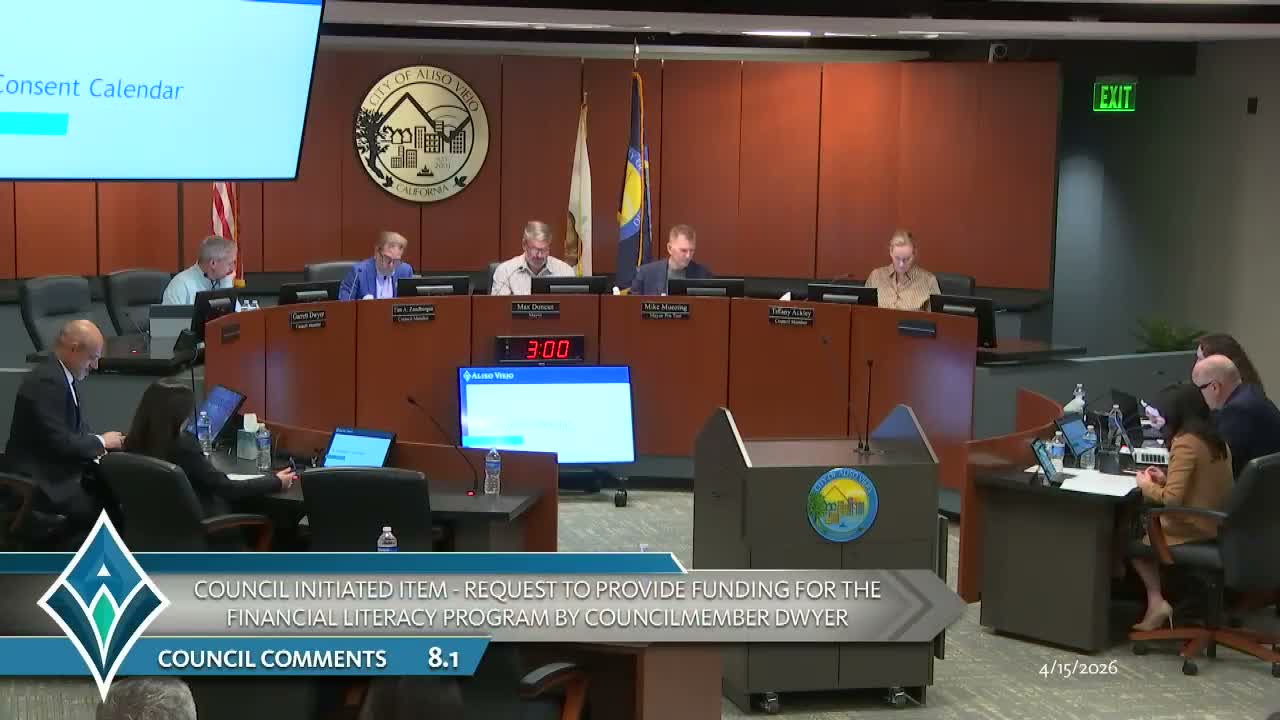
The Aliso Viejo City Council unanimously approved funding for a student-run financial literacy initiative, directing a one-time $3,000 donation to Junior Achievement and $2,500 per year to the Aliso Niguel High School Associated Student Body as part of a three-year pilot.
Council member Dwyer introduced the 'Know Your Dough' program as a lunchtime, student-led club that would pair Junior Achievement’s credentialed curriculum with a High School Heroes peer-teaching component. Dwyer cited AB 2927 and the California State Board of Education’s curriculum guide as reasons to start local programming now rather than wait for the state-mandated high-school course to be routinely offered. "Our kids need this information today," Dwyer said during the presentation.
Program details presented to the council included five classroom topics (making, spending, saving, borrowing and protecting money) taught over a series of school-year sessions; a plan to recruit five volunteer instructors from the Aliso Viejo and Laguna Niguel chambers of commerce; and a requirement that the student club report back quarterly with a budget reconciliation if the city provides funds. Dwyer said the $3,000 would cover Junior Achievement’s curriculum support and the annual $2,500 would flow through ASB to pay for incidental costs such as food, shirts, outreach and materials.
Speakers at the meeting were split on the proposal’s timing and scope. Nicole Berkman, business and marketing teacher and advisor to the new club, said the program will give students "hands-on experience in financial decision making" and create opportunities to teach younger students. Destiny Lara, Junior Achievement’s regional program manager, described the curriculum as state- and nationally‑credentialed and said volunteers are trained to deliver the material.
Some residents urged caution. Marie T questioned whether the city should fund a program the state is rolling out and asked for clearer line-item accounting. "It just seems like every time y'all get together you put us further in the hole," Marie T said, pointing to other local priorities and existing school resources. Council members responded by distinguishing the lunchtime, student-run club from the state’s future high‑school class, noting the club’s public‑speaking, mentorship and scholarship elements that the state course may not provide.
After discussion, the council amended the original request to fund the program as a three‑year pilot and voted to approve it. Council members said the shorter pilot will allow evaluation of outcomes and community partnerships before any longer commitment.
The council did not adopt line‑by‑line budget detail at the meeting; staff and the program advisors were asked to provide quarterly reports on expenditures and program metrics during the pilot period. The council’s action is a funding authorization for the pilot; implementation details and reporting will follow through staff work and partner agreements.