Get Full Government Meeting Transcripts, Videos, & Alerts Forever!
Get email alerts on the Transportation topic
No spam. Unsubscribe anytime.
County upholds denial of traffic-impact analysis for proposed Hwy 73 commercial center
Summary
Lincoln County commissioners upheld a staff denial of a traffic-impact analysis for a proposed retail center at Highway 73 and Little Egypt Road after staff and residents said the study failed to meet county level-of-service standards; the applicant presented road-improvement plans that staff said were insufficient under the UDO.
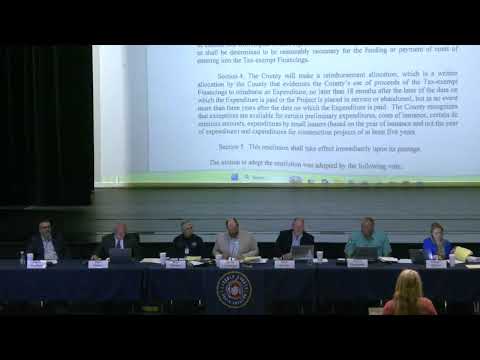
Lincoln County commissioners on a May meeting upheld the Development Services director’s technical denial of a traffic-impact analysis (TIA) submitted by EJG Ventures for a proposed retail center at the southwestern corner of Highway 73 and Little Egypt Road.
Andrew Bryant, Lincoln County’s director of development services, told the board the submitted TIA did not meet the county Unified Development Ordinance’s level-of-service standards and therefore could not be accepted. “The traffic impact analysis was not compliant,” Bryant said, adding that the proposed mitigation — dual southbound left-turn lanes and related restriping — improved operations but did not restore the intersection to the no-build level-of-service required by the ordinance.
The applicant’s team — represented by attorney Rob Brown and traffic engineers from DRMP — described a package of roadway improvements that includes dual southbound left-turn lanes on Little Egypt Road, an additional receiving lane on Highway 73, restriping of approaches and separate right-turn lanes into site driveways. Traffic engineer John Sheck said the study was scoped with both Lincoln County and NCDOT and that the proposed improvements align with NCDOT recommendations. He said NCDOT preliminarily approved the study’s approach.
Residents and Trilogy neighborhood representatives urged the board to uphold staff’s denial. George Arena, speaking for Trilogy residents, said the volume of added peak-hour trips and the absence of school-traffic data left significant safety and capacity gaps: “There’s a significant amount of traffic that this development is adding to this intersection … and it just doesn’t fit,” Arena said. He and other speakers emphasized that cumulative growth in the corridor — including recent nearby subdivisions — exceeds the TIA’s modest growth assumptions.
Commissioners framed their decision around two required findings for an appeal hearing: whether the applicant has satisfactorily mitigated adverse traffic impacts, and whether any variance from the TIA standards is consistent with the ordinance’s spirit and secures public safety. After discussion the board voted to adopt findings of fact that the applicant had failed to satisfactorily mitigate adverse traffic impacts and that the additional traffic would have a significant impact on county and state roads. A motion to uphold the development services director’s denial carried; the chair announced that the director’s decision was upheld.
The applicant said it plans to return with more detailed site plans and pursue available funding programs for transportation mitigation, and the developer noted recorded covenants and prior approvals envisioning a commercial node near Trilogy. The denial applies to the TIA compliance under county rules; it does not, by itself, resolve any future rezoning or plan-development applications for the site. The applicant may revise the study or seek additional improvements if it chooses to proceed.