Get Full Government Meeting Transcripts, Videos, & Alerts Forever!
Get email alerts on the Grants And Funding topic
No spam. Unsubscribe anytime.
Santiago Creek Commission adopts three ad hoc subcommittees, seeks grants to implement strategic plan
Summary
The Santiago Creek Commission received a presentation from Townsend Public Affairs on state and federal grant programs and voted 5-0 to form three ad hoc subcommittees to work with staff and Townsend to pursue funding and implement the adopted Santiago Creek Strategic Plan.
On April 22, 2026, the Santiago Creek Commission voted 5-0 to create three ad hoc subcommittees to help carry out the recently adopted Santiago Creek Strategic Plan and to pursue grant funding with support from Townsend Public Affairs.
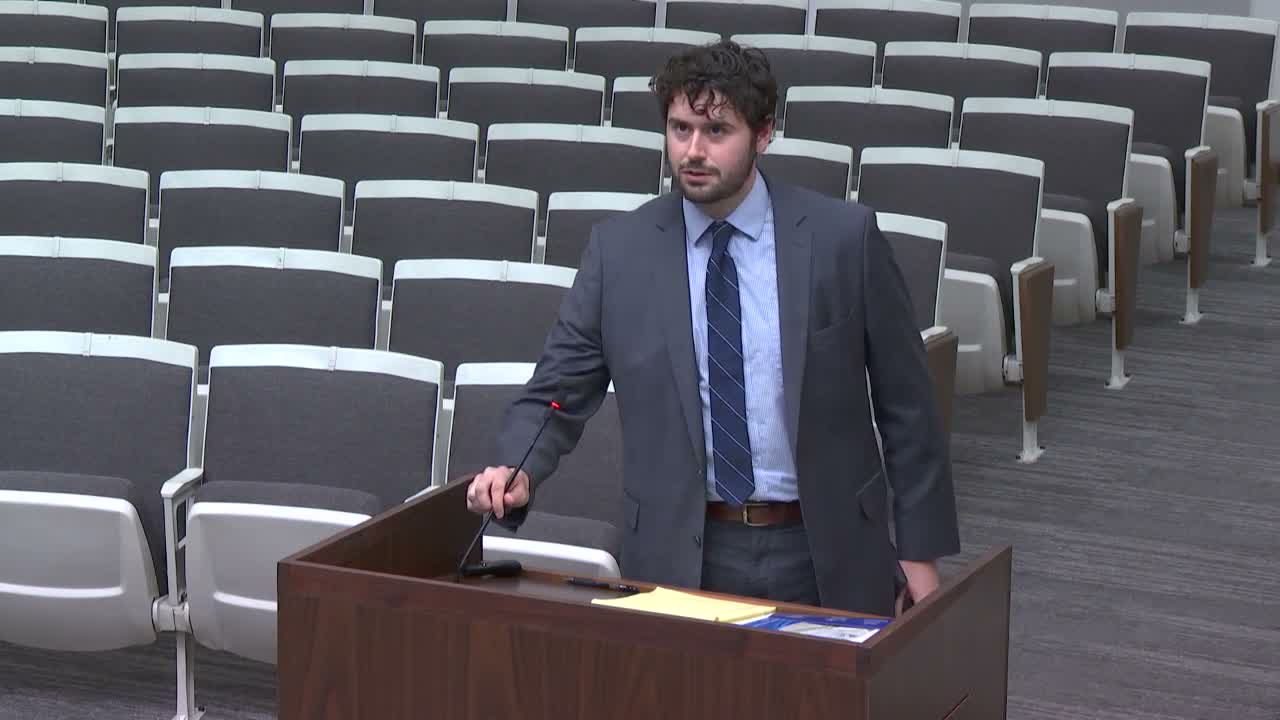
Townsend Public Affairs grant-writer Jake Leishner told commissioners the commission could pursue multiple funding sources that align with plan projects, citing the California Wildlife Conservation Board's consolidated grant (planning through implementation), the National Fish and Wildlife Foundation's 5-Star program, the California State Parks Habitat Conservation Fund and the federal Recreational Trails Program. Leishner said the NFWF 5-Star award is currently open, carries a maximum award in the roughly $150,000 range, requires a 1-to-0.75 local match (for example, a $60,000 request would require $45,000 in local or other non-federal match) and has a May 14 pre-application deadline for this cycle.
"There are no limits on things you can apply for," Leishner said, adding that Townsend sees itself as an extension of city staff on grant work and can help prepare applications on short windows.
City staff recommended organizing three topic-based subcommittees'ecological preservation and restoration; historical, cultural and archaeological preservation; and recreational enhancement and safety'eto avoid duplication and to align with grant types. Staff proposed that each subcommittee have no more than three commissioners, operate in an advisory capacity under Brown Act exemptions for ad hoc groups, and sunset in January 2027 with a progress report to the city council.
Commissioners volunteered to serve on the groups and confirmed assignments before voting. Vice Chair Pamela Galera and Commissioner Knight were named to the ecological subcommittee; Commissioners Tallulah and Baca to historical preservation; and Commissioners Hillman, Chair Moeller and Adams to recreational enhancement and safety. The commission took a recorded voice vote; the motion passed 5-0.
Staff said Townsend is retained by the city for a flat fee and can be deployed on multiple applications: "Townsend's on retainer with us for $9,000 a month and we can use them as much as we need to," staff said during the meeting. Staff also said that while the commission and subcommittees can advise, formal grant acceptance and any required appropriation for local match would come before the city council when necessary.
The commission discussed next steps for imminent opportunities and volunteer assistance from commissioners on pre-applications. Staff said Townsend will circulate a regular grants memo to flag opportunities tied to the Santiago Creek plan.
The commission's action creates a standing structure to match specific plan projects to funding opportunities and to marshal community and staff resources to prepare competitive applications. The subcommittees are scheduled to conclude in January 2027, when staff will present a progress report to the council.