Get Full Government Meeting Transcripts, Videos, & Alerts Forever!
Get email alerts on the Traffic Safety topic
No spam. Unsubscribe anytime.
Fullerton committee reviews draft Safe Streets and Roads for All plan proposing 380 treatments to reduce serious crashes
Summary
Consultants presented a draft SS4A action plan that identifies about 380 roadway safety treatments grouped into 10 neighborhood projects, prioritizing southern Fullerton and corridors near Cal State Fullerton. The plan is intended to make the city eligible for federal implementation funding and will be taken to council in May for adoption.
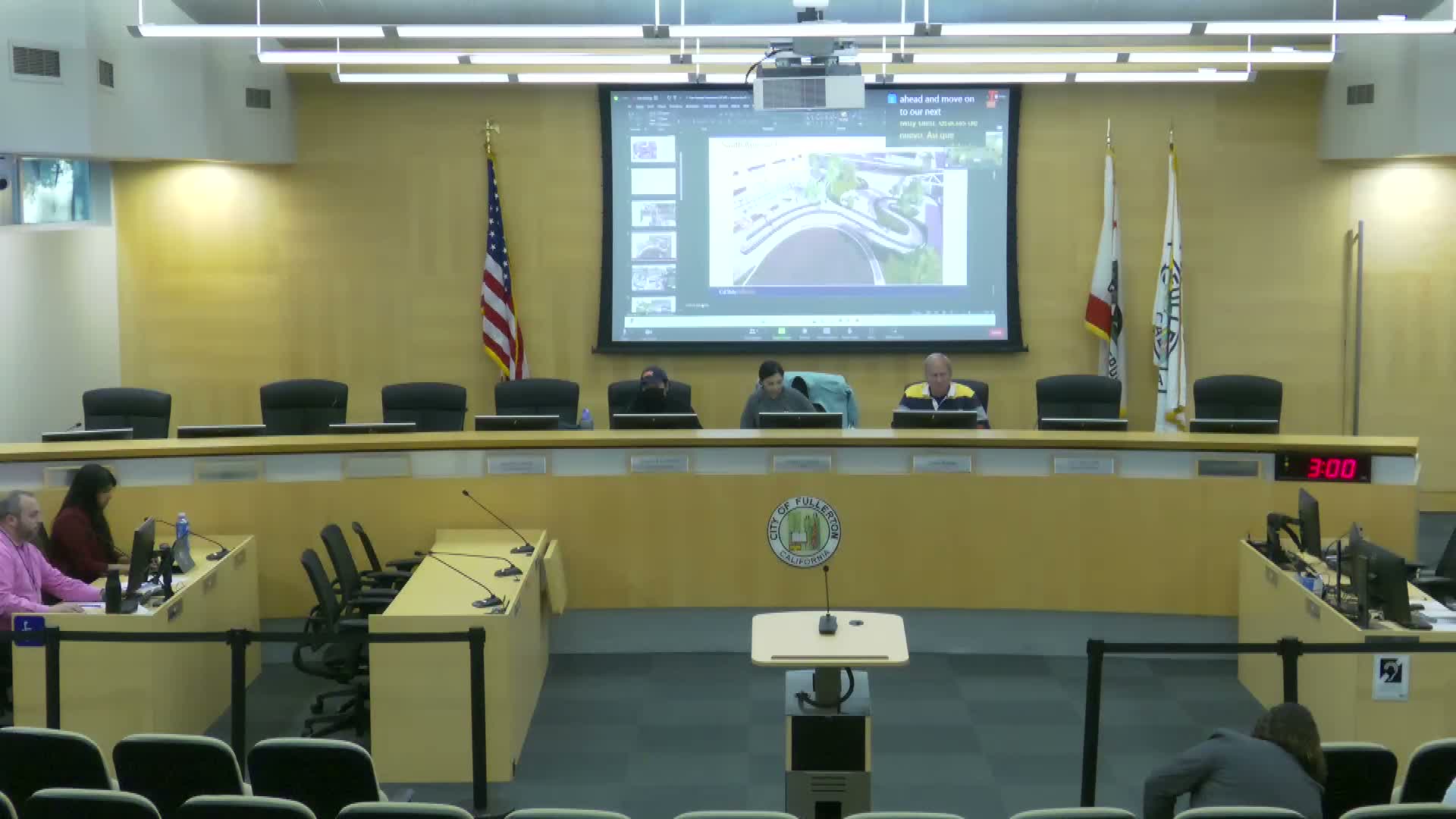
Lochner consultant Carlos Velasquez told the Active Transportation Committee that Fullerton's draft Safe Streets and Roads for All (SS4A) action plan maps citywide crash patterns, equity indicators and community input to prioritize safety treatments and prepare Fullerton to apply for federal implementation grants.
"This is not an active transportation plan," Velasquez said. "It's intended to address where you have the highest concentration of collisions and where you have the highest need, and some of those treatments might also benefit active transportation roadway users." He described a data-driven prioritization using four weighted categories (network, safety, equity and support) and said the team has identified roughly 380 proposed improvements grouped into 10 grant-ready neighborhood projects.
Velasquez said the plan focuses on areas south of Commonwealth Avenue, around Orangethorpe and near the Cal State Fullerton campus and the 57 Freeway. Sample recommended treatments include speed-feedback signs, retroreflective backplates on signal heads, leading pedestrian intervals, higher-visibility crosswalks, curb extensions and targeted stop signs (typically assigned to minor streets), bicycle boxes at complex intersections and a proposed road diet that would narrow part of Commonwealth to one lane each way to slow traffic and create space for bike facilities.
The consultant described community engagement that included farmers-market outreach, three community meetings (two in person and one on Zoom), multilingual surveys and coordination with public works and Cal State Fullerton mobility staff. Survey responses were mostly positive about measures such as retroreflective backplates and curb ramps, mixed on bike boxes and lane reconfiguration, and supportive of curb extensions and rectangular rapid flashing beacons (RFBs) at select locations.
Public commenter Carol Thackery, a Rolling Hills Drive resident, urged consideration of her neighborhood, saying Rolling Hills is 64 feet wide, serves as a detour and has a daily traffic count of about 4,700 (2019) with school access concerns. "This one mile between State College and Brea Boulevard has no traffic signals, no stop signs," she said, noting existing speed-feedback signs and a crossing-guarded school crossing.
Committee discussion praised the plan's data work and recommended considering additional measures such as raised crossings, protected bike lanes, pedestrian scrambles downtown and selective chicanes or median islands in residential streets. Members also cautioned against blanket stop-sign proliferation, raised the trade-offs of adding on-street parking for traffic calming, and noted that some vertical treatments (speed tables, roundabouts) were omitted because the city is currently reviewing relevant policies.
Velasquez emphasized that the plan groups improvements into coherent neighborhood projects to make stronger grant applications and that the city can still deviate from the plan in specific grant proposals with supporting analysis. The consultant said the plan is scheduled to go to city council in May so Fullerton will meet SS4A deadlines to remain eligible for implementation funding.
What happens next: The draft will be forwarded to city council for potential adoption in May, which would allow the city to pursue implementation grants under the federal SS4A program. Public works and other city departments will continue technical review.
Sources: Presentation by Carlos Velasquez (Lochner), public comments from Carol Thackery and committee Q&A at the April 15, 2026 Active Transportation Committee meeting.