Get Full Government Meeting Transcripts, Videos, & Alerts Forever!
Get email alerts on the Gun Policy topic
No spam. Unsubscribe anytime.
Minnesota Senate passes comprehensive gun-safety package after emotional debate
Summary
The Minnesota Senate passed Senate File 4067 on May 4, 2026, a package that pairs an assault-weapons and high-capacity magazine ban with school-safety and mental-health funding. The final Senate vote was 34-33 after hours of debate and testimony from families affected by the Aug. 27 Annunciation Church shooting.
Senate File 4067, a sweeping gun-violence-prevention package that combines an assault-style weapons ban with school-safety and mental-health investments, passed the Minnesota Senate on May 4, 2026, by a vote of 34-33.
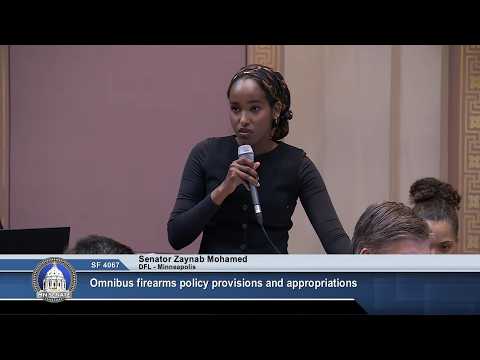
Senator Z. Mohammed, the bill’s chief author, framed the measure around the Aug. 27 Annunciation Church shooting in Minneapolis and urged the chamber to adopt a layered approach of prevention, intervention and harm reduction. "We need both — banning certain weapons and investing in school safety and mental health," Mohammed said during floor remarks.
The bill includes: a prohibition on certain semiautomatic "military-style" firearms and large-capacity magazines defined by a set of physical features; a ban and criminal penalties for so-called ghost guns and for altering serial numbers; expanded safe-storage requirements so that firearms are not accessible to persons legally prohibited from possessing them; a clarification and reenactment of a binary-trigger ban; funding for school-linked behavioral health grants and mobile crisis teams; a $20 million approximate school-safety aid package with roughly $1 million set aside for nonpublic-school grants (reported per-pupil equivalency approximately $21.82); and provisions to expand and fund a public-awareness campaign for extreme-risk protection orders (ERPOs).
Senators clashed over the bill’s scope and enforceability. Opponents repeatedly raised constitutional concerns about banning widely held firearms and questioned whether the package would survive legal challenges; supporters argued the range of measures would reduce harm and save lives. "We are debating what happened that day, Aug. 27," said Senator D. Dibble, invoking victims who testified at hearings.
Technical and implementation questions were aired on the floor. Senators asked how weapon features such as "protruding grips" or barrel shrouds would be interpreted in practice; the author replied that ordinary handguns lacking the listed features would not be captured. The bill requires owners of firearms that meet the prohibitions to certify them with the Bureau of Criminal Apprehension (BCA); Senator Holmstrom asked about fees and background checks. Mohammed told the chamber the BCA would set a fee (the bill does not specify an amount) and said background checks are not currently required for the certification process as written but that the language could be adjusted in conference committee.
An A50 amendment offered by Senator Matthews — which would have stripped many of the bill’s policy provisions while retaining and increasing school-safety funding and mental-health dollars — failed on a roll-call vote, 33-34. The Senate then proceeded to final passage.
The final roll call on SF 4067 produced 34 ayes and 33 nays. After the vote, the Senate recessed to the call of the president so administrative tasks and conference committee appointments could be completed.
What happens next: with Senate passage, SF 4067 has cleared this chamber and will move forward through the legislative process (including any conference and reconciliation steps the House may require). Supporters said they will continue to refine implementation details — including certification procedures, fee language and any clarifying edits recommended in conference — to address concerns raised on the floor.
The debate showcased strong emotions and competing views: supporters urged immediate action to reduce the risk of mass shootings and to expand prevention and mental-health resources; opponents described constitutional and practical concerns with the bill as drafted. The measure’s author and backers said the package is intended to be comprehensive and to honor the families who testified and the victims whose deaths prompted the legislative push.
The Senate also appointed conference committee members on other bills during the session and took additional routine motions before adjourning to the president’s call.