Get Full Government Meeting Transcripts, Videos, & Alerts Forever!
Get email alerts on the Tobacco Retail Policy topic
No spam. Unsubscribe anytime.
Chula Vista hears weeks of public testimony and staff options on stronger tobacco retailer rules
Summary
Council heard an informational staff presentation and 33 public speakers urging tougher enforcement, routine compliance checks, density limits and buffers from schools in the Tobacco Retailer Permit (TRP) program; staff will return with specific ordinance language and impact analyses.
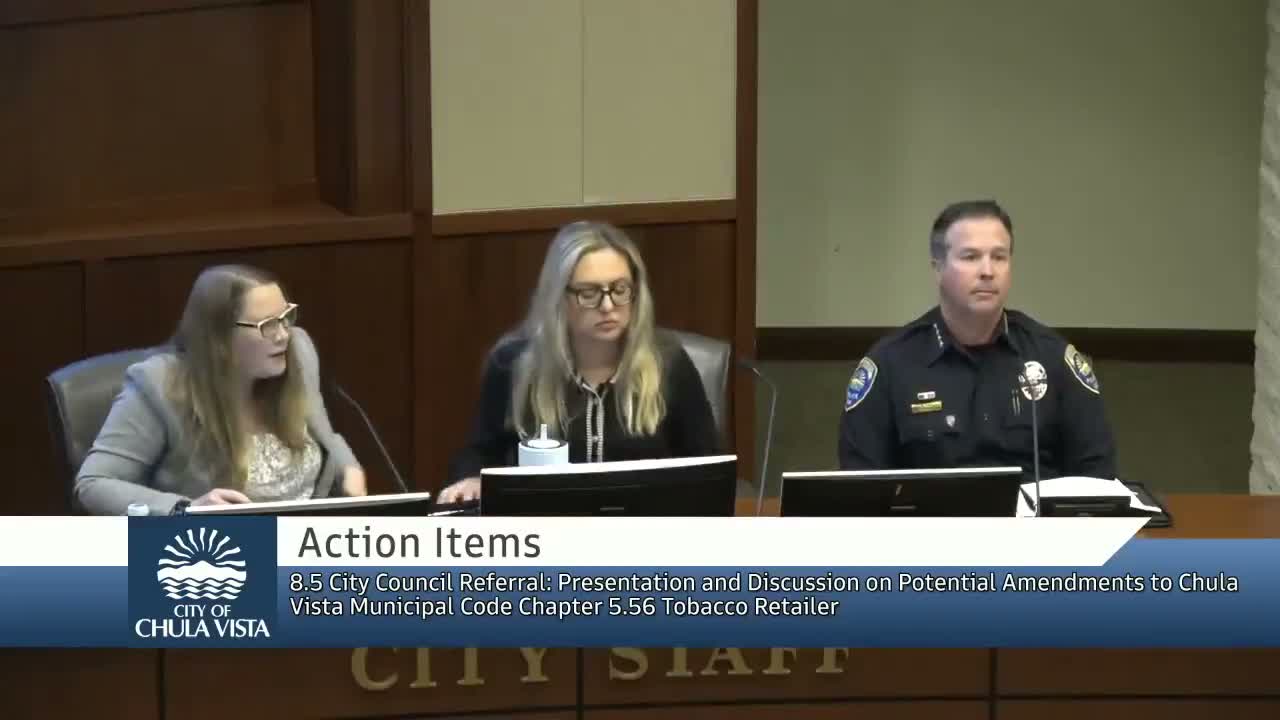
Mayor John McCann moved item 8.5 (a review of Chapter 5.56, the city’s tobacco retailer permit program) forward on the agenda and city staff summarized two staff directives: strengthen enforcement of the existing TRP and explore policies to reduce the number of tobacco retailers in Chula Vista.
Stacy Kurtz, who leads the city’s healthy and age‑friendly efforts, told the council staff had reviewed the ordinance’s implementation, changes in the tobacco market and state law and had engaged with community and business stakeholders. Deputy City Attorney Nicole Carnahan and the acting police chief outlined enforcement tools now in the code — administrative citations, civil penalties, progressive permit suspensions and revocation — and described limitations staff said reduce effectiveness in practice.
The council then heard more than 30 public speakers. Health groups, doctors, cancer‑center representatives, school students and advocacy coalitions urged mandatory annual undercover compliance checks, higher penalties for bad actors, proximity buffers to schools and parks, caps or district‑based permit limits, and restricting certain retailer types (for example, pharmacies or smoke shops). Students described finding flavored vapes and urged protections for youth; health presenters cited studies linking retailer density to youth initiation and argued combined policy measures reduce initiation and improve quit outcomes. Neighborhood retailers and the Neighborhood Market Association supported enforcement but urged protections for long‑standing, compliant small businesses and a clear transfer process so owners can sell their business as retirement equity.
Council members expressed broad agreement on the need to strengthen enforcement and penalties for repeat violators, but differed on whether to set city‑ or district‑level caps, how to treat existing permits (grandfathering or phase‑out on transfer), and precise buffer distances. Several council members emphasized that good actors — long‑standing, compliant merchants — should retain the ability to transfer a permit to a qualified buyer, while bad actors should face stronger sanctions and loss of transferability. Staff committed to returning with a proposed ordinance package that will include enforcement reforms, options for caps and spacing (including district maps and impact analyses), and draft grandfathering/transfer rules.
The item was informational; no ordinance was adopted at the meeting. Staff indicated they will return with concrete language and analyses for council consideration and possible adoption.
Ending: The council directed staff to bring back a comprehensive amendment package that addresses enforcement authority, penalties, permit review and renewal changes, and options for permit caps and buffers along with district‑level impact assessments. No final vote was taken on policy changes at the April 21 meeting.