Get Full Government Meeting Transcripts, Videos, & Alerts Forever!
Get email alerts on the Police Services topic
No spam. Unsubscribe anytime.
Police chief outlines potential cuts to crossing guards, front desk and community services under 5% budget reduction
Summary
Fullerton Police Chief John Radis told the committee that a 5% reduction to the police departments general-fund budget would require eliminating programs including Operation Clean Streets, reducing crossing-guard coverage, and cutting up to 10 police service representatives, which he said would force closure of the front desk and materially increase response times.
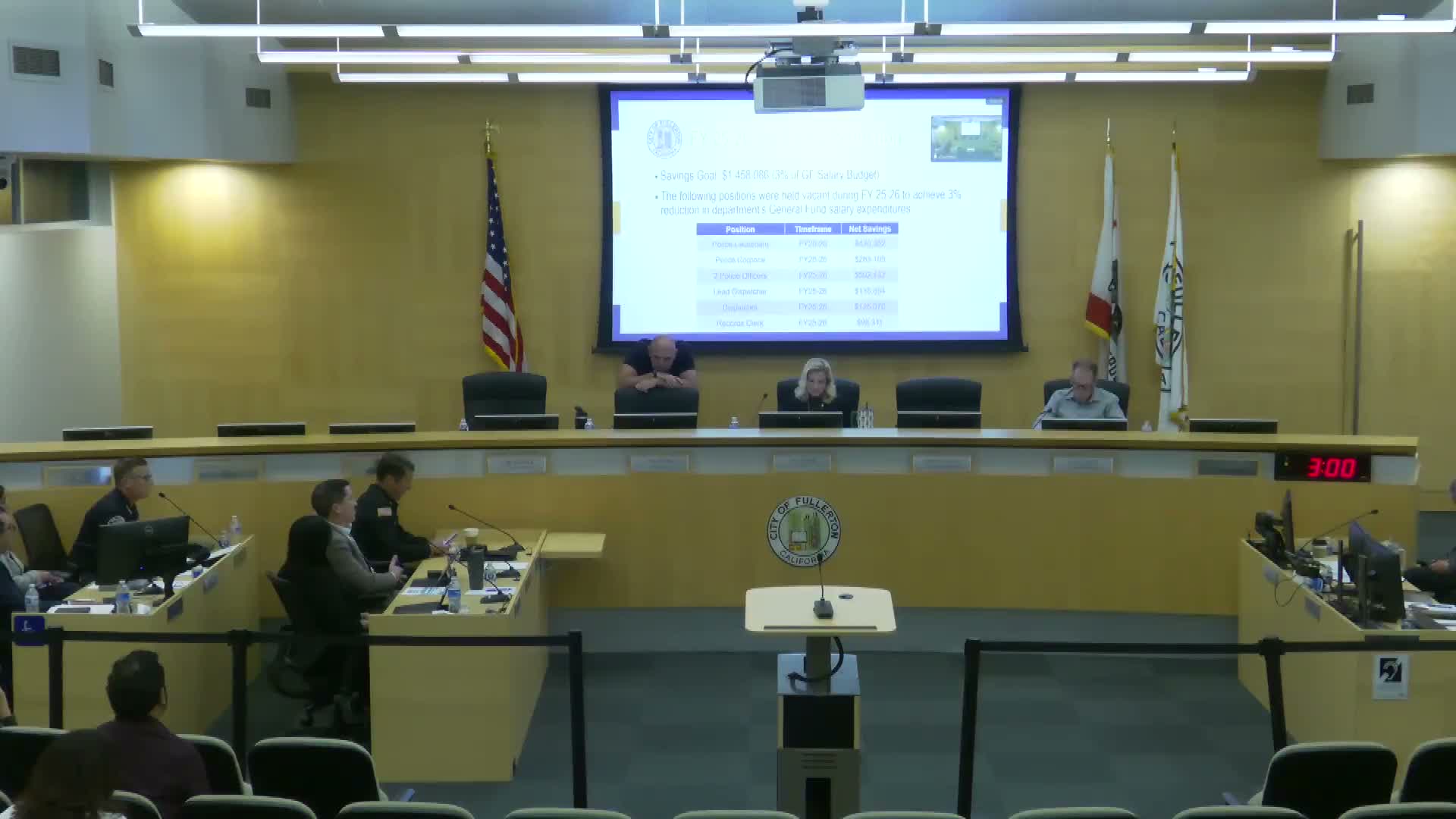
Police Chief John Radis told the ad hoc committee that the Fullerton Police Departments operating budget is primarily general fund and that about 74% of the departments operating budget is salary and benefits (approximately $52 million).
Radis said the department currently is budgeted for about 196 full-time positions and that it is holding about 10 positions vacant as part of recent cost-containment. He described units such as the gang unit, special investigations, mounted unit and a pair of behavioral-health clinicians funded through a county grant.
Explaining what a 5% reduction would require, Radis said the department had identified program cuts that would reach the target, but they would carry service implications. Among the items listed were forgoing "Operation Clean Streets" proactive enforcement, cutting crossing-guard services (Fullerton pays for 30 locations, about $550,000 total; a stated reduction would save roughly $244,000), and eliminating 10 police service representatives (PSRs). Radis said losing 10 PSRs would require closing the front desk and would shift many routine functions to sworn officers, substantially increasing response-time pressures.
"If we had to close our front desk, which would mean that our response times currently, the industry standard should be 5 minutes or less for a priority 1 call for service ... that number will skyrocket," Radis said, referencing recent monthly averages that hovered around four minutes 30 seconds for priority-one calls.
Radis also described deeper 10% scenarios that would force layoffs of sworn officers and closure of investigative units and possibly the department jail, which would shift arrestees to county facilities and increase officer time spent on transport and booking.
He framed the departments proposals as policy choices for council direction and said staff would provide more detailed metrics if council or the committee asked for modeled response-time impacts.
"Reductions are both mostly based on personnel savings. It would have an incredible impact on the police department, our operations, and mostly our service level to our residents," Radis said.