Get Full Government Meeting Transcripts, Videos, & Alerts Forever!
Get email alerts on the City Budget topic
No spam. Unsubscribe anytime.
Glendale council reviews FY26–27 budget as staff trim costs and seek new revenues to close multi‑year deficit
Summary
City staff presented a proposed FY26–27 general fund budget that incorporates department‑wide 5% baseline reductions, $29.5M in combined strategies that lower an anticipated $31.7M gap to roughly $2.2M, and a mix of one‑time transfers, fee increases and service adjustments to protect reserves.
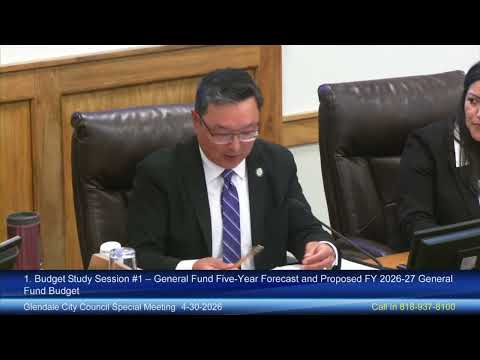
Glendale City Council members on April 30 reviewed the first of four budget study sessions covering the city’s proposed FY2026–27 general fund budget and a five‑year forecast that shows persistent structural deficits.
City Manager Golaniyan told the council he had directed a mandatory 5% reduction “across the board in general fund expenditures” for each of the city’s 14 departments, calling it a baseline requirement intended to stabilize near‑term finances. “This was not a suggestion,” he said, urging frank review of tradeoffs.
Finance Director Jack Glania outlined the process and schedule for four study sessions and said staff will seek adoption at a public hearing currently scheduled for June 23. Torina Cervantes Vasquez presented the third‑quarter update, reporting the city had received about $200,000,000 through March 31 (roughly 57.1% of expected receipts at that point in the fiscal year), year‑to‑date expenditures of $246,400,000 (≈68.9% of budget) and a revised FY25–26 surplus projection of $3.6 million, down from an earlier $6.3 million estimate.
Taken together, staff said, updated forecasting assumptions, cost reductions, revenue enhancements and limited service‑level additions reduce a previously projected FY26–27 shortfall from about $31.7 million to an estimated $2.2 million. Staff showed an ending FY26–27 fund balance of about $139,600,000, equal to roughly 37.4% of reserves (their stated reserve target is 35%).
The cost‑reduction package includes citywide measures and departmental adjustments: internal service fund rate reductions; delayed capital purchases; elimination or reallocation of staffing and subscriptions (examples cited include a reallocated administrative associate position and discontinued Treasurer software); and department‑level spending trims (community development, parks, library hours). Staff described a proposed reduction of certain auto allowances for inspectors and shifting some school crossing guard costs to a non‑general fund source rather than eliminating the service.
For pensions, staff proposed accelerating a Section 115 trust withdrawal: drawing roughly $5,000,000 per year from a trust currently near $49,000,000 to help cover pension costs during an anticipated peak in pension rates in 2031–2033. Finance staff described that as a multi‑year draw intended to smooth the near‑term spikes in pension expense.
On the revenue side, staff identified a list of concrete measures included or being pursued: a one‑time transfer of underused Fairmont property ($2.4 million), higher garage/lot parking fees (estimated $1.2 million), expanded occupancy tax collection, increased vegetation management fees (about $1.1 million), a concierge/express plan‑check fee (~$1.0 million), code enforcement fee adjustments (~$0.5 million), valuation of landfill gas (~$0.4 million), and digital kiosk revenue (~$0.3 million). Staff said some initiatives (for example, meter rate increases for on‑street downtown parking and a tourism business improvement district) are not yet included in the forecast because timing and estimates remain uncertain.
Council members pressed staff on which revenue items were already built into the forecast versus those that remain aspirational. Staff answered that the forecast includes measures that are far along and executable but excludes the full long list of possible revenue initiatives until estimates and implementation timetables are firmed up.
Several council members and the public raised concerns about service impacts. Library staff defended the proposal to consolidate or reduce hours at lower‑use branches, explaining the Chevy Chase branch’s card‑access pilot requires significant startup and recurring costs and that Adams Hill (a leased facility with low visits and a high cost per visit) was among locations identified for reduced hours or closure. Council members also cited aquatics programs and community events as services they hoped to preserve if possible.
Public safety topics surfaced in budget discussions: police staff outlined maintenance and operations reductions and said the department plans to gradually reduce helicopter air‑support spending as drone and other technologies mature. Interim Police Chief (name not specified on the record) said helicopters are not being immediately retired and that the department can sustain air support for several years while evaluating drone capabilities. Fire leadership described the Glendale Medic subscription (a voluntary household subscription currently $60) that waives transport fees for subscribers and said staff are reviewing ways to streamline enrollment and renewal.
Staff also proposed limited service‑level increases that add cost but support revenue generation or compliance (examples include expanded transient lodging tax enforcement, additional fire personnel tied to increased vegetation inspections, and an in‑car video/body camera contract for police). New personnel items listed in the proposal total about $2.6 million and include six firefighter positions, two fire inspectors, a groundskeeper, audit/compliance support and communications staff tied to grant and revenue work.
Council members asked for follow‑up detail: a breakdown of the $150,000 projected from changes to nonprofit subsidy policy, documentation showing which revenue initiatives are included in the forecast, the library‑hour and use‑per‑visit data that informed closure proposals, and legal advice on whether any fee or impact‑fee changes could be applied retroactively to entitled projects. Staff said those follow‑ups will be provided in upcoming study sessions.
Glendale staff recommended an overall discipline to avoid new cost additions and estimated the city needs roughly $10–$15 million in recurring revenue (staff suggested a working range of $10–$15M, while some council members discussed $13M) to return to a level reserve posture without further service reductions. The finance director reiterated that, absent significant stable new revenue, deeper cuts would begin to eliminate services that residents expect.
The council set the remaining study schedule (May 13: departmental/non‑general fund details; May 21: CIP and fee schedule; May 28: follow‑ups) and left a public hearing and adoption penciled for June 23. No formal budget adoption occurred at this meeting. The session adjourned at 10:49 a.m. following a motion to adjourn that was moved and seconded.
Sources: Council meeting transcript, Glendale City Council budget study session No. 1 (Apr. 30, 2026).