Get Full Government Meeting Transcripts, Videos, & Alerts Forever!
Get email alerts on the Open Meetings Law topic
No spam. Unsubscribe anytime.
City attorney briefs council on SB 707 changes to Brown Act; tech‑disruption policy to follow
Summary
Mission Viejo’s city attorney summarized SB 707 changes to the Brown Act that require remote‑participation policy, two‑way telephonic/AV systems with real‑time parity and tech‑disruption procedures; staff said a formal technology‑disruption policy will be returned for adoption before the July 1 compliance date.
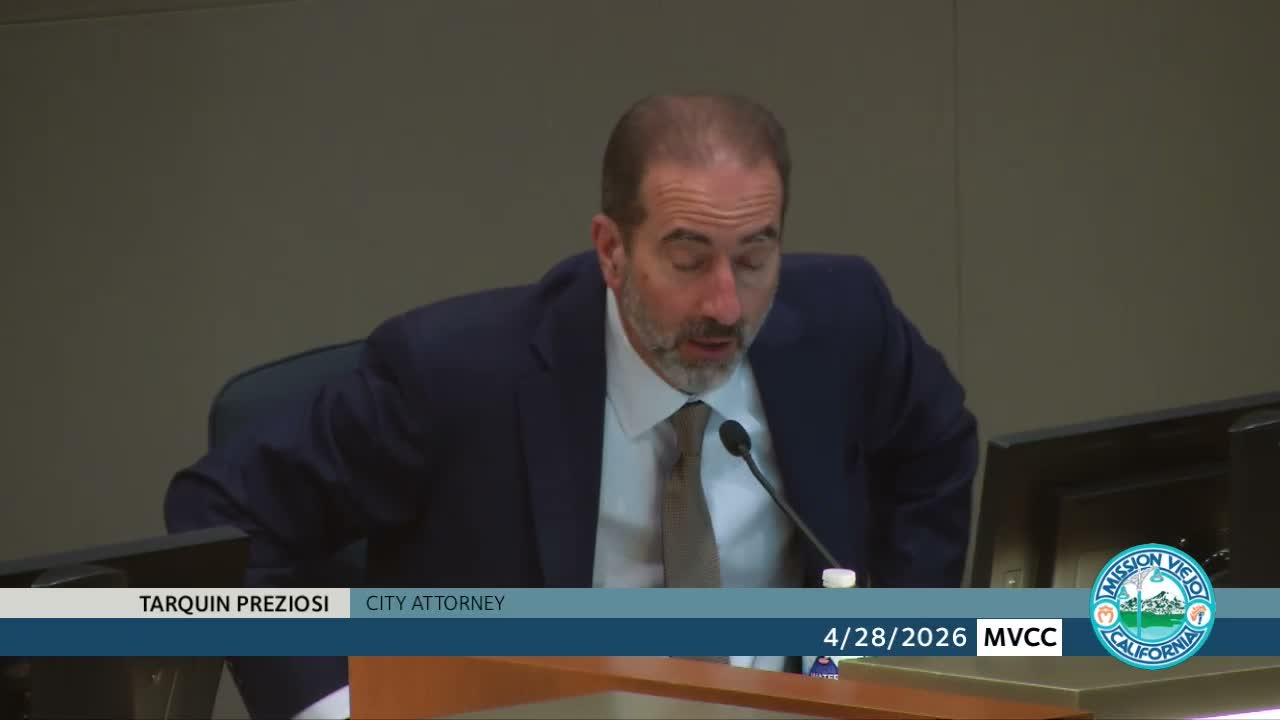
The Mission Viejo City Council received a detailed presentation on SB 707 and the Brown Act on April 28 from the city attorney, who described a broad set of new requirements that will take effect July 1 for eligible legislative bodies.
Key elements explained by the city attorney include: remote‑participation parity (the public must be able to participate in real time via a two‑way telephonic or audiovisual platform and receive the same time allotment for comment as in‑person participants), mandatory written policies for handling technological disruptions (including a required recess of at least one hour if remote access is lost, and a roll‑call finding if the service cannot be restored), and expanded teleconferencing options for members with qualifying disabilities or for just‑cause and emergencies with specified limits.
The attorney noted translation and webpage requirements apply to jurisdictions meeting certain ACS thresholds; Mission Viejo currently does not meet the threshold for required agenda translation. The new rules also require a dedicated meeting webpage, proactive outreach to underrepresented groups, and the ability to allow private translation by members of the public while disclaiming responsibility for accuracy of third‑party interpreters.
Staff said the city clerk and IT team are preparing a technology‑disruption policy and meeting‑procedure changes to return as an action item (not on consent) so the council can adopt required procedures before July 1. The attorney warned that SB 707 expands the Brown Act framework and thereby could increase the chance of litigation for noncompliance, but also noted the state provides a cure process that can avoid litigation if an agency corrects procedural failures.
What’s next: staff will present a technology‑disruption policy and administrative changes at an upcoming meeting; the council will need to adopt the policy as a regular‑meeting action item to comply with the statute.