Get Full Government Meeting Transcripts, Videos, & Alerts Forever!
Get email alerts on the Tourism Economy topic
No spam. Unsubscribe anytime.
Kem C. Gardner report: timed entry linked to lower Arches visits but countywide visitor spending rose
Summary
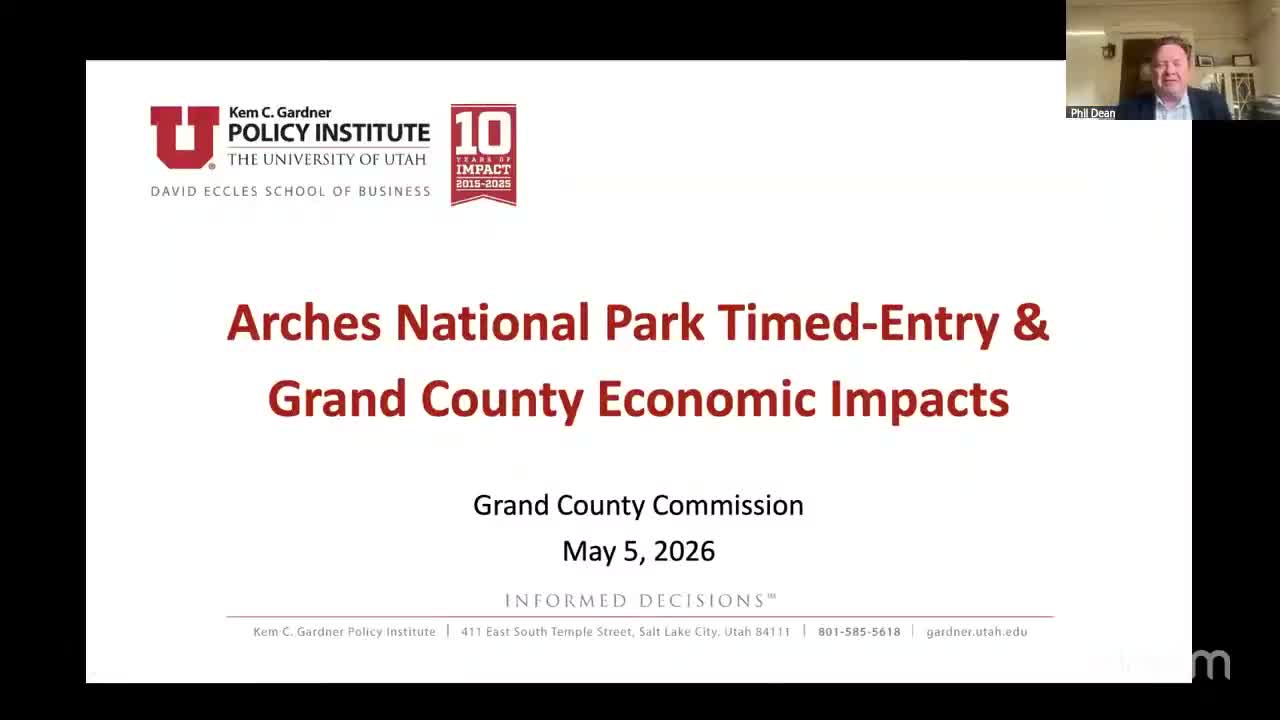
A Kem C. Gardner Policy Institute analysis presented to the Grand County Commission estimates Arches National Park visitation fell in the timed-entry period while countywide visitor spending and jobs increased; the institute said the park-level declines are model-based estimates and offered full data and slides to commissioners.
Phil Dean, research director and chief economist at the Kem C. Gardner Policy Institute, presented the institute’s analysis of Arches National Park’s timed-entry system and the broader Grand County economy. The institute compared a pre-implementation baseline (2017–2019) to a post-implementation window (2022–2024) and described a mix of observed data and model-based counterfactual estimates.
Dean told the commission that, in inflation-adjusted terms, average annual visitor spending countywide rose from roughly $373 million in the pre-period to about $456 million in the post-period, and that private-sector jobs were “almost 20% higher” than the pre-timed-entry baseline. He also said Arches itself saw lower visitation during 2022–24 (about a 9% drop compared with the immediate prior period), while visitation to other nearby national parks in the county increased.
On the counterfactual analysis designed to isolate the effect of timed entry, Dean said the institute’s best-fitting econometric model suggests a roughly 14% difference between what Arches visitation likely would have been absent timed entry and what actually occurred. He emphasized these are estimates: “We’ve given you our best thinking and analysis,” Dean said, adding that econometric models provide counterfactuals rather than statements of what definitively happened.
Commissioners asked for the precise counterfactual tables and the institute pointed them to appendix F (tables F3, F4) in the report and offered to deliver the slides and underlying figures by email. Commissioner Martinez requested the specific pre/post counterfactual dollar value referenced in the MOA; Dean said he would follow up with the appendix tables and email the mapping to the commission.
Why it matters: The institute framed its findings as a data point for county decisionmaking, not a policy prescription. The presentation shows countywide tourism indicators grew in aggregate even as Arches-specific counts declined, a distinction the institute stresses matters when evaluating local policy responses to timed entry. The institute offered to post the report and slides publicly and to answer written follow-up questions from commissioners.
What’s next: Dean offered to provide the detailed tables and slide packet to staff and the public; commissioners asked staff to attach the report to the meeting agenda and post it on county channels.