Get Full Government Meeting Transcripts, Videos, & Alerts Forever!
Get email alerts on the Maternal Health topic
No spam. Unsubscribe anytime.
OLO report shows persistent racial gaps in maternal and infant outcomes; Council chair demands 60-day HHS action plan
Summary
An Office of Legislative Oversight report found Black mothers and infants in Montgomery County face higher rates of severe maternal morbidity, cesarean delivery, preterm birth, low birth weight and infant mortality, prompting Chair Lori Ann Sales to request a written HHS action plan within 60 days and follow-up on program capacity, data and funding.
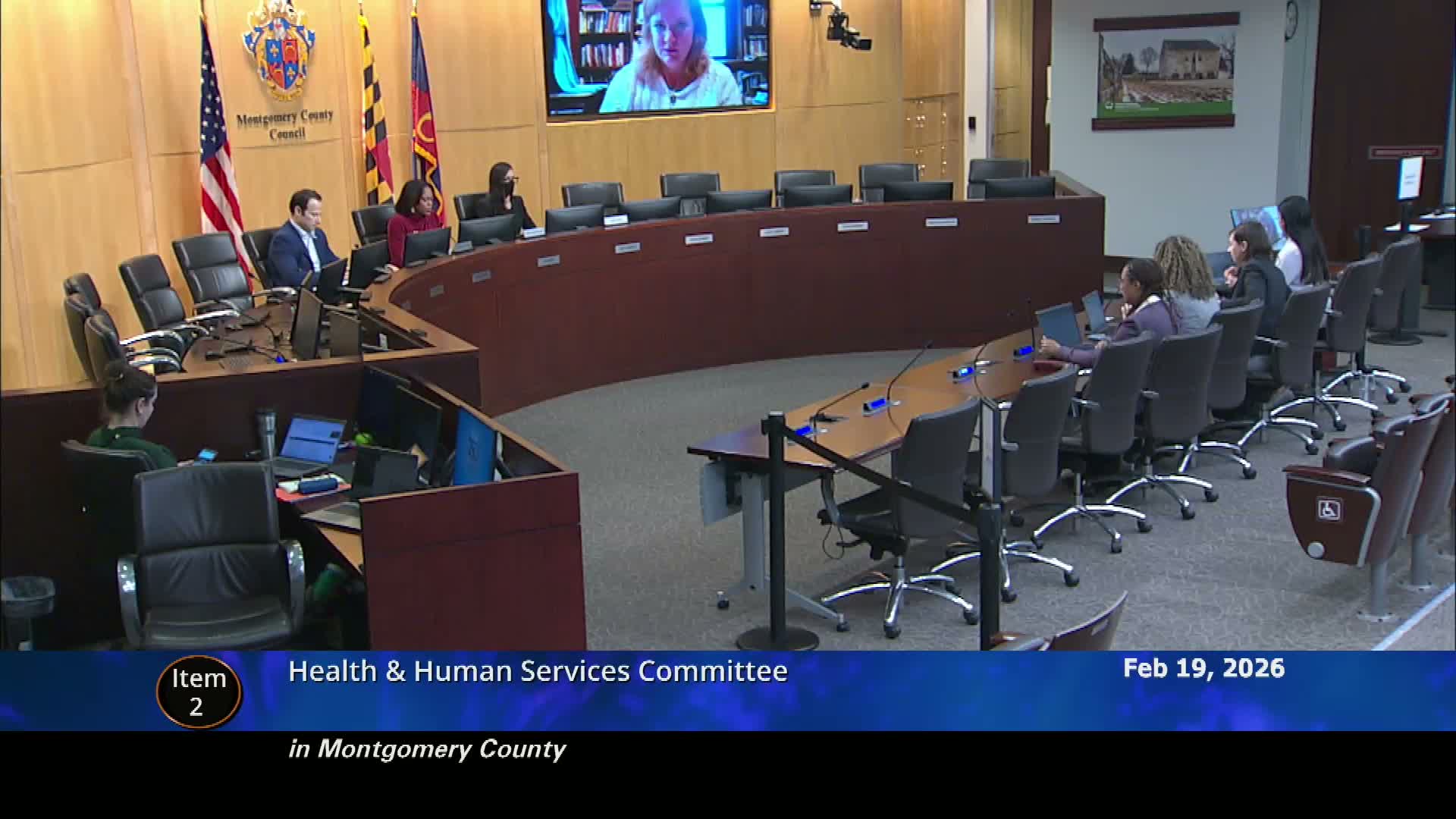
An Office of Legislative Oversight (OLO) report presented to the Montgomery County Health and Human Services Committee documented persistent racial disparities in maternal and infant health outcomes and prompted the committee to demand concrete, time-bound steps from county agencies.
Natalia Carrizosa of OLO summarized the report’s findings: "The U.S. has the highest maternal mortality rate of any high-income country and the infant mortality rate is also higher than most other high-income countries," she said, and OLO highlighted that Black and Indigenous mothers and infants suffer the worst outcomes locally. OLO analysts told the committee that disparities arise from three broad drivers: the legacy of racist pseudoscience, contemporary medical racism (including differential treatment and workforce gaps) and structural determinants of health.
Chitra Kelly Enderg, who presented local data, said county statistics show Black women in Montgomery County experience higher rates of severe maternal morbidity and adverse perinatal outcomes than white women — including higher cesarean rates (42% for Black women vs. 33% for white women), higher preterm and low-birth-weight rates, and higher fetal and infant mortality rates. OLO also reported that county home-visiting programs differ in size and outcomes: the Montgomery Perinatal Program (MPP) serves about 1,500 clients; Babies Born Healthy (BBH) served ~185 in FY24; and SMILE served ~254. OLO recommended deeper evaluation of program outcomes and increased alignment with promising models.
HHS leadership responded with program updates and near-term changes. Dr. Nina Ashford, the county’s Chief of Public Health Services, and Dr. Kisha Davis, the county health officer, described funding structures, noted shifts after Medicaid expansion, and said the department is piloting a standardized home-visiting curriculum (MIHOW) across programs. Dr. Ashford said HHS has an existing community action team that reviews fetal, infant and maternal mortality and that recommendations flow into program improvements.
Committee members pressed HHS on outreach (how the department identifies and contacts Medicaid-eligible pregnant people), data integration (possible CRISP access), capacity to pay for doulas, and the limited midwifery workforce. Members also flagged the BBH program’s notably low cesarean rate for its cohort and asked whether additional county funding could be immediately put to use to scale that program. HHS said that additional funding could be absorbed to make some split-funded positions full-time and to add a social-worker or mental-health navigation capacity for BBH clients.
Chair Lori Ann Sales closed the session by requiring a written HHS action plan within 60 days that outlines specific steps, timelines, budget estimates and measurable metrics addressing OLO’s recommendations. The chair also requested a written services plan for the approved Affordable Living Quarters project, including remediation and air-quality status and a referral process developed with people with lived experience.
What happens next: HHS and DGS are expected to provide the committee with the requested written plans and documentation; the committee indicated it will use those materials to inform budget and capital-investment decisions.