Get Full Government Meeting Transcripts, Videos, & Alerts Forever!
Get email alerts on the Local Economic Development topic
No spam. Unsubscribe anytime.
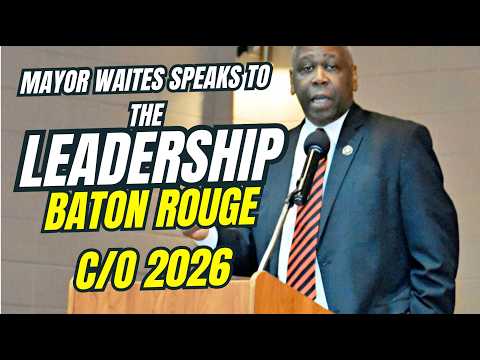
Alvin Baker tells Leadership Baton Rouge class Baker is 'moving forward,' cites infrastructure, schools and youth sports
Summary
Alvin Baker spoke to the Leadership Baton Rouge class about his path from military service to local leadership, the 30-day flood that affected much of Baker, and a series of infrastructure and youth-sports projects he says are driving housing and business growth.
Alvin Baker spoke to the Leadership Baton Rouge class about his personal journey and how deliberate local investments have shaped economic growth in Baker.
Baker, who said he left Jacksonville, Florida, to join the Army at 21 and served 27 years, framed his public service as a response to personal challenges and a belief in steady work and networking. "It's not where you come from, but it's where you're going," he told the group, explaining how he moved from volunteering in schools to local government.
He described an early crisis in office: "30 days in office, we had a flood. We lost 60% of that city," Baker said, presenting the disaster as a defining test that shaped the city's recovery priorities. He credited persistent outreach to state lawmakers and strategic infrastructure work for later progress.
To attract development, Baker recounted using municipal resources and bond funding to extend water, sewer and gas across a nearby 55-acre parcel and to build a water tower. He said those moves—plus a fire station funded with help from Senator Kennedy—set the stage for housing growth just outside Baker: "Now they got 1,000 homes being built over there," he said, noting Baker supplies utilities to the area.
On education and housing, Baker discussed the city's independent school district and efforts to maintain the high school’s viability by coordinating K–8 enrollment flows. He said charter schools’ growth prompted new strategic conversations and that the city used infrastructure and outreach to persuade developers to invest.
Baker emphasized youth sports as an economic strategy. "I tore [the Little League field] down ... I went and found $400,000 to rebuild it and put a rug on it," he said, describing plans for a three-field complex he discussed in Washington aimed at bringing year-round visitors, hotels and restaurants.
Throughout his talk Baker framed leadership as sitting "at the table" and building relationships across party lines to get results for residents, saying local leaders must be present where decisions are made. He closed by reiterating priorities—economic development, good schools and good housing—and urging persistence in community work.
The remarks combined personal history with concrete examples of municipal projects Baker said drove recent housing and recreational development in and around Baker. No formal votes or legislative actions were taken during the talk; Baker answered at least one audience question about the school district's history and strategy.