Get Full Government Meeting Transcripts, Videos, & Alerts Forever!
Get email alerts on the Municipal Liability topic
No spam. Unsubscribe anytime.
Alabama Supreme Court hears dispute over city duty after recurring home flooding
Summary
The Supreme Court of Alabama heard arguments in City of Mountain Brook v. Rodney and Mary Leah Miller over whether a city's easement and state statute create a duty to prevent stormwater from overflowing onto private property; the trial court awarded roughly $80,000 and a permanent injunction, and the high court took the case under submission.
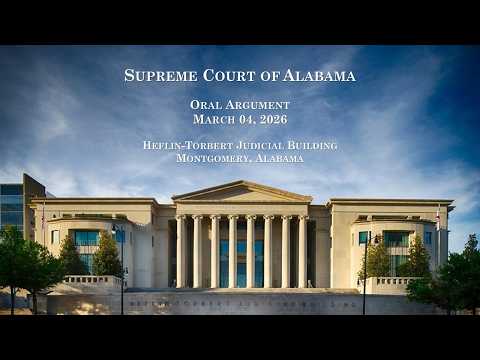
The Supreme Court of Alabama heard oral argument in City of Mountain Brook v. Rodney and Mary Leah Miller, a dispute over whether the city’s rights to operate stormwater infrastructure through a private easement trigger a legal duty that can overcome municipal substantive immunity.
At oral argument, Ben Presley, attorney for the City of Mountain Brook, told the court the trial court erred by relying on Beatty (1974) and imposing an effective strict-liability standard. Presley said the city holds a dedicated easement and exercises authority under a code provision referenced throughout the argument as “11 50 50,” so the proper standard for municipal conduct is negligence. Presley added that a post-flood video inspection showed the pipe at issue was clear and not blocked, and he urged the court to limit liability to negligent maintenance rather than design or policy decisions.
Rodney Miller, the homeowner and appellee, said the city’s drain system floods his house at 2801 Montevallo Road and that the city’s inlets and pipe have repeatedly overflowed outside the easement. Miller told the court the home had flooded multiple times—he said this was the seventh time in two years—and framed his claims as nuisance and trespass arising from the city’s easement duties. “Every bit of water that came onto our property that day came out of their drainage,” Miller said, urging the court to recognize an easement-based duty distinct from immunity for general public services.
The lawyers and justices discussed whether Beatty is distinguishable because it involved a prescriptive easement, while Mountain Brook holds a dedicated easement and statutory authority to construct stormwater infrastructure. Counsel also debated how recent substantive-immunity decisions—cited in argument as Rich and in ex parte City of Orange Beach and other cases—fit with longstanding lines of authority holding municipalities liable for failing to maintain drainage systems.
The parties disputed the practical effect of a permanent injunction. The Millers prevailed at trial, which awarded approximately $80,000 in damages and ordered injunctive relief; the trial court also cited a Shoal Engineering three-phase remediation plan with a preliminary cost estimate of about $3.9 million. Presley warned the court a mandatory injunction could require costly, repeated engineering work and might simply expose the city to additional rounds of liability if future storms overwhelm upgraded pipes.
Justices asked both sides whether the core claim sounds in negligent maintenance (which courts have treated differently) or in design and construction (which can be time-barred and treated as policy choices). Miller argued that Beatty and other precedent create a duty for an easement holder not to overflow onto adjacent property, while the city argued that when municipal functions and policy trade-offs are at issue, substantive immunity principles should limit remedies.
The court took the case under submission after questioning and argument. No decision was announced. The court then adjourned.
What happens next: The Supreme Court will issue an opinion resolving whether the easement and related case law permit relief on nuisance and trespass claims without displacing municipal substantive immunity. The record shows the underlying flooding event occurred on 05/15/2023 and that the trial court awarded about $80,000 and permanent injunctive relief to the Millers; the high court’s ruling could affect similar easement-based drainage claims statewide.