Get Full Government Meeting Transcripts, Videos, & Alerts Forever!
Get email alerts on the Local Sales Tax topic
No spam. Unsubscribe anytime.
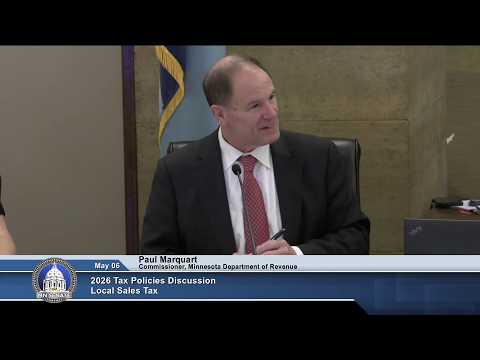
Senate briefing lists dozens of local-option sales tax proposals in omnibus tax bill
Summary
A Minnesota Senate briefing reviewed the omnibus tax bill’s local-option sales tax provisions, listing city-specific projects, funding amounts and termination dates and prompting House–Senate coordination and debate over referendum and statutory compliance.
The Minnesota Senate tax briefing on local-option sales taxes reviewed dozens of city-level proposals included in the Senate omnibus tax bill, outlining project authorizations, funding amounts and termination timelines and prompting House–Senate coordination on which items each chamber has heard.
The committee chair opened the session with an overview of three clusters in the bill: general local-sales-tax authorizations for capital projects; a boundary modification for a downtown taxing area (a provision the presenter cited as bill 4872); and multiple Saint Paul provisions dealing with the Xcel Energy Center and the RiverCenter complex, including increases to bondable amounts and extensions of sales-tax termination dates.
A presenter listed individual Senate files and the projects they would finance. For example, committee members described Senate File 4355 (a Doornick proposal) that would let Albert Lea extend a half-cent sales tax to raise $20,000,000 for Shell Rock Watershed District water-quality improvements, $9,300,000 for the Songbird Trail, $4,500,000 for library improvements, $4,700,000 for the Snyder Field Complex and $1,500,000 for Myrtle Field at Edgewood Park, with the tax to terminate after the earlier of 30 years or when sufficient funds are raised. Another example: Senate File 3689 (Doornick) seeks $28,000,000 for an Austin law enforcement center with a 20-year cap, while Senate File 4709 (Heintzeman) would extend Baxter’s half-cent sales tax to fund $67,000,000 for wastewater and water systems and $10,000,000 for a public facility over a 20-year maximum.
The briefing covered dozens of other local projects: Elk River’s authorization to finance a $20,000,000 fire station using its existing half-cent tax (SF 4831); Sauk Center’s increase in bonding for Trunk Highway 71 (SF 4539); Edina’s package including a new public safety facility and Bremer Ice Arena (SF 5065); a Cloquet Area Fire District tax to fund ambulance and fire station construction (SF 4188); Douglas County’s authorization to impose a quarter-cent tax for a new library (SF 4181); and a set of smaller-city proposals for parks, community centers and public-safety facilities spread through the omnibus document.
The committee also flagged at least two procedural items: section 44 (Osseo, SF 3709) will be deleted at the author’s request when the omnibus bill reaches the floor, and Senate File 2657 (Pappas) would exempt the City of Saint Paul from the statutory requirement that modifications to a local sales tax be preceded by a local resolution submitted to tax committee chairs and ranking members; SF 2657 would instead allow modifications to the half-cent Saint Paul local sales tax to proceed subject to voter approval without the usual resolution submission.
House members present compared the Senate list with the House’s proposals and read a corresponding House Republican list, identifying many overlapping cities and noting several modifications. A House Republican lawmaker said the House approach inserts referendums or project caps in several bills where the Senate bills either lack a referendum or have different scope.
A staff member pointed the committee to statutory constraints in chapter 297A.99 — including resolution-submission schedules, limits on the number of capital projects, definitions of permitted capital projects, and referendum timing — and warned that several proposals appear to violate those limits, urging compliance.
The briefing concluded with committee members stressing the need to produce a tax bill, consider federal conformity where appropriate and continue House–Senate coordination; the panel agreed to reconvene to reconcile differences and next steps.
The session provided a detailed inventory of local-option sales tax proposals in the Senate omnibus tax bill, but produced no formal votes or final actions during the briefing.