Get Full Government Meeting Transcripts, Videos, & Alerts Forever!
Get email alerts on the Infrastructure Sewer topic
No spam. Unsubscribe anytime.
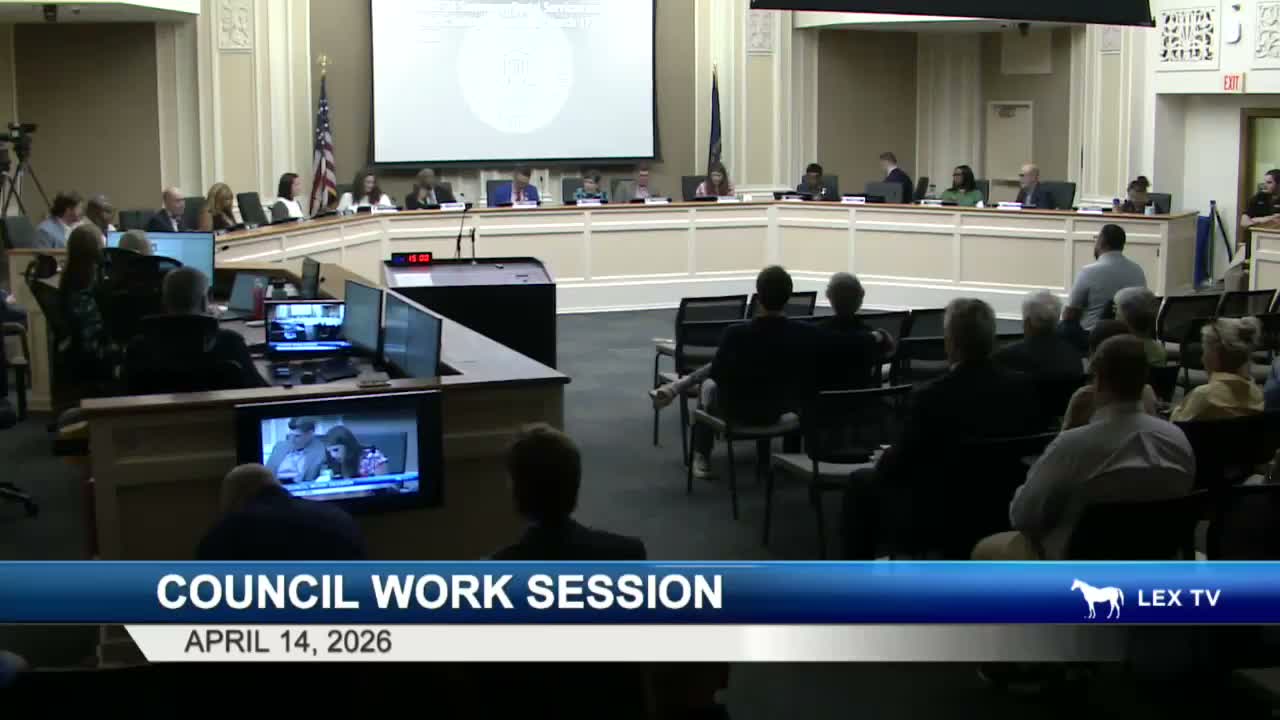
Lexington council splits over whether to move Mint Lane pump station; motion to authorize easement talks at Dunbar fails 9–4
Summary
After hours of public comment and a technical presentation, city staff detailed three options for handling the failing Mint Lane (Mid Lane) pump station. Council declined a motion to authorize negotiations at the existing Dunbar site; members asked for the full engineering report and a follow‑up work session.
The Lexington‑Fayette Urban County Council on April 14 wrestled with a technical and political choice over where to fix a failing sewer facility after a lengthy public‑comment period and an engineering presentation by acting water‑quality commissioner Charlie Martin.
Public commenters were sharply divided. Opponents of moving the facility outside the urban service boundary (USB) warned that relocating a pump station to Bowman’s Mill Road would set a “slippery slope” precedent for sprawl. John Phillips of the Lexington Frankfort Scenic Corridor said placing a new station outside the USB “is a horrible precedent.” Several speakers representing farming and conservation interests urged keeping infrastructure inside the USB to protect farmland and the Bluegrass landscape.
Supporters of relocation — including Price Bell of Mill Ridge Farm and his family — argued the Bowman’s Mill site is technically superior and could unlock a state‑funded wetland restoration on Mill Ridge that officials said depends on moving the pump station. Beth Bell, representing Mill Ridge Farm, said Kentucky Fish and Wildlife “is prepared to restore nearly 25 acres of floodplain wetlands along a linear mile of Cave Creek on our property” using wetland mitigation fees and that “the conservation easement cannot be finalized while the existing pump station sits within the project area.” Price Bell told the council that the existing Mid Lane station has overflowed repeatedly: “Nearly 13,000,000 gallons of untreated sewage have been discharged onto our farm and into Cave Creek.”
Commissioner Martin’s presentation summarized an engineering study of three options: rehabilitate the existing Mid Lane/Dunbar pump station, build a new facility at a Bowman’s Mill site downstream, or route to a more distant airport site. Martin said the Dunbar rehabilitation estimate was roughly $19.6 million versus about $24.9 million for the Bowman's Mill option (estimates rise further if the downstream site is sized to serve a larger drainage area). He cautioned that the airport option was far more expensive and likely too slow to meet the city’s federal consent‑decree schedule. He also highlighted constructability risks at Dunbar (karst, sinkholes, floodplain constraints) and at the other sites (easement negotiations, impacts to springs, pipeline length and cost).
Council debate mixed technical questions (land acquisition assumptions, capacity, odor control, springs and pipeline routing) with policy concerns about whether infrastructure placement should affect future USB expansion. Several council members said they wanted the full written engineering report before taking binding steps. Council Member Sam Dunn and others stressed neighborhood odor impacts known locally as the “Dunbar funk,” while others, including Council Member Lee Neland, urged following engineering judgment rather than messaging from either side.
Council Member Boone moved to authorize and direct the Division of Water Quality to proceed with negotiations for easements and take preliminary steps toward implementing the Mid Lane Pump Station Sewer Project at its existing location adjacent to Dunbar High School. After extended discussion and public comment, the motion failed on a 9–4 vote. A subsequent motion to refer the matter back to the Environmental Quality and Public Works committee also failed 9–4.
Next steps: Commissioner Martin told council he would distribute the full engineering report "posthaste" — likely by the end of the week — and council members agreed to schedule a follow‑up work session (target April 28) to hear the completed report and additional public commentary before any final action.
Why it matters: The decision will determine where the city invests tens of millions of dollars to meet EPA consent‑decree obligations to reduce sewage overflows and will affect wetland restoration opportunities, future development pressure near Lexington’s urban edge and the long‑term costs and risks of the sanitary‑sewer system.
What the council voted on: The motion to authorize property negotiations and preliminary work at the existing Dunbar/Mid Lane site failed 9–4. Council did not take a final site‑selection vote; the engineering report and a second work session have been scheduled to inform a later decision.
Documentation and quotations above are drawn from council members, public commenters, and the Division of Water Quality presentation during the April 14, 2026 work session.