Get Full Government Meeting Transcripts, Videos, & Alerts Forever!
Get email alerts on the Transportation Pedestrian Safety topic
No spam. Unsubscribe anytime.
Mankato officials approve plan to pilot leading pedestrian intervals this fall
Summary
City staff proposed a two'phase plan to pilot leading pedestrian intervals (LPIs) at high'crash corridors, with a feasibility report and pilot implementation targeted for the start of the 2026 school year and a citywide policy to follow in 2027; council members urged staff to accelerate public outreach and deployment where feasible.
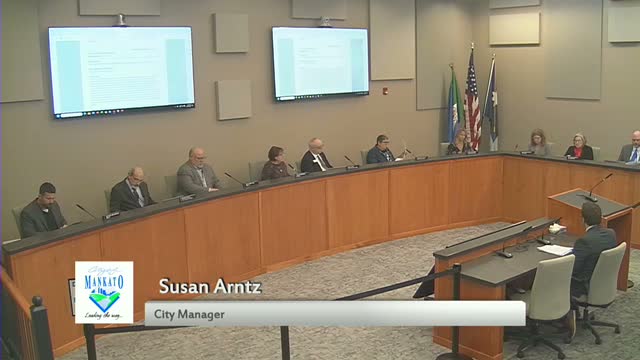
City Engineer Corey Bienfang presented a two'phase plan to the Mankato City Council to test leading pedestrian intervals, a signal timing change designed to give pedestrians 3 to 7 seconds of advanced walk time at crossings.
Bienfang told council members the goal of Phase 1 is a feasibility analysis and a pilot implementation at prioritized intersections, with deliverables that include a feasibility report, a ranked list of pilot sites and an education campaign. "The goal in phase 1 here would be implementation of LPIs via pilot project," Bienfang said, adding that the city would target pilot operation by the fall 2026 school year.
The recommendation calls for a Phase 2 evaluation and the development of a formal city policy in 2027 that would summarize pilot results, public feedback and proposed policy language. Bienfang said staff will prioritize corridors that show higher rates of bicycle and pedestrian crashes and noted the pilot will be button'activated at intersections where appropriate. "LPIs are a safety mechanism for pedestrians in crossings," he said.
Council members pressed staff on timing and potential traffic impacts. Council member Lavin asked whether removing or modifying an LPI at a single intersection could harm corridor signal synchronization; Bienfang said such tradeoffs would be considered and that the pilot would avoid changes that require major infrastructure upgrades. Council member Tampa and others urged faster action: Tampa said city staff should accelerate implementation where possible, and Council member McLaughlin said he would not oppose the pilot "if it's done by August 1" to allow public adjustment before school starts.
Staff emphasized that public education will be a significant component of Phase 1, including public meetings, social media, and targeted outreach to drivers and pedestrians. Bienfang said the pilot'site selection would incorporate heat'map crash data and advocacy group input.
The council did not take a formal vote to adopt policy but agreed to move forward with the Phase 1 feasibility and pilot work and asked staff to report back with recommended pilot locations, evaluation criteria and an outreach plan.