Get Full Government Meeting Transcripts, Videos, & Alerts Forever!
Get email alerts on the Hangar Development topic
No spam. Unsubscribe anytime.
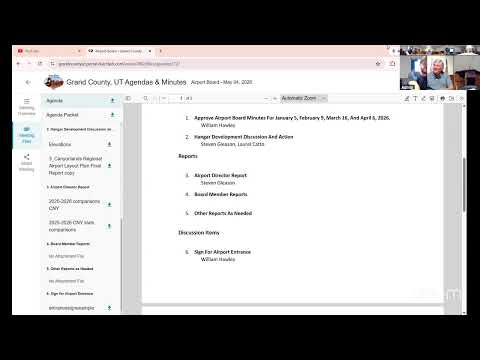
Airport board backs developer to advance Phase 2 hangar lease; staff to draft lease for BOCC review
Summary
The airport board agreed to let a private developer continue work on a Phase 2 hangar project and asked staff and county attorneys to finalize lease language and plans for referral to the Board of County Commissioners for formal approval.
Laurel Caddo, a hangar developer who said her company built a prototype 63-by-70-foot hangar at Canyonlands in 2023, won board agreement to move forward with plans for additional hangars at the airport.
The board’s chair asked for a consensus that the developer could advance drawings and lease negotiations; the board recorded a voice vote approving the move to draft lease language and bring a formal lease to the county commission for final action. "So what I would like to do then is just have an agreement, from the board here that we are okay with Laurel's plan going forward," the chair said, and members responded in the affirmative.
Why it matters: the project would add hangar capacity on new taxiways and create a county lease revenue stream while requiring coordination on utilities, fees and permitting. Caddo told the board Phase 1 — a set of duplex hangars — is sold out and that the Phase 2 package includes T-type hangars adjacent to an existing tenant (Plain Lucky) and a triplex prototype; she said lead time on the triplex order is about 24 weeks and that two units have been presold.
Key details discussed included hangar dimensions and capability (example: 60-foot doors, 18 feet high, accommodating wingspans up to roughly 55 feet), site-footprint options for T-hangars and triplex units, and a linear footage ("footage") charge tied to Taxiway F. The applicant and staff discussed a working figure of about $231 per linear foot for that footage charge as a staff estimate and noted that the board could refine the methodology (for example, prorating by asphalt square footage) before any final fee is locked into a consolidated fee schedule.
Board members and staff emphasized utilities as a gating item. The airport currently lacks full water and sewer to the proposed pad sites; staff said the county’s consultant Lochner will prepare a utilities plan that will drive how trunk infrastructure is built and funded. The applicant said she will "stub in" service lines to individual hangars during construction so future tie-ins are possible, but both sides acknowledged that funding and a timing plan for larger mains and treatment/collection would be required before permanent connections were completed.
The board instructed staff and the county attorney to draft lease language that incorporates agreed elements (including any square-footage vs. linear-footage fee language discussed) and return the package for formal countycommission consideration. The board’s vote on moving the proposal forward was by voice and recorded in the meeting; the minutes will include the official mover/second and roll-forward details.
Next steps: staff will work with the developer and county attorneys to circulate final plans and a lease for review; if the BOCC approves, construction and formal lease execution will follow the county’s permitting and utility-planning timeline.