Get Full Government Meeting Transcripts, Videos, & Alerts Forever!
Get email alerts on the Land Use topic
No spam. Unsubscribe anytime.
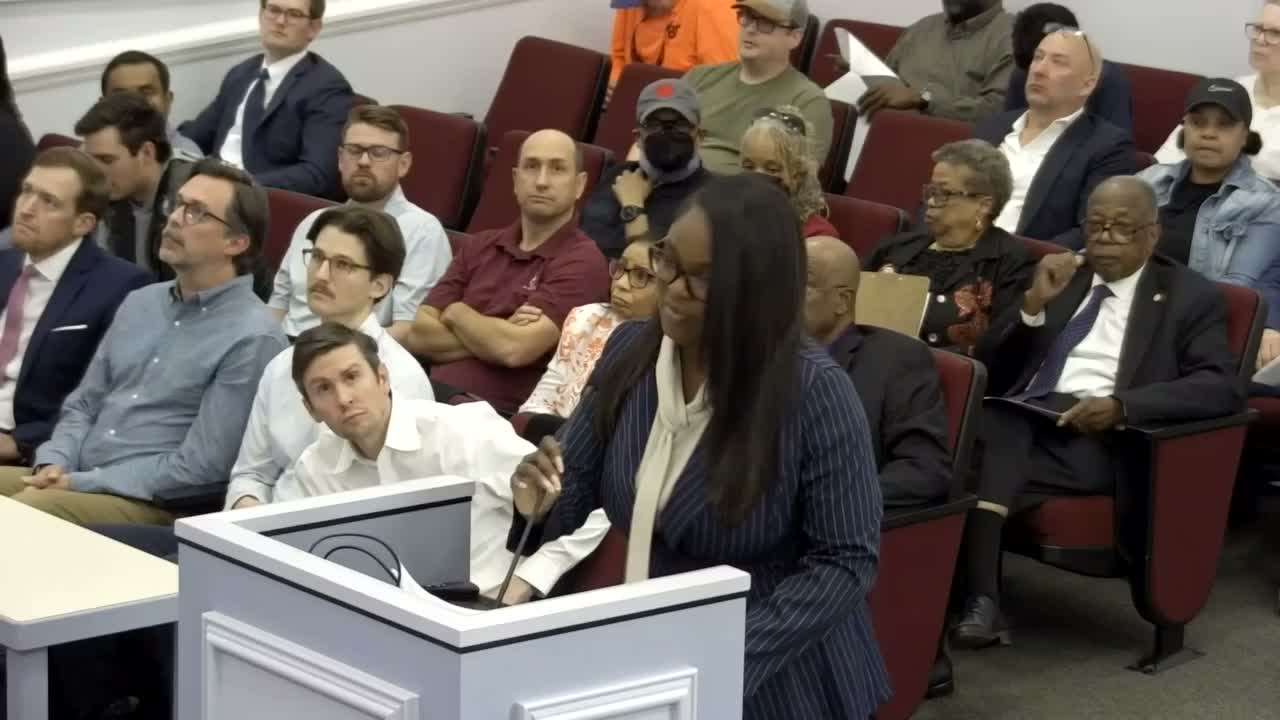
Residents press Rockdale County commissioners over Treaty Oak battery‑storage rezoning; no vote taken
Summary
At a March 26 zoning hearing, residents opposed a proposed 48.48‑acre Treaty Oak battery energy storage system (BESS) near Farmer Road, citing safety, water and property‑damage concerns. Planning staff and the developer outlined 19 recommended conditions and economic benefits; the board took no final vote and the matter will return for future consideration.
At a March 26 Rockdale County zoning public hearing, the Board of Commissioners heard more than an hour of testimony on a rezoning request from R‑1 to M‑2 to allow a 48.48‑acre battery energy storage system (BESS) proposed by Treaty Oak (applicant represented by Trio). Planning staff presented the case and recommended approval subject to 19 conditions, and the applicant defended the project’s safety and economic benefits. The board did not take a final vote.
The project (REZ‑2025‑13 / Future Land Use Map amendment 2025‑07) would convert the site at 2002 Rockbridge Road NW and Farmer Road from medium‑density residential to Technology Park and permit a containerized BESS on roughly 48.48 acres, of which staff said about 7 acres (14%) would be impervious and the remainder preserved or forested. Planner Ryan Sadler told commissioners the development would include a 100‑foot undisturbed buffer adjacent to residential properties, traffic and noise studies, stormwater controls, an operation and maintenance plan, and a decommissioning plan among the 19 recommended conditions.
Why it matters: the applicant said the 200‑megawatt facility would store electricity for use during peak demand, improve grid stability and could produce an estimated $45 million in property‑tax revenue over the project life. Supporters said the project helps integrate more renewable energy and offers long‑term local revenue. Opponents said the project threatens neighborhood safety, health and property values and questioned who benefits.
“Every time they blow up something in the ground, another part of my house falls apart,” said Quaylee Simmons, who told the board that construction near an existing data center had caused cracks, a failing ceiling and murky lake water near her home. “Who’s gonna pay for that to get fixed?”
Residents also repeatedly linked emotional and safety concerns to recent chemical fires and blasting in the area. Linda Akins Young, a lifelong Farmer Road resident, told commissioners the community has suffered “biolab fires, evacuations, and air contaminations on several occasions” and urged denial or a stronger moratorium.
Applicant and utility defenders pushed back with technical and economic arguments. Patrick Duffy, speaking for Treaty Oak, said the project is a BESS — not a data center — and emphasized community outreach that included two open houses, 8,400 mailers and certified letters. Duffy said the company has engaged Rockdale Fire Rescue, will meet NFPA guidance and UL test protocols, and intends to sign a reimbursement agreement to cover extraordinary public‑safety costs if an incident were caused by the project.
Josh Cherry, the applicant’s technical representative, said the site was chosen to interconnect to a Georgia Power 115‑kilovolt switchyard and to sell energy to local provider Snapping Shoals EMC, not to serve adjacent industrial neighbors. On safety, Cherry said the facility uses lithium‑iron‑phosphate chemistry and industry testing (UL 9540A); he described an emergency‑response approach in which a small, contained battery cell fire would be monitored and allowed to burn to completion under a defensive posture to avoid unsafe water runoff. “These things are designed to fail safely,” he said.
Supporters included Chris Wood of Snapping Shoals EMC, who described grid benefits and peak‑shaving uses for batteries, and Amal Nike (former Atlanta chief resilience officer), who cited clean‑energy and resilience gains and repeated the applicant’s tax‑revenue estimate.
What the board did: staff closed the public‑hearing portion and declared the item complete for tonight; no vote was taken. Staff and applicants offered to remain after the hearing to address residents’ questions. Planning staff said applicants intend to return in July and that the county’s moratorium on data‑center approvals is guiding next steps.
Next steps: the rezoning will appear at a future Board of Commissioners meeting for formal action after the public‑hearing process continues. Residents were told they can submit written comments and speak to staff or the applicant at post‑meeting gatherings.
Sources: planning presentation by Ryan Sadler, applicant presentations by Patrick Duffy and Josh Cherry, public comments from Quaylee Simmons, Linda Akins Young, Eugene Nixon and others at the March 26 Rockdale County Board of Commissioners zoning public hearing.