Get Full Government Meeting Transcripts, Videos, & Alerts Forever!
Get email alerts on the Retroactivity Sentencing Beck topic
No spam. Unsubscribe anytime.
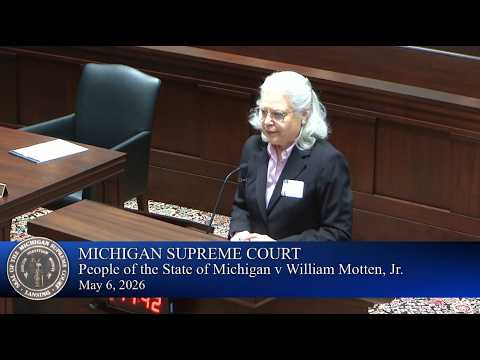
Court Hears Arguments on Applying People v. Beck Retroactively in Morton Sentencing
Summary
At oral argument, defense counsel urged the court to apply People v. Beck retroactively to William Morton Jr., arguing that the rule categorically bars using acquitted conduct to increase sentences; the prosecution urged Teague-style limits and defended the trial court’s OV3 scoring. The justices took the matter under advisement.
The state supreme court heard oral arguments in the appeal by William Morton Jr., whose attorneys asked the court to apply People v. Beck retroactively and vacate a sentence they say relied on conduct for which juries acquitted him.
Laura Kathleen Sutton, counsel for William Morton Jr., told the court that Morton underwent three jury trials and that, while he was acquitted of murder in at least one trial, the sentencing record shows the trial judge used acquitted conduct to score offense variables. Sutton argued that People v. Beck established a substantive rule protecting the presumption of innocence under the Fourteenth Amendment and the Michigan Constitution and that the state court should give Beck full retroactive effect so that Morton’s sentence be reconsidered.
Sutton acknowledged that Beck’s practical reach may be limited in some cases but said the principle is straightforward: courts may not rely on acquitted conduct to increase a sentence because doing so infringes core due-process protections. She cited several federal and state precedents and asked the court to overturn the appellate ruling and remand Morton’s case for resentencing or a new proceeding.
Representing the Wayne County prosecutor, Tim Boffman argued the court should apply traditional retroactivity frameworks such as Teague and the Michigan test for retroactive application of new rules. Boffman told the court that many of the defense’s cited authorities are distinguishable, defended Judge Jackson’s sentencing remarks as not establishing a basis for reversal, and said the OV3 scoring here was legally permissible under the applicable standards for assessing causation and offense-variable scoring.
Boffman also urged the court to limit any retroactive application where finality and settled precedent counsel against broad retrospective relief, and he asked the court to decline the defense’s request for a wholesale, retroactive extension of Beck.
In reply, Sutton reiterated that the record shows use of acquitted conduct in a way that Beck prohibits and urged the court to remand for further proceedings. After questioning and limited back-and-forth, counsel for both sides rested and the court took the case under submission.
The court’s decision will determine whether Beck’s bar on using acquitted conduct in sentencing applies to Morton and similarly situated defendants and may affect how sentencing guidelines and offense-variable scoring are applied in future Michigan cases.