Get Full Government Meeting Transcripts, Videos, & Alerts Forever!
Get email alerts on the Dhs Whistleblower Testimony topic
No spam. Unsubscribe anytime.
Whistleblowers tell House committee DHS ignored fraud tips, suppressed investigations
Summary
Whistleblowers and former DHS staff told the House Fraud Prevention and State Agency Oversight Committee that DHS tip lines are fragmented, reports of abuse were sometimes handled with form letters, and senior officials ordered edits to investigator findings; witnesses detailed childcare fraud red flags and forensic evidence tied to high-dollar providers.
Whistleblowers and former Department of Human Services staff told the House Fraud Prevention and State Agency Oversight Committee on May 5 that long-standing program vulnerabilities allowed large-scale fraud in childcare and Medicaid and that some agency responses to reports were inadequate.
Faye Bernstein, who said she currently works at the Department of Human Services, told the committee DHS operates two major tip lines (an OIG line and a central office line) that are logged but also many smaller program-specific email addresses that are not. "We probably have too many tip lines," Bernstein said, adding that the multiplicity makes it hard for employees and the public to know where to call. She said smaller mailboxes are often not logged and that the agency sometimes replied with form letters rather than investigating alleged abuse.
Bernstein said she found messages that described sexual harassment and requests for sexual favors sent to a housing supports mailbox and said those allegations should have been escalated. "The Department of Human Services absolutely investigates allegations of abuse," she told the committee, and expressed concern that some licensed staff monitoring email boxes failed to treat those messages as mandated abuse or maltreatment reports.
Retired DHS investigator Jay Swanson said his unit opened investigations based on tips and used plainclothes physical surveillance and electronic checks to determine whether attendance records matched billing. He described common fraud patterns: centers that billed for many children but showed no staff or children on site, or centers that billed for full days when only brief visits occurred. "When a center opened and, after a year, was billing us for over $1,000,000, that's not a normal trajectory," Swanson testified.
Swanson said he faced pushback in 2017–2018 after resisting edits to documents for the Office of Legislative Auditor and that senior DHS officials ordered removal of paragraphs that raised concerns. He said the agency shifted investigative decisions away from experienced criminal investigators toward committees without fraud-investigation experience, and that investigative priorities changed to spend equal time on very low-dollar providers and the very high-dollar providers he said posed the biggest risk.
Independent investigator David Hoke (Hoke) described fieldwork documenting clusters of multiple provider registrations at single addresses, mailboxes used as locations and other red flags. Hoke said he received no outreach from DHS after he released videos that he said exposed fraud and asked the committee what individual members would do to stop it. "If what I have said is false in any way ... why has nobody sued me?" Hoke asked the committee.
Scott Stillman, the former DHS digital forensics lab supervisor, described handling evidence in the Deco childcare investigation, saying initial estimates of fraud were as high as $40 million though the prosecuted amount was lower. Stillman said multiple law-enforcement agencies were involved in executing search warrants and evidence processing.
The committee also heard a public commenter who said a family she represents could not obtain accounting for roughly $500,000 in Medicaid spending and accused a Bloomington nonprofit of failing to file required attorney general reports; the chair invited the resident to submit documentation to committee staff.
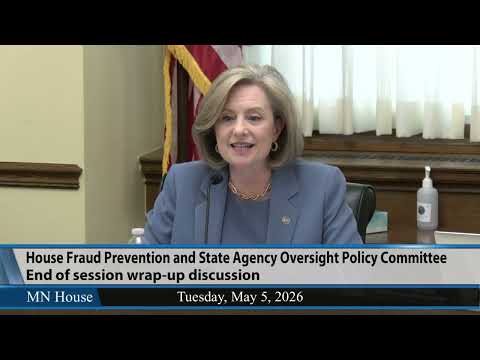
Members expressed frustration that agency leadership declined to appear for the committee's final hearing despite staff being present in the building; Chair Robbins said the committee will continue sending questions and will include findings in a majority report next week. Several members stressed both short-term control fixes — stronger prepayment review, whistleblower protections and an OIG — and longer-term system redesign to change incentives that enable fraud.
What the committee heard: logged tip lines at DHS exist but multiple unlogged mailboxes create gaps; staff sent form letters in some cases rather than formally escalating maltreatment allegations; experienced investigators reported being silenced or sidelined; forensic work and law-enforcement search warrants identified large-dollar fraud in at least one case.
What comes next: committee leaders said staff will continue follow-up with agencies, collect documents and publish majority and minority reports next week that summarize the committee’s findings and recommendations.