Get Full Government Meeting Transcripts, Videos, & Alerts Forever!
Get email alerts on the Public Safety topic
No spam. Unsubscribe anytime.
Residents press Montgomery council for faster speed‑hump installations; staff proposes on‑call asphalt contract
Summary
Residents and council members criticized long waits for neighborhood speed humps and petitions; traffic staff proposed an on‑call asphalt speed‑hump contract to speed installations and explained design, data collection, and public‑safety tradeoffs; police said enforcement relies on constituent calls.
Residents and council members pressed city staff to speed up installations of neighborhood speed humps, saying long waits for traffic studies and petition thresholds have left dangerous locations unaddressed.
Council members described repeated constituent complaints and said some requests have waited months. "We don't need studies to study what we need," one council member said, arguing neighborhoods know where humps should go. Several council members urged the city to find an expedited path.
Wesley, a city traffic staff member, described an on‑call contract for asphalt speed humps as an option the department plans to use alongside existing rubber composite devices. He said asphalt humps could be quicker to install and more durable but require careful site selection and design to avoid creating new problems for public‑safety vehicles and buses. "I've gotta figure out some type of solution to try to physically slow them down," Wesley said, adding that design work and data collection (including radar signs that record speeds) take time.
Wesley said the city has shifted away from an 85% door‑to‑door petition threshold and now prefers support from neighborhood representatives or homeowners associations to speed the process and reduce burdens on residents.
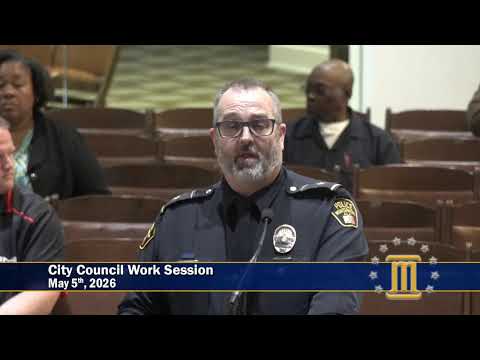
The police chief said enforcement remains essential and depends on constituents calling 311. "If those are not called into us, we do not put a traffic unit or extra details," the chief said, urging residents to report problem locations so targeted enforcement and ticketing can be deployed.
Staff also noted the city has proposed a contract (on the agenda) for asphalt installations (A & C Construction, up to $100,000) that would support such traffic‑calming work; a related procurement for fleet fluids (W H Thomas Oil, $150,000) was also presented. Council members asked staff to provide a schedule and clearer time frames for neighborhood requests.
No formal vote was taken in the work session; staff passed contract documents for council review.