Get Full Government Meeting Transcripts, Videos, & Alerts Forever!
Get email alerts on the Public Safety topic
No spam. Unsubscribe anytime.
Cochise County reviews CCOM budget as $16-per-call fee and reduced state grant create shortfall
Summary
Cochise County officials on May 6 reviewed the communications center budget as leaders shift to a $16-per-call subscriber fee and grapple with a state 9-1-1 grant cut that could force the county to cover roughly $94,000 in reduced reimbursements; staff also flagged staffing, radio upgrades and capital needs.
Kim Jogelpens, identified in the meeting introductions as the CCOM director, told the Cochise County Board of Supervisors on May 6 that the county’s regional communications center has seen rising call volumes and is shifting from a radio-count fee to a $16-per-call subscriber model beginning July 1.
Jogelpens said CCOM tracked 186,015 incoming calls in 2023 and 212,658 in 2025, with year-to-date totals already up by about 3,200 calls. ‘‘We went to a schedule where subscribers...are going to be charged $16 per call instead of a flat fee based on radios,’’ she said, describing a billing method that will subtract the first 100 calls each quarter and bill agencies in arrears.
The change follows concerns that the previous radio-based assessment penalized smaller agencies that have many radios but limited staffing. Jogelpens said a few low-volume volunteer fire districts will face only a minimal annual charge (she cited an example of about $444 a year for very low-call agencies), while others that exceed the 100-call threshold will see larger bills.
The presentation included an overview of projected revenues and a funding gap. Jogelpens cited a CCOM budget figure of $3,000,225.73 and assessed subscriber amounts of $2,399,411, producing a shortfall in the roughly $800,000 range that is split between county and city partners; she said that split is about $412,831. Portions of the transcript listing per-entity dollar amounts were unclear and are not specified here.
A separate but key pressure on the budget is a change to the state 9-1-1 equipment grant. ‘‘The grant awards are going to be reduced to 65% of the total award,’’ Jogelpens said, adding that the statewide program faces an estimated $4 million shortfall. She said that reduction forces CCOM to add about $94,000 back into its FY27 request as a contingency; if the state reverses course the contingency would be removed.
Jogelpens also discussed technology and capital costs that feed the budget: CCOM will split a GIS contractor cost with County IT (her share about $59,000), split Datalarmark software costs with County IT ($12,500 each), add funds for a dedicated HVAC for the network room, and seek to add a radio to an existing console to support an additional monitored radio channel. She flagged an ongoing large recurring expense tied to Motorola equipment (the ‘‘SUA2’’ line cited in the packet) as a number the center watches annually.
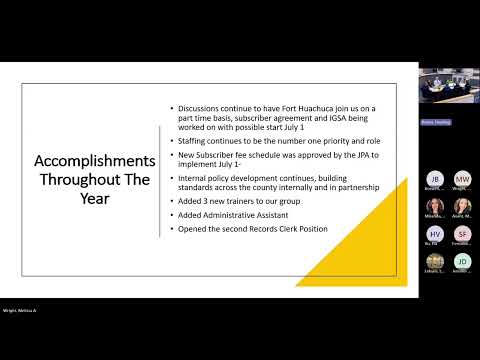
The center is pursuing new subscribers to broaden its revenue base. Jogelpens described ongoing discussions with Fort Huachuca about a part-time subscriber agreement (an anticipated July 1 start was delayed by a ‘‘hiccup’’), and she said Benson and Douglas have been briefed on possible benefits and cost savings if they join. Douglas currently functions as a backup PSAP and could be credited or adjusted on its subscriber fee if it accepts a satellite/backup role, she said. Yuma is CCOM’s secondary backup for overflow routing.
Staffing remains the center’s top priority, Jogelpens told the board. She said CCOM recently increased trainers to seven, has multiple trainees in background checks, and plans to reclassify positions—adding an administrative manager and an in-house system administrator role—to absorb more budget and HR workload internally.
Board members raised equity concerns for rural and volunteer departments and urged outreach so local councils and mayors understand backup arrangements and future fees. On workforce support, Jogelpens said the center budgets $5,000 per year for trauma support in addition to the county Employee Assistance Program.
No formal vote or motion was taken at the work session; the board adjourned and set a 2:00 p.m. budget work session to review the County Attorney’s Office budget later the same day.