Get Full Government Meeting Transcripts, Videos, & Alerts Forever!
Get email alerts on the Telecommunications topic
No spam. Unsubscribe anytime.
Plumas County planners move to curb cell‑tower exemptions in timberland zone after public concern
Summary
At a March 19 workshop, Plumas County planning staff and commissioners agreed to prioritize changes to the telecommunications ordinance to remove or limit the Timberland Production Zone (TPZ) exemption for new towers, consider longer public‑notice distances and expand tribal notification after residents and experts raised legal, health and land‑use concerns.
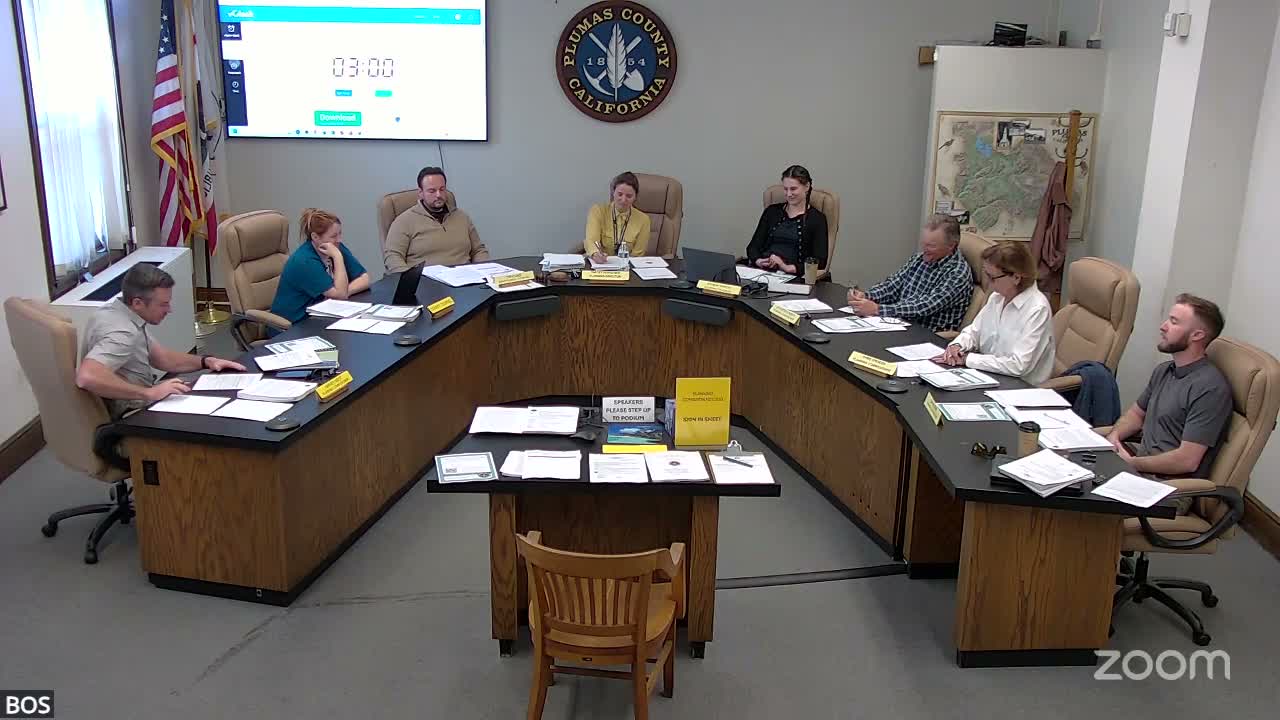
Plumas County planning commissioners said on March 19 they will pursue targeted amendments to Article 41 of the county code to restrict the longstanding TPZ exemption for new telecommunications towers and to expand public and tribal notice for discretionary applications.
The decision followed a staff presentation by Tim Evans, senior planner, and substantial public comment from residents and technical experts who argued the current exemption allowed some towers to be built with minimal public review. Evans summarized recent work and public input, saying the ordinance “gives some background and recap of what happened on, February 5” and that staff had compiled dozens of comments for the commission to consider.
Why it matters: commissioners and members of the public cited a recent tower on Power Line Road and other developments as examples where the exemption limited local review and raised concerns about proximity to homes, cultural sites and viewsheds. Josh Hart, director of Feather River Action and Plumas WIRED, told the commission that the exemption should be removed and urged broader notice: “I would say … remove the TPZ exemption, add a 1,500 foot public notification limit,” he said. Engineer Patrick Prestel, representing Planisierra Telecommunications, submitted technical materials and suggested distinct treatment for fixed wireless vs. cellular facilities to preserve rural broadband options.
Commission debate centered on process and scope. Several commissioners favored a staged approach: phase‑1 would address TPZ when coterminous with residential or dwelling‑unit‑allowing zones and increase noticing distances; phase‑2 would consider broader ordinance reforms such as tribal notification rules, colocation standards and other “loopholes.” Senator Joan Cruz, speaking in the public record, warned that related code changes such as lot‑line adjustment provisions can amount to illegal “piecemealing” and must be considered in context.
Staff and commissioners discussed the practical options on the table: requiring a special use permit (discretionary review) for new towers in TPZ, retaining ministerial zoning clearance for certain co‑location or small fixed‑wireless facilities, and setting tiered notice radii tied to facility height. Evans noted that before the 2019 ordinance there were no design/location standards in the code and that many earlier telecom permits proceeded through building review without planning setbacks.
The commission directed staff to prepare a redlined and a stricken draft of Article 41 that address TPZ exemptions and propose revised noticing distances and tribal notification language. Staff said they will return with those draft amendments at a follow‑up workshop planned for the coming weeks.
What’s next: staff will draft ordinance language that could require special use permits for new towers in TPZ (or narrower triggers tied to adjacency or proximity), propose longer notice distances for discretionary applications, and include options for proactive tribal notification. The commission will review the drafts at Workshop No. 3 and then may forward a recommendation to the Board of Supervisors.