Get Full Government Meeting Transcripts, Videos, & Alerts Forever!
Get email alerts on the Land Use topic
No spam. Unsubscribe anytime.
Council approves Bartholomew Winery expansion with noise limits, event logs
Summary
After hours of testimony from neighbors and supporters, the Elk Grove City Council approved a zoning text amendment and conditional use permit amendment to allow limited outdoor events at Bartholomew Winery with conditions including event caps, amplified-music cutoffs and a 60-day event-log retention requirement.
The Elk Grove City Council on Jan. 28 approved amendments that will allow Bartholomew Winery to host a limited number of larger outdoor events and expand tasting hours, subject to new operational controls and monitoring.
Planning staff told the council the proposal would add an "outdoor event center" use to the agricultural-residential zoning table for parcels of at least 10 gross acres near major arterials and would require a conditional use permit. "The Bartholomew winery amendment project consists of a request for a text amendment to the Elk Grove municipal code, title 23 zoning, to allow outdoor event center use with approval of a conditional use permit," planning staff said in the presentation (Sarah Kirsch Gessner, planning division).
The applicant sought to increase typical winery events to 40 per year and add a separate outdoor event-center category allowing up to 18 events per year (Fridays–Sundays) with up to 125 attendees and amplified music until 10 p.m.; staff and the applicant offered reduced hours and other conditions. Staff noted the current winery CUP allows 24 events per year with a 50-person cap for special events and said the site met the proposed locational parameters.
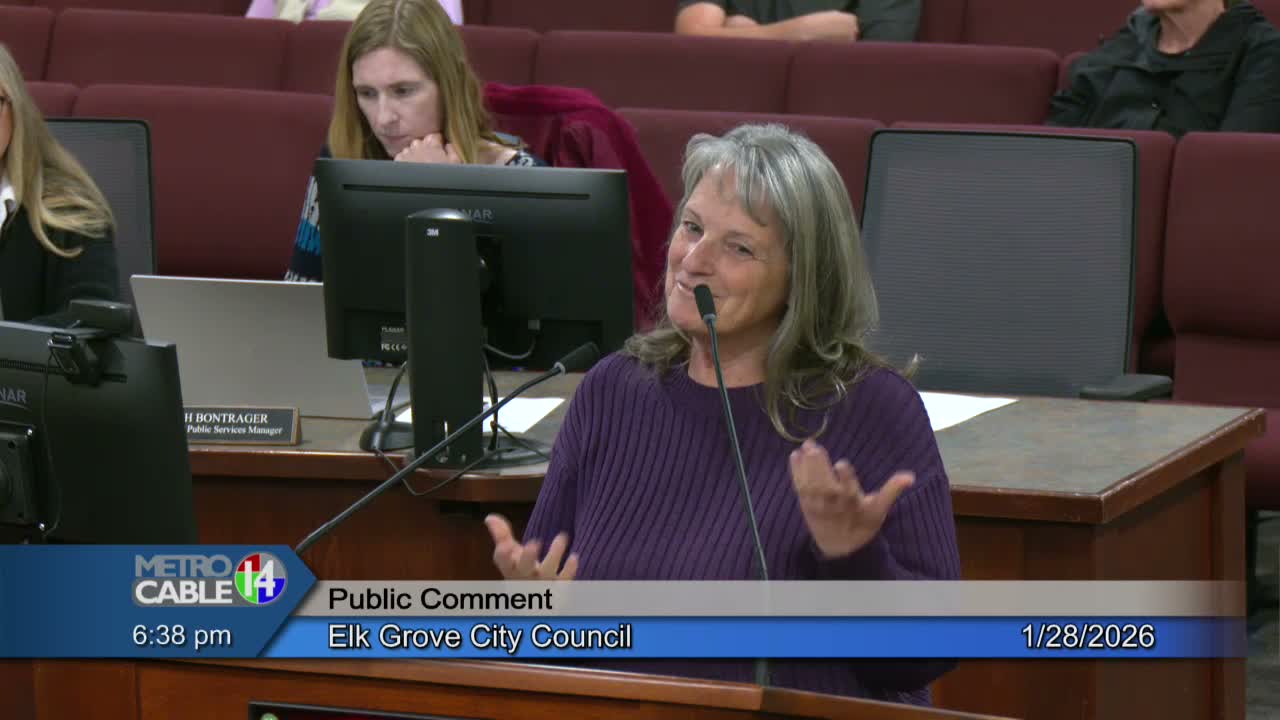
Neighbors voiced concerns about noise, frequency and the study methods. "I've heard it on Friday and Saturday nights in my backyard," said a neighbor who identified herself as a representative of surrounding residents (Catherine MacLean). A father of three asked that larger amplified events be indoors so "it won't carry into our homes and into the night" (Chandler Bender).
Supporters, including other neighbors, cited the winery's community contributions and the sound study findings. "The consultants' sound level study...appears from the sound level consultants that they can meet the noise ordinance requirements within the city and at the property boundaries," said David Benedetti, who urged approval.
Applicant representative Darren Wilson said the winery would not immediately run at the full scale requested and agreed to multiple conditions. "The applicant agrees to all the conditions as published in the staff report," he said, and offered additional restrictions including limiting subwoofers and bass-enhancing equipment and ending amplified music earlier than the hours requested.
Key conditions approved by the council include: a cap of up to 18 outdoor event-center gatherings (Fridays–Sundays) with a 125-person cap; limits on amplified music to 75–85 decibels at specified reference points with earlier cutoff times (typical winery events: music ends at 8 p.m.; outdoor event-center music ends at 9 p.m.); and requirements for the applicant to log event audio measurements and publish contact information for complaints. Council members also amended two log-related conditions to require a 60-day retention period for logs (conditions 23 and 25 as amended) so staff can review recent events without indefinite archival obligations.
Planning staff advised no further environmental review was required for the code text amendment and CUP amendment, citing the environmental document consistency analysis in the staff report. The council discussed enforcement and auditability of audio logs, staffed sound measurements, and the potential for revocation or modification of the CUP if conditions are not met.
The council voted to approve the ordinance amending Title 23 and to adopt the conditional use permit amendment with the staff-recommended and council-amended conditions. The approval included the additional 60-day log retention amendment proposed by council.
The permit includes monitoring and complaint-response procedures; if neighbors report out-of-compliance events, city code enforcement or police may respond and the council retains authority to review or revoke the permit for cause. The council noted the approval is structured as a trial with enforceable conditions and opportunities for future review.
The council's action ends the public hearing phase; staff and the applicant will coordinate implementation of the permit conditions and public-notice requirements.