Get Full Government Meeting Transcripts, Videos, & Alerts Forever!
Get email alerts on the Inclusive Park topic
No spam. Unsubscribe anytime.
Visalia OKs site for $7.8 million inclusive park after neighbors press for safety details
Summary
The City Council approved a recommended site for an inclusive park funded by a $7.8 million State Parks grant after extensive public comment about parking, fencing and neighborhood impacts. Council and staff said design details and a traffic study will return to the council for review; the motion passed 5-0.
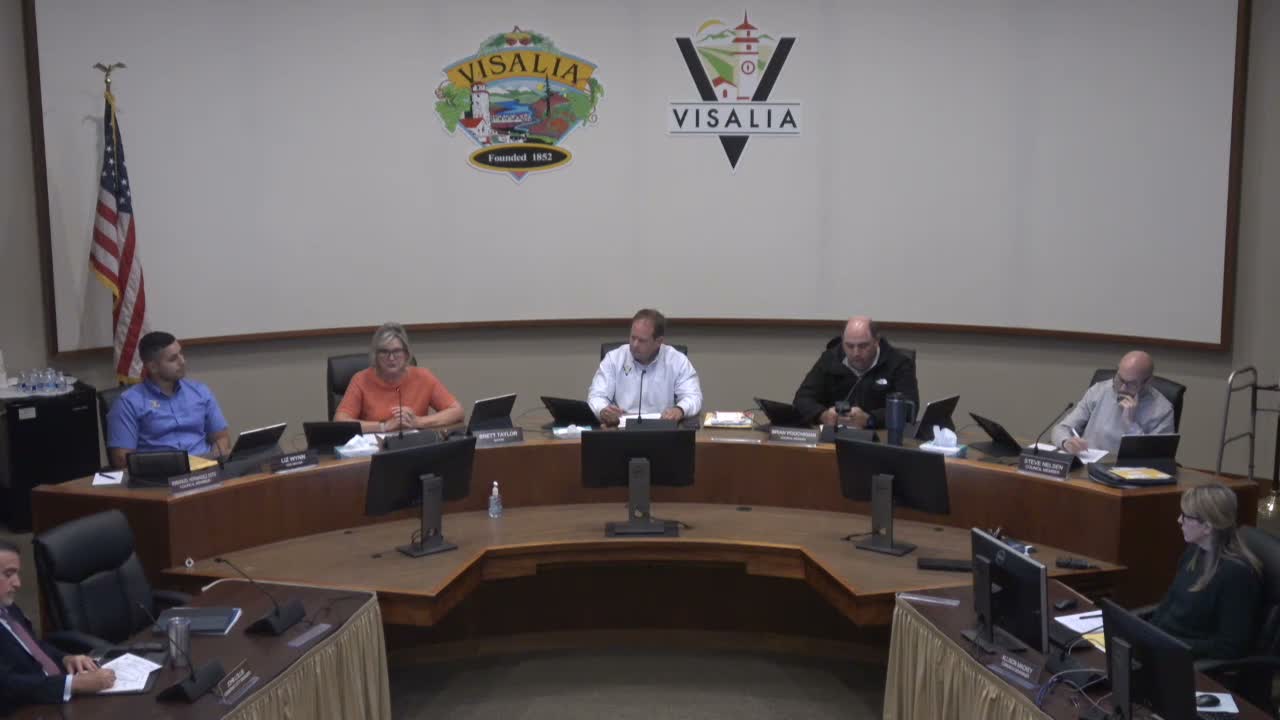
Councilmember Nelson moved and Mayor seconded a measure to approve a recommended site and associated professional services for a planned inclusive park on an undeveloped parcel at McAuliffe Street and Mill Creek Parkway; the council approved the motion unanimously (5-0).
The project, described by Jason Huckleberry, Director of Engineering, carries $7,800,000 in grant funding from the California State Parks Department. Cody, the city code engineer leading design work, said the site would be a roughly 4.5-acre, Sequoia-themed inclusive play area that aims to serve users of “all varying physical, mental, social and learning abilities.” Staff showed concept renderings and said many final amenities remain to be selected during design.
Neighbors pressed councilmembers and staff for details at several points. Theresa Glessner, three doors from the proposed site, told the council she feared traffic and insufficient buffering from nearby homes and asked the city to consider a taller fence ("7 feet, I think, would be optimal") and natural screening. John Peterson, who lives directly across Manzanita, said he had not seen a site plan and worried about loitering, overnight parking, litter including needles and the location of noisy amenities relative to homes.
Councilmember Nelson, who has advocated for an inclusive park since the project's inception, acknowledged the long timeline and said the council was approving the parcel and funding path, not a final design. Nelson told neighbors that the park would be designed with community input and that staff would return with a detailed layout and traffic analysis.
Staff described operational and security approaches. Cody said the park would be enclosed by a six'foot fence, open during specified daylight hours, and opened and closed by city staff; staff also said they would explore heavy'duty restroom fixtures to reduce vandalism. The parks department indicated that neighborhood parks are not continuously staffed and that park rangers would perform scheduled visits; the parks director said the city does not plan to place a full-time staff person at the site.
Councilmembers debated security tradeoffs: some favored fences to protect children and users with disabilities from nearby traffic; others preferred hiring more park rangers or installing less aggressive, visually pleasing fences. Councilmember Roseto said he would rather hire another park ranger and reserve fencing for restrooms or high'vandalism areas.
Next steps: staff said that if the council approved the site, they would prepare utility research, a concept layout and a bid package for construction that they hoped to release by the end of the year, with construction expected to begin in late spring and a targeted eight to ten months for build time. The council approved the site and associated professional services to update the design scope and directed staff to return with the design and further community outreach.