Get Full Government Meeting Transcripts, Videos, & Alerts Forever!
Get email alerts on the Transit Blue Line topic
No spam. Unsubscribe anytime.
Elk Grove council accepts Blue Line implementation plan, keeps light‑rail as preferred long‑term option
Summary
After a lengthy public hearing and divided public comment, the Elk Grove City Council accepted a staff Blue Line transit implementation plan that retains light rail as the preferred long‑term alternative while directing staff to further study regional connectivity, express service options and evolving technologies before committing to construction.
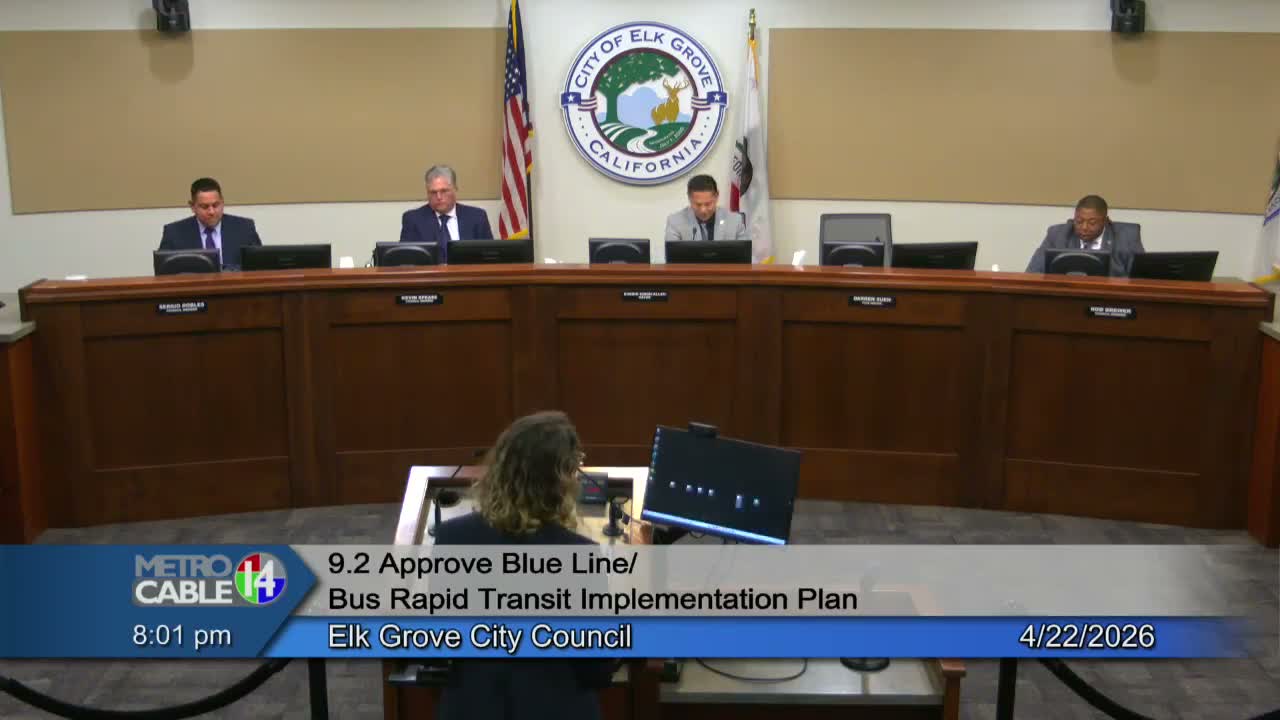
Elk Grove — The City Council accepted an implementation plan on April 22 that advances a long‑range vision for high‑capacity transit through Elk Grove and keeps light rail as the preferred build option, while asking staff to study regional connections and emerging technologies before the city moves toward funding or construction.
The plan, presented by Kaylee Lyons, the city's transportation planning manager, evaluated five alternatives — including full light rail, full bus rapid transit (BRT), and several mixed scenarios — along an alignment from Cosumnes River College south through Bruceville and Bighorn to District 56. Lyons told the council that full light rail produced the highest ridership forecasts (about a 20% increase in Blue Line ridership versus the no‑build baseline) but also carried the highest capital and operating costs.
"Light rail for the full corridor has the greatest benefit to transit travel time," Lyons said during the presentation, noting the tradeoffs between travel time, ridership, and cost. A consultant from Kimley‑Horn summarized the modeling and traffic analysis, which showed modest vehicle delays at some intersections under build scenarios.
The council heard more than a dozen public commenters. Students and environmental advocates said frequent, reliable rail service would reduce vehicle miles traveled, improve accessibility for riders without cars and support Elk Grove's climate goals. A Cosumnes River College student said, "I don't have a car — affordable transit is important for my education and commute." Others, including several long‑time residents near District 56, urged caution, citing tree removal, neighborhood impacts, and a projected multi‑hundred‑million‑dollar price tag and ongoing operating costs.
Council discussion focused on two themes: the need to build an initial segment that will attract riders, and the desire not to preclude other technologies or service patterns. Vice Mayor Sewan emphasized the importance of an initial segment that will be "very efficient and such that it'll encourage more ridership," saying the first phase must work operationally and for commuters. Council Member Spies raised emerging mobility technologies and asked that staff continue to consider alternatives beyond a binary rail vs. BRT choice.
Councilmembers amended staff language and, by voice vote, accepted the plan as a feasibility/implementation strategy rather than as an authorization to build. The motion preserved the study's proposed alignment and phasing but directed staff to:
- use the acceptance to continue federally‑oriented early engagement while clarifying that acceptance does not commit the city to construction; - analyze express or skip‑stop service patterns that could speed commutes to downtown Sacramento and evaluate dual‑track/operational configurations for reliability; - broaden future work to examine regional connectivity, potential land‑use strategies that increase station‑area ridership, and emerging transportation technologies before finalizing any proposed project for environmental review and funding applications.
City staff and legal counsel told the council that accepting the implementation plan is a necessary step to complete grant reporting and early corridor planning; it does not, by itself, approve design, environmental clearance, or construction. "Approving the report tonight will not commit the city to build anything," staff said, noting CEQA review and funding steps would come later.
Next steps outlined by staff include continued coordination with Sacramento Regional Transit (SacRT), early engagement with the Federal Transit Administration to explore grant competitiveness, technical work on potential express service patterns, land‑use strategies to support ridership, and future environmental review phases if a proposed project moves forward.
Council action: The council accepted the Blue Line Implementation Plan (resolution amended on the dais to change the word 'adopt' to 'accept' and to include direction for additional regional connectivity and technology analysis). The acceptance passed by voice vote.