Get Full Government Meeting Transcripts, Videos, & Alerts Forever!
Get email alerts on the Public Health Kratom topic
No spam. Unsubscribe anytime.
Riverside council hears hours of divided public testimony on proposed kratom ordinance
Summary
The City Council heard extensive public comment for and against a proposed kratom ordinance April 21; speakers split between calls to ban all kratom after deaths and appeals to regulate natural leaf kratom while targeting synthetic concentrates. The council took no final vote during the hearing.
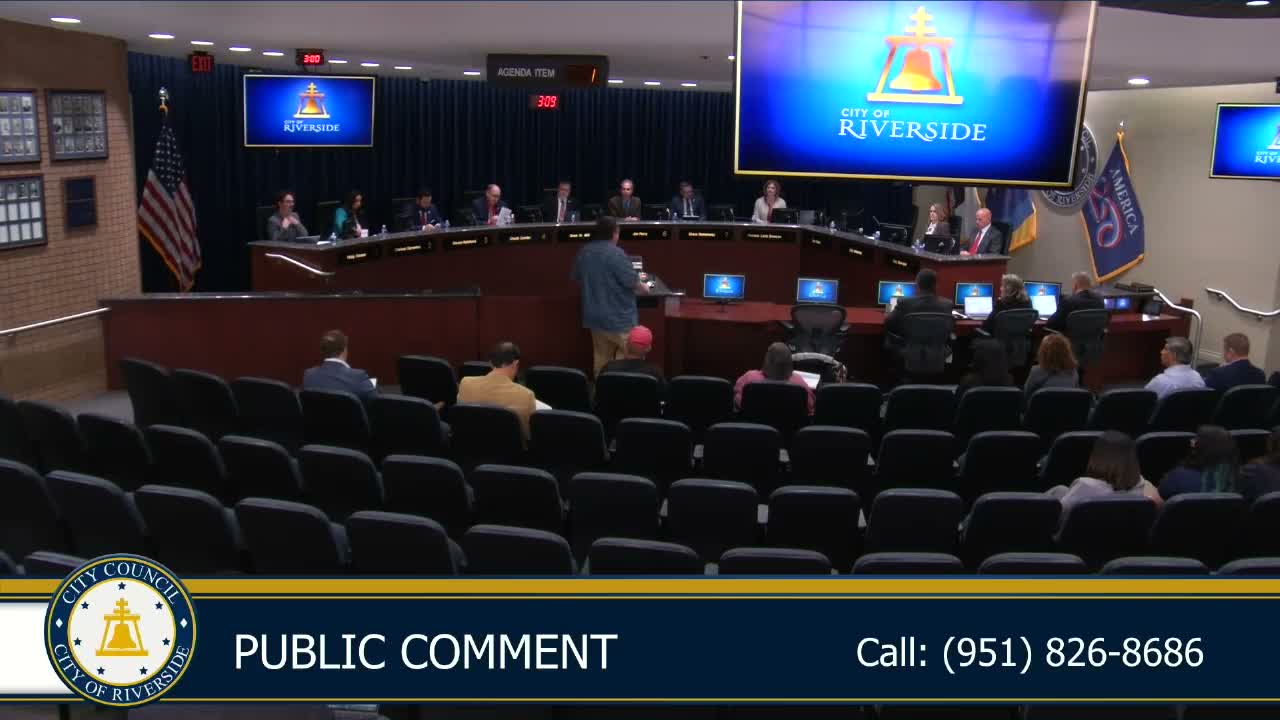
Hundreds of minutes of public comment at the Riverside City Council meeting on April 21 centered on a proposed ordinance to address kratom products, with callers sharply divided between those asking for a blanket ban and those urging regulation that preserves access to natural leaf kratom.
Supporters of regulation—including several long‑time consumers and representatives of the Global Kratom Coalition—argued that concentrated synthetic products such as laboratory‑enhanced 7‑hydroxymitragynine (7‑OH) pose the primary risk while unadulterated leaf products provide pain relief and harm‑reduction benefits. Walker Gollman, legislative director of the Global Kratom Coalition, urged the council to “preserve access to natural leaf kratom and regulate concentrated synthetic 7‑OH products,” pointing to state and federal guidance and citing AB 1088 as a parallel policy effort.
Several callers framed enforcement options around third‑party certificates of analysis (COAs) and age restrictions so that retailers, not law enforcement, would carry the burden of demonstrating compliance. Heidi Sikora, volunteer chief scientific officer for the International Plant and Herbal Alliance, told the council a COA requirement would allow police to verify product testing without laboratory visits: “The retailer must be able to produce on demand a COA from an independent accredited laboratory,” she said.
Other speakers—many of them parents who lost children—urged an outright ban on kratom in all forms. In a caller statement, Susan Eppard said her son died in 2021 and that toxicology linked the death to metragynine from kratom leaf powder; she asked the council to ban the product to prevent future fatalities. Dan Gibbs, another caller, said his son’s death was ruled mitragynine toxicity and argued that kratom alkaloids act on opioid receptors and therefore present the same pharmacological risk.
The hearing included both in‑person speakers and callers, and testimony repeatedly returned to the same two themes: whether natural leaf kratom can be reliably distinguished from dangerous, concentrated synthetics, and whether local regulation or a ban is the better public‑health response. Several witnesses urged the council to follow federal agency guidance that targets concentrated synthetics rather than banning traditional leaf products.
Councilmembers did not take a final ordinance vote during the extensive public comment period recorded in this session. The council closed public comment and moved on with the agenda; further council action on the ordinance may appear on a future agenda. The hearing record includes references to federal guidance and to pending state legislation (AB 1088) and to county and neighboring city ordinances that have taken varied approaches.