Get Full Government Meeting Transcripts, Videos, & Alerts Forever!
Get email alerts on the Resident Golf Benefit topic
No spam. Unsubscribe anytime.
Indian Wells council orders more study of resident golf access after hours of public comment
Summary
After hours of public comment and council debate, the Indian Wells City Council voted to request additional staff analysis and to consult with golf operator Troon on whether the resident tee-time system can be made more equitable; council members agreed not to change rates immediately.
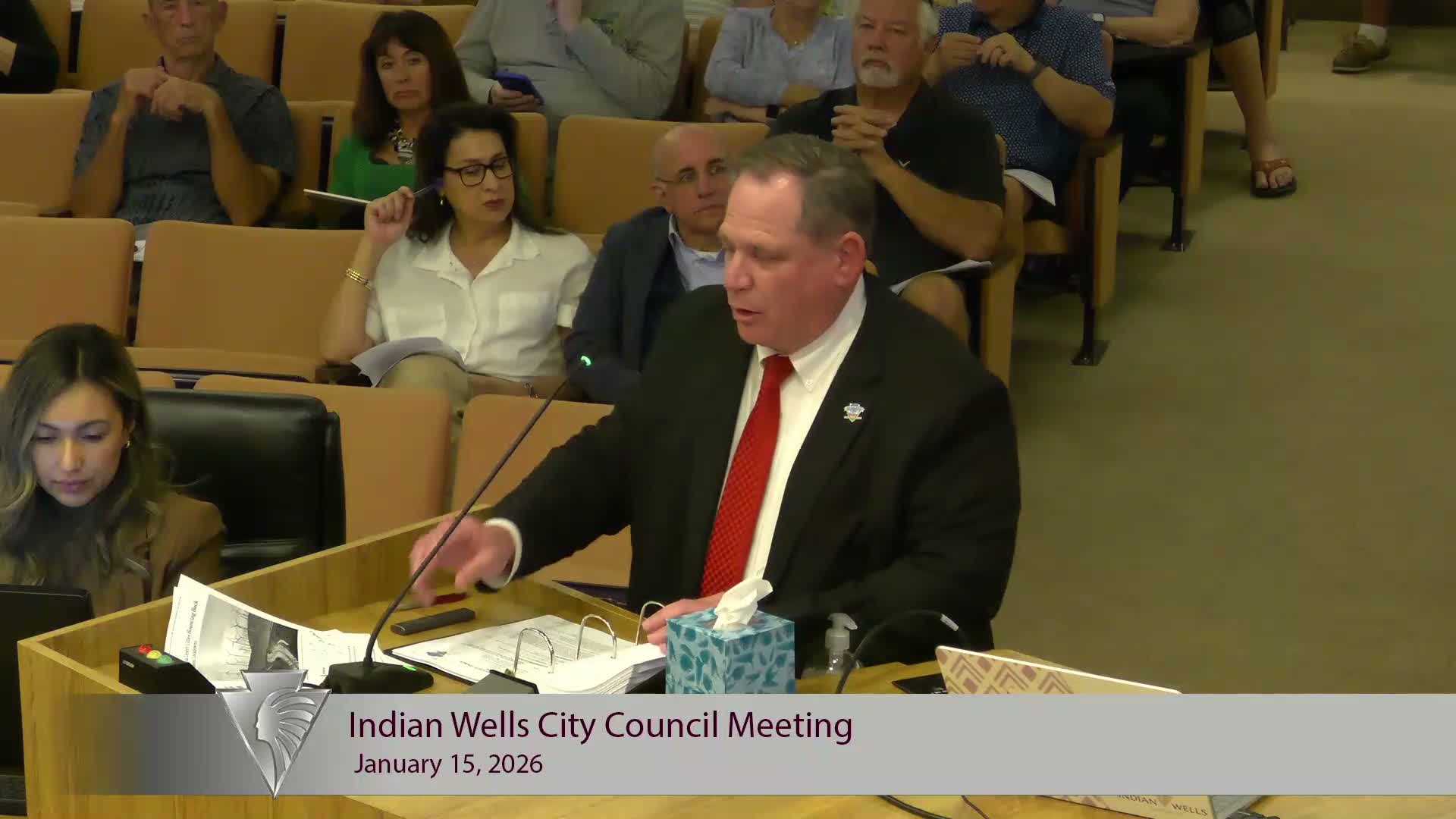
The Indian Wells City Council on Jan. 15 directed staff to conduct additional analysis of the city’s resident golf benefit and reservation system after an extended public-comment period and council discussion.
Mayor Brian Taylor opened the meeting by stressing that "the resident golf benefit that Indian Wells residents enjoy is not being eliminated," and said the council had asked staff for a comprehensive review of the resident card and related vendor contracts. Finance Director Kevin McCarthy then reviewed the benefit’s history, explaining that the resident discount dates to a 1993 agreement and that a 2023 contract change shifted operational subsidy responsibility to the club operator, Troon.
The council heard from nine public speakers and more than 30 written commenters during the allotted public-comment period. Views diverged: some residents urged the council to leave the resident benefits intact as a signature city amenity, while others, including council members, argued the current reservation mechanics produce an unfair concentration of prime tee times among a small number of frequent players.
"We have 96 prime starts per day and 2,642 resident-card holders," Council Member Dana Reid said during debate, arguing the system "is totally unfair" when a small group monopolizes frequent prime rounds. Several residents echoed concerns about the booking window and asked the city to explore alternatives such as changes to advance-booking rules, a lottery or other distribution mechanisms.
Opponents of change stressed the value residents place on the benefit. "This amenity should not be the last thing that your team ... is looking on how to rationalize," Douglas Hansen, a long-time resident and former mayor, told the council, urging that benefits be preserved.
Faced with the competing views, Council Member Reid moved a substitute motion to request additional analysis (council option No. 2 in the staff report): staff should evaluate the fairness and accessibility of the reservation system, confer with Troon to identify feasible operational changes, and return with recommendations. Reid and others agreed the motion should include a condition not to alter resident fees while the analysis proceeds.
On roll call the substitute motion passed 3–2 (Reid: yes; Sanders: yes; Taylor: yes; Whitman: no; Mayor Pro Tem Bridal Pena: no). The council’s direction requests technical follow-up from staff and Troon and does not change the current resident or resident-guest rates.
What happens next: City staff will work with Troon to evaluate allocation and booking mechanics, return with proposed options and data on potential revenue/usage impacts, and include public outreach as part of the analysis. The council’s vote preserves the status quo while seeking data and possible operational fixes.
Why it matters: The resident golf benefit is a long-standing, visible municipal amenity tied to property values and community identity. The council’s decision to study fairness reflects competing priorities—protecting a resident perk while addressing access inequities raised by some residents.
The council took no immediate rate or policy changes at the meeting; it expects staff to report back with a detailed analysis and feasible options.